

Blended family counseling is therapy designed for stepfamilies: couples and children who have come together after divorce, death or separation. It can help you work through loyalty conflicts, discipline disagreements, co-parenting friction and the slow work of building a shared family identity. At The Bridge Therapeutic Services in Tyler, Texas, we offer this support in person and through telehealth across Texas, with a faith-informed approach for families who want it.
If your home feels harder than you expected it to, that is common. Stepfamilies are built differently from first families, and the tools that work in a first family often do not fit. This guide explains why, what happens in sessions, who attends, how to prepare and how to choose a therapist.
Blended family counseling at a glance
Blended family counseling treats the stepfamily as its own kind of family, with its own predictable pressure points: insider and outsider roles, loyalty binds, discipline and ex-spouses.
Research on stepfamilies suggests the couple relationship, the parent-child bonds and the new step-relationships all need attention, usually in a planned order.
Consider seeking help before conflicts become entrenched. Seeking it is a sign of strength, not failure.
Children and teens need room to share negative feelings without judgment or shame.
The Bridge Therapeutic Services offers in-person counseling in Tyler, TX and telehealth statewide for couples, parents, kids and whole families.
Table of Contents
Why stepfamilies need their own kind of counseling
A stepfamily does not begin the way a first family does. The adults have a history with other people, the children have lived through loss, and everyone arrives with habits from a different household. Authors of the American Psychological Association’s book Stepfamily Therapy note that stepfamilies are vulnerable in a way that is distinct from typical first families, and that they often resist traditional family therapy techniques.
That last point matters when you look for help. Researcher Patricia Papernow, writing in the journal Family Process, points out that few clinicians receive adequate training in stepfamily dynamics. She warns that leaning on first-family models can be unhelpful and sometimes harmful. A good blended family therapist adjusts the approach to the structure of your family rather than asking you to act like a family that formed all at once.
The five pressures most stepfamilies face
Papernow’s review identifies five challenges that stepfamily structure creates. They give you a useful checklist for what to bring to counseling:
Insider and outsider positions. The biological parent and child are the insiders. The stepparent is often the outsider, and those positions can feel intense and fixed.
Children’s losses and loyalty binds. Kids are asked to adapt to change they did not choose, and many feel that liking a stepparent betrays their other parent.
Parenting and discipline. Differences about rules often divide the couple.
Clashing family cultures. The couple has to build a new family culture while two older ones still operate.
Ex-spouses. The other household remains part of the family system, whether anyone likes it or not.
Naming these does a lot of good on its own. Many parents come in believing they are failing, when they are actually running into the standard terrain of stepfamily life.
What blended family counseling actually helps with
Most families come in with a specific complaint: a child who refuses to listen to a stepparent, fights about bedtime or screens, a teen who has withdrawn, or a couple who argue about the kids more than anything else. Underneath, counseling usually works on a few connected goals.
Building trust and communication
One approach, emotionally focused family therapy, looks at stepfamily conflict through an attachment lens. Furrow and Palmer describe how divorce and remarriage can make family members more sensitive to whether the people closest to them are emotionally available and responsive. When that goes unmet, negative patterns can take over and bids for connection get blocked. In this approach, the therapist helps the family see those stuck patterns and work toward more secure bonds. Their paper presents a clinical framework and case example, not a guarantee that one approach will work for every family.
In plain terms: an argument over dishes may also be about wanting to matter and not knowing how to say so. Counseling can give each person a safer way to say it.
Working through loyalty conflicts
Children often feel caught between households. Writing for the American Bar Association, Dr. Lyn Greenberg describes kids who feel angry about the disruption of the original family, guilty about enjoying the new stepparent, or caught in the middle of a conflict between their parents.
A therapist can help parents respond well. The National Board for Certified Counselors quotes counselor Petruk as saying it is extremely important for parents to give children permission to care about a stepparent. Parents can acknowledge the loyalty bind and explain that the stepparent is an additional person who cares for the child, not a replacement for the other parent.
Sorting out discipline and parenting roles
The same NBCC piece notes that parenting styles can clash and need to be worked through, and that stepparents who discipline stepchildren can create resentment. Greenberg adds that new stepparents may need guidance about how quickly to take on a role in a child’s life. A common starting point is that the biological parent leads on discipline while the stepparent builds a relationship first. A counselor helps the couple agree on this together instead of improvising in the middle of a conflict.
If parenting is the main stress, our parenting support sessions focus on exactly these questions: consistent expectations, shared rules and how to back each other up.
Handling the other household
Ron Deal, a well-known stepfamily educator, writes that divorce reorganizes family life rather than ending it. Many divorced adults have not yet moved from being partners to being co-parents, and he notes that unrecognized, unexpressed loss can undermine stepfamily integration. Greenberg also observes that conflicted adults may sabotage limits set in the other household. Counseling gives you a place to sort out what you can control (your own home, your tone, your consistency) and let go of what you cannot.
What happens in sessions
No two stepfamilies are alike, so no two courses of counseling look the same. Still, the process tends to follow a shape. Your therapist will tailor who attends and when to your family’s needs, safety and goals.
The first sessions: assessment
Deal’s clinical guidance recommends that the first session be with a primary subsystem, preferably the couple. This is one clinical recommendation rather than a requirement for every family. Your therapist will ask about family history, the timeline of the new household, each child’s age and situation, and what a good outcome looks like for you.
The middle: de-escalating and working through
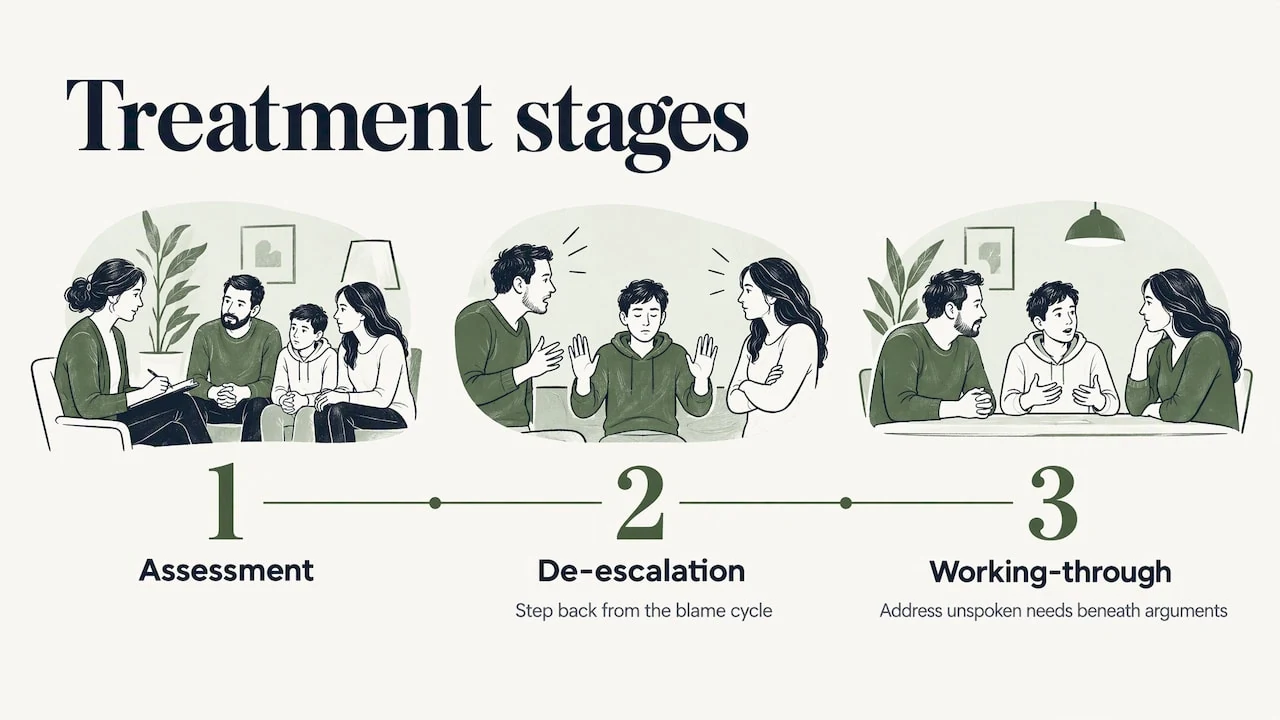
In the attachment-based model described by Furrow and Palmer, treatment moves through three stages: assessment, de-escalation and working-through. First the therapist helps the family step back from the cycle of blame. Then everyone works on the unspoken needs under the arguments.
Other approaches exist. The American Counseling Association’s book Intervening for Stepfamily Success looks at a single stepfamily through Adlerian, structural, cognitive behavioral, solution-focused, narrative and other lenses. The lesson for families is that therapists choose among methods to fit your presenting issues, rather than running one script for everyone.
The goals sessions work toward
Deal describes three goals for stepfamily therapy:
Resolve the problems that brought the family in.
Develop an integration plan that builds family identity and step-relationships.
Strengthen the marital bond.
Papernow’s model adds a useful frame for how this happens: psychoeducation (learning what is normal for stepfamilies), interpersonal work (changing how people relate) and, when needed, deeper work on each adult’s own family-of-origin history.
Who comes to counseling, and what each person’s role is
You do not need every family member in the room every week. A plan often mixes formats.
| Format | Who attends | Typical focus |
|---|---|---|
| Couple sessions | The two adults | Shared parenting approach, communication, protecting the marriage |
| Parent sessions | One or both parents | Discipline, co-parenting, helping children with loyalty binds |
| Whole-family sessions | Parents, stepparent and children | Family rules, rituals, new family culture |
| Child or teen sessions | One child | Processing loss, change and big feelings in an age-appropriate setting |
| Individual adult sessions | One adult | Personal history, grief, stress, stepparent role |
Biological parents often carry the most weight. They are the bridge between the child and the stepparent, and they set the tone for how welcome the new adult feels.
Stepparents usually need space to be heard too. Being the outsider is lonely, and it helps to have someone who treats that as a normal part of the process instead of a flaw.
Children and teens need a say. Counselor Petruk, in the NBCC newsletter, describes this as a huge transition requiring intentional conversations and room to express even negative feelings without judgment or shame. Petruk adds that parents often minimize the impact because they badly want the family to blend smoothly, and that doing so typically leads to more conflict. Our child and teen counseling gives younger family members a place to talk that is separate from the adults’ conversations.
Perspective: how we approach blended families
At The Bridge Therapeutic Services, we meet many families who think they should be further along than they are. A new marriage, new siblings and a new house can look like a fresh start on paper. For the people living it, it is also a collection of losses and adjustments. We start by treating those feelings as normal.
We see the work in three parts. First, support the couple, because the adults set the climate for everyone else. Second, help each parent and child feel secure and heard, which means making room for grief and loyalty struggles without rushing anyone past them. Third, build the family’s own rhythms, rules and traditions so the household has an identity that belongs to all of you.
Our approach combines evidence-based psychological care with a Christian perspective for families who want faith included. For some, that means prayer or scripture in session. For others, it simply means a counselor who respects what they believe about marriage, forgiveness and family. We tailor the work to each family, and we are glad to meet you where you are.
Jennifer Wood, LPC-S
How to prepare for your first session
You do not need a polished story. A little thought beforehand does help.
Decide who comes first. If you are unsure, ask your therapist. Starting with the couple is one option described in Deal’s guidance; other formats may fit your family better.
Write down three recurring conflicts. Specific scenes (Sunday night handoffs, who enforces homework rules) are more useful than general statements like “we fight a lot.”
Note what is working. Strengths give your therapist something to build on.
Talk to your kids in simple terms. Tell them you are going to meet someone who helps families get along better, that they are not in trouble and that their feelings matter.
Check logistics. We offer in-person counseling in Tyler and online therapy across Texas, which helps when schedules, two households or distance make weekly visits hard. Payment is by private pay or health insurance, so confirm your coverage details with your insurer and ask us any billing questions when you reach out.
When to seek help
There is no need to wait for a crisis. Greenberg writes that most problems in separated and recombined families are best and most quickly resolved when addressed promptly, and that seeking help often demonstrates strength rather than weakness.
Signs that counseling could help:
Arguments about the kids dominate your marriage.
A child is withdrawing, acting out or refusing to engage with the stepparent.
You or your spouse feel like an outsider in your own home.
Conflicts with an ex keep spilling into daily life.
Holidays and transitions between households bring dread.
You are planning to marry and want to prepare for a blended household.
If you are engaged, premarital and marital enrichment counseling can address stepfamily expectations before the wedding. If your marriage is under strain now, marriage and couples counseling gives the two of you dedicated time to rebuild your footing as partners.
If someone is in immediate danger, call 911. For emotional distress or thoughts of suicide, call or text 988, the Suicide & Crisis Lifeline.
How to choose a blended family therapist
Because stepfamily structure is different, the therapist’s fit matters. Papernow’s warning about first-family models is a good reason to ask a few questions up front:
How do you work with stepfamilies and stepparent-child relationships?
Will you see the couple, the children or the whole family, and in what order?
How do you involve a child who does not want to be there?
How do you handle a co-parent who is not attending?
Does your approach make room for our faith, if that matters to us?
The right answers sound collaborative and practical. You should come away understanding the plan, who will be involved and what you will be working on.
Our blended family counseling in Tyler, TX
The Bridge Therapeutic Services provides compassionate, faith-informed counseling for individuals, couples, families and children. Our divorce and blended family counseling supports families in this transition, and our family counseling brings parents, stepparents and children into the same room to build communication and unity. Our therapists use evidence-based methods tailored to each client and weave in Christian values when families want that.

Whether you live in Tyler or elsewhere in Texas, you can start with an in-person or telehealth visit. Reach out through our contact page to ask questions and get started. If you want to begin with your own questions and stress, individual counseling is also a good first step.
FAQ
Does the whole family have to attend blended family counseling?
No. Many plans start with the couple, and Deal recommends beginning with a primary subsystem, preferably the marital one. Children, stepparents and whole-family sessions can be added as the plan develops. Some children do best with their own time first.
How is blended family therapy different from regular family therapy?
Stepfamilies have different structures, with insiders and outsiders, loyalty binds, two households and no shared history. Papernow notes that first-family models can be unhelpful when applied to stepfamilies. Blended family therapy builds around those realities and focuses on step-relationships and integration.
When should we start counseling?
You do not need to wait for a breaking point. Greenberg recommends addressing problems promptly, and some couples seek counseling before marriage or during the first year of living together. Timing and progress vary with each family’s circumstances.
Can counseling help if my stepchild refuses to accept me?
A counselor can help the biological parent give the child permission to care about you and acknowledge the loyalty bind. Counselors also help stepparents pace their role and build the relationship gradually before taking on discipline. Acceptance cannot be forced or guaranteed.
Do you offer blended family counseling online?
Yes. The Bridge Therapeutic Services offers telehealth counseling across Texas as well as in-person sessions in Tyler. Online visits can be useful when family members live in different homes or have busy schedules.
Sources
Clinical Guidelines for Working With Stepfamilies, Family Process
EFFT and Blended Families: Building Bonds From the Inside Out
Family Therapy with Separated and Recombined Families, American Bar Association
Family Therapy with Stepfamilies: Assessment and Treatment, Ron L. Deal
Intervening for Stepfamily Success, American Counseling Association