

Online couples counseling is a series of live video sessions with a licensed therapist, held while you and your partner sit together at home or join from separate places. Research on videoconference couples therapy is encouraging: in a 2024 study of married clients, teletherapy was overall as effective as in-person couple therapy for couple satisfaction and sexual satisfaction. Below you will find how sessions run, what the evidence does and does not show, what it costs, how to set up a private space, and how to pick a therapist who fits the two of you.
TL;DR
- Online couples counseling uses secure video to deliver the same kind of guided work you would do in an office: communication, conflict, trust, intimacy and goals.
- Studies of videoconference couples therapy show improvements in relationship satisfaction comparable to face-to-face delivery, though the bond with the therapist may build a little more slowly.
- Expect an intake, a brief private conversation with each partner, then structured sessions with exercises between meetings.
- Couples therapy often costs somewhere between $100 and $250 per session, and insurance coverage depends on your plan and diagnosis.
- In Texas, choose a therapist licensed in the state. We offer telehealth counseling across Texas and in-person sessions in Tyler.
Table of Contents
- What online couples counseling is
- Does online couples therapy work?
- Who online couples counseling suits well
- What to expect in your first sessions
- Setting up for a good session
- Privacy and safety: what to know first
- What online couples counseling costs, and whether insurance helps
- How to choose an online couples therapist
- Our perspective
- Start couples counseling with The Bridge
- FAQ
- Sources
What online couples counseling is
The American Psychological Association describes telepsychology as psychological services delivered through technology, including telephone, videoconferencing, email, chat and text. For couples, the working format is almost always video. You and your partner log in to a secure platform, and the therapist guides the conversation just as they would in the room.
You can use the same screen together on the living room couch, or each join from a different location if one of you travels or is deployed. Most couples choose the first option, because sitting side by side makes it easier to practice the exercises the therapist assigns.
The topics are the same ones couples bring to an office. Clinical guidance on telehealth couple therapy lists communication and emotional-intimacy difficulties, trust problems, addictive behaviors and frequent arguments among the common reasons couples seek help. Others come for a major transition, such as a new baby, a move, a blended family or the stress of caring for aging parents.
Does online couples therapy work?
For most couples who are safe to do it online, the answer from the research is yes, with some nuance worth knowing.
Video sessions compare well with in-person care
In a randomized study of 30 couples in the six-session Couple CARE program, videoconferencing and face-to-face delivery both improved relationship satisfaction and mental health, with no significant difference between the two. Anxiety and stress reductions held at the three-month follow-up.
The 2024 study of 1,157 married clients mentioned above found one difference: the therapeutic alliance, meaning the sense of trust and teamwork with the therapist, improved twice as quickly in face-to-face treatment. In practice, that means it helps to be intentional early on. Say what you want from the work, speak up when something feels off, and give the relationship with your therapist a few sessions to settle.
Structured programs show measurable gains
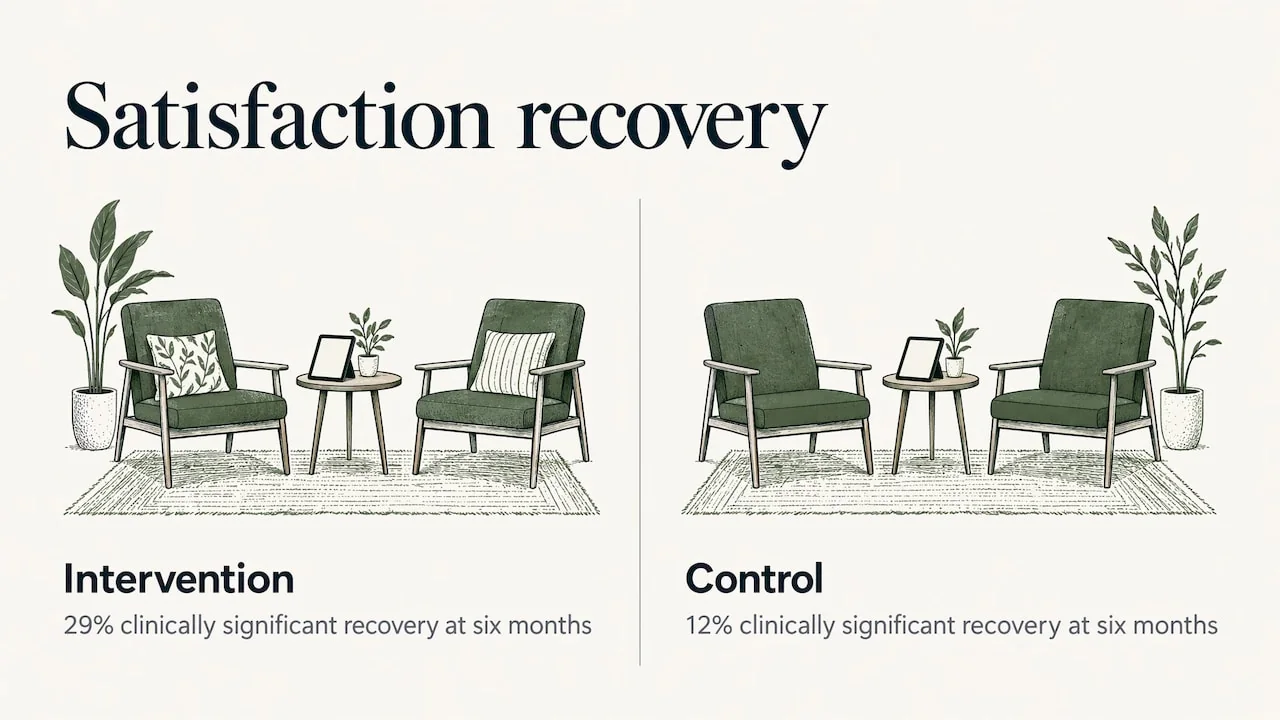
A nationwide randomized trial of 742 low-income couples tested two online programs. Both produced greater improvements than a wait-list control in relationship satisfaction, communication conflict, emotional support and breakup potential, and the gains lasted through four months after treatment. A 2021 review of that trial reported that clinically significant satisfaction recovery at six months was 29% for intervention couples versus 12% for controls.
A broader 2025 review of digital relationship interventions found 15 eligible studies. Most reported significant improvement, and a meta-analysis of six studies found a significant moderate effect. The same review notes that results vary across designs and are strongest for structured, skills-based or coach-supported formats and videoconference interventions.
What the numbers do not promise
The nationwide trial also found that neither program significantly reduced actual breakups by six-month follow-up. Better communication and satisfaction are real, measured outcomes. Counseling gives you tools and a guided space, and what you do with them is up to the two of you. A good therapist will help you define success in your own terms, whether that is fewer fights, more closeness, a clearer decision, or a stronger foundation before a big step.
Who online couples counseling suits well
Virtual sessions work especially well when logistics have been the obstacle. Clinical guidance notes that online help may suit couples facing scheduling difficulties or childcare needs, and a review of online relationship education adds that it can reduce cost, transportation, scheduling and childcare barriers because you take part from home.
That describes many of the people we hear from:
- Parents who cannot easily find a sitter for a weekday-evening appointment
- Couples with demanding or shifting work schedules
- Partners who live in rural parts of East Texas and would otherwise drive a long way
- Couples who travel, relocate or live apart for a season
- Couples who simply feel more at ease starting in their own home
If you are engaged, premarital and marital enrichment counseling can also be a good fit for online sessions, since the work is largely conversation and guided exercises.
What to expect in your first sessions
Clinical guidance describes a typical path. It begins with an intake covering your relationship history, current concerns and goals, often with separate safety screening. Here is how that usually looks from your side.
- Scheduling and paperwork. You complete consent forms and basic information before the first session, usually through a secure portal.
- A brief private conversation with each partner. The literature recommends screening each partner separately before the first joint session, generally in a conversation of no more than about 15 minutes. It protects privacy and lets the therapist check that joint sessions are appropriate.
- The first joint session. You describe what brought you in, what each of you hopes will change, and what is already working. The therapist sets expectations for how sessions will run.
- Ongoing sessions. These may include structured turn-taking, therapist-guided discussion, communication and problem-solving exercises, progress reviews and homework between meetings.
One point from the clinical literature is worth carrying into the first session: set expectations early, and let each partner speak to the therapist without being interrupted. Online, talking over each other is even easier, so agree on a simple rule such as one person finishes before the other responds.
Setting up for a good session
The room matters more than the software. The telehealth literature advises that couples arrange a private space, a reliable device and connection, and a plan for interruptions or emergencies. A short checklist:
- Pick a closed-door room. A bedroom, a parked car or a quiet office all work. The kitchen at dinnertime does not.
- Use headphones. The federal health privacy guidance for patients recommends private rooms, careful device placement, and headphones or headsets so no one else can overhear.
- Keep your devices updated. The same guidance flags risks such as malware, unauthorized device access and phishing, so use a personal device on a network you trust rather than a shared or public one.
- Plan for the kids. Schedule sessions during naps, after bedtime or while another adult is home.
- Share one screen or use two. If you are in the same room, one device with a stable stand is usually enough.
- Know the backup plan. Ask your therapist what happens if the video drops, and have a phone number ready.
Privacy and safety: what to know first
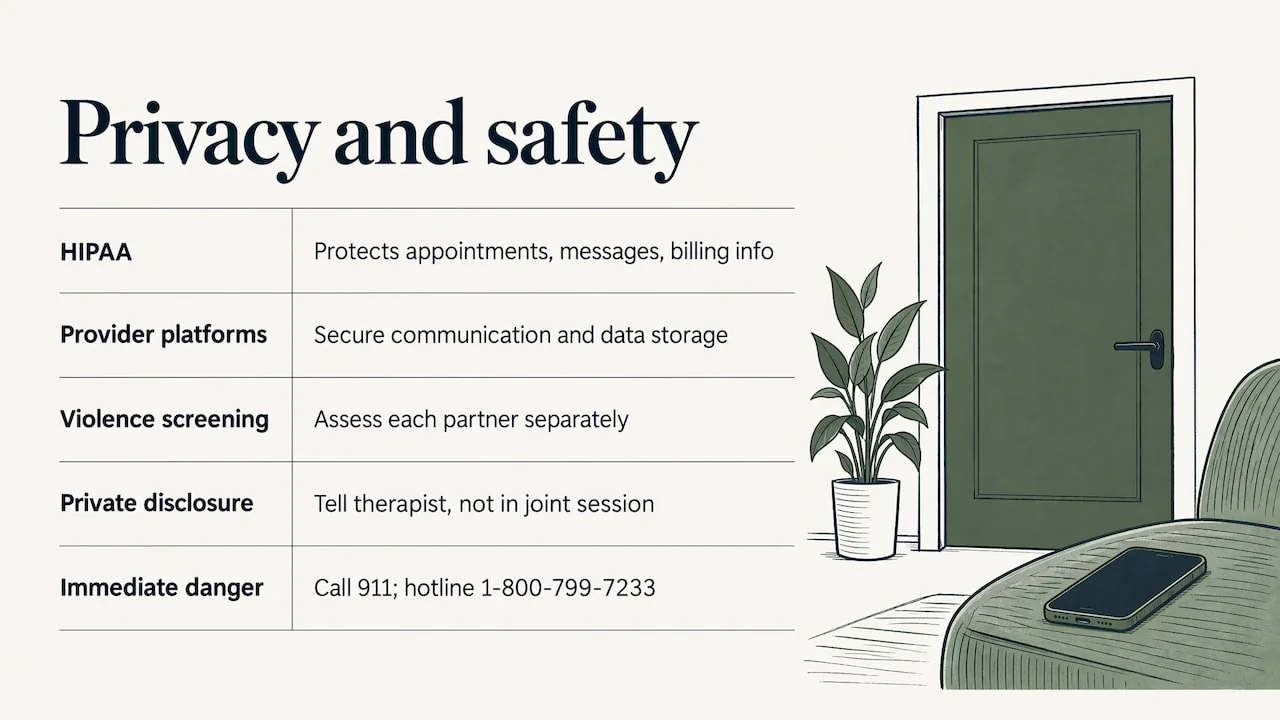
In the United States, HIPAA protects telehealth information handled by covered health care providers and their business associates. The Department of Health and Human Services says it protects appointments, messages and related health and billing information and requires covered providers to use platforms that ensure secure communication and data storage. Your part is the physical privacy on your end, covered above.
Safety is the other piece, and it deserves plain words. Clinical guidance recommends assessing interpersonal violence with each partner because some forms of couples therapy are contraindicated when violence is present. That is the reason therapists speak to each of you separately at the start.
If you are afraid of your partner, or you are controlled or threatened at home, tell the therapist in your private screening conversation rather than in a joint session, and the therapist can help you decide what kind of support is appropriate. If you are in immediate danger, call 911. The National Domestic Violence Hotline is also available at 1-800-799-7233.
The APA also advises that the therapist should evaluate whether telepsychology suits the client at all, considering technology access and comfort, disability and language needs, private environments, informed consent, emergency procedures and clinician training. If one of you is in a mental health crisis, in-person care may be the better starting point, and a good therapist will say so.
What online couples counseling costs, and whether insurance helps
Couples therapy is typically priced per session, and the range is wide. One consumer guide reviewed by a licensed marriage and family therapist says to expect roughly $100 to $250 per session, with higher fees in expensive metro areas. It also notes that therapists typically charge the same for virtual and in-person sessions.
Insurance is where couples get tripped up. The same guide explains that health plans generally cover couples therapy only when one partner qualifies for care for a specific mental health diagnosis. Plans differ, so the reliable route is to call the number on your insurance card and ask three questions:
- Does my plan cover telehealth mental health visits?
- Does it cover relationship or family counseling when a diagnosis is part of the treatment plan?
- Is there a deductible or copay I should expect?
At The Bridge, sessions are paid either privately or through health insurance, and we do not list session fees on our site. These general cost estimates are not a quote for The Bridge. Reach out through the couples counseling page and we will walk you through your options before you book.
How to choose an online couples therapist
The APA’s guidance supports checking several things before you begin: technology and privacy practices, emergency procedures, applicable laws and clinician training. Turn that into questions you can ask on a first call:
- Is the therapist licensed in the state where you live? Licensure depends on where each partner is physically located during the session. For clients in Texas, ask about a Texas license or other applicable practice authorization. We serve clients statewide through telehealth.
- Do they have training in working with couples? Individual therapy and couples therapy are different skills.
- What does a typical course look like? Ask about the structure, the exercises and how progress is reviewed.
- How do they handle safety screening and privacy? The answer should be specific.
- Do your values fit? Many couples want their faith to be part of the conversation. Others prefer that it stay out. Say which you prefer.
Fit is also about the two of you feeling heard. Each partner should leave the first couple of sessions feeling that the therapist understood their side without taking sides. You can read about our clinicians on our therapists page.
Our perspective
We hear the same worry from couples before their first online session: will a screen get in the way of something this personal? In our experience, what shapes the work is the quality of the guidance, not the room it happens in.
Our approach to couples counseling combines evidence-based psychological methods with a Christian perspective, and we adapt it to the couple in front of us. For many couples that means a faith-informed space to talk about forgiveness, commitment and trust. For others it means practical skills first: how to argue without wounding, how to rebuild closeness, how to make decisions together.
We value telehealth because it removes the obstacles that keep couples from starting. A couple in a small East Texas town, or two parents who can only meet after bedtime, can still sit down with a therapist and do real work. We also offer in-person sessions in Tyler, and some couples begin in the office and continue online, or the reverse.
Whatever the format, we want each partner to feel seen and supported, and we want you to leave sessions with tools you can use at the kitchen table that same week.
Start couples counseling with The Bridge
If you are ready to talk, our marriage and couples counseling is available in person in Tyler and by secure video anywhere in Texas. Our therapists use evidence-based methods tailored to each couple, with a faith-informed perspective when you want it.

If you are not sure whether your situation calls for couples sessions, individual work or family sessions, tell us what is going on and we will help you find the right starting point. You can also read more about online therapy across Texas or about our Christian counseling.
FAQ
Is online therapy good for couples?
For many couples, yes. A 2024 study of married clients found teletherapy was overall as effective as in-person therapy for couple satisfaction and sexual satisfaction, though the bond with the therapist formed more slowly. It is best suited to couples who are safe to work together and have a private space.
Can couples therapy be done if we are in different places?
Yes. Each of you can join the same video session from your own device, which helps with travel, work schedules or time apart. Some couples prefer to share one screen at home because it makes exercises easier. Your therapist can help you decide which works better and confirm that they are authorized to treat each of you in your physical location.
Is there free online couples therapy?
Some community programs and free self-guided tools exist, but individual sessions with a licensed therapist are billed. Typical couples therapy sessions run about $100 to $250. If cost is a concern, ask your therapist about payment options, and check with your insurer about what your plan covers.
What percentage of marriages survive counseling?
No single figure fits every couple, and it depends on what the couple wanted and how far along the problems were. In one large online trial, couples improved in satisfaction and communication, but breakups at six months did not differ significantly from the control group. Counseling is best judged by whether it gives you clarity and skills.
Does insurance cover online couples counseling?
Often only when one partner has a diagnosis that the treatment addresses, so coverage varies by plan. Call your insurer and ask about telehealth benefits and relationship counseling. We can also talk through payment options when you contact us.
Sources
- Telehealth and telepsychology (American Psychological Association)
- Conducting Couple Therapy via Telehealth: Special Considerations (PMC)
- Call me maybe? In-person vs. teletherapy outcomes among married clients (PubMed)
- Couples Therapy Delivered Through Videoconferencing (PMC)
- Online programs improve relationship functioning for low-income couples (APA PsycNet)
- How Effective is Online Couple Relationship Education? (PMC)
- Effectiveness of digital interventions on relationship outcomes (BMC Psychology)
- Privacy laws and policy guidance (Telehealth.HHS.gov)
- Resource for health care providers on educating patients about privacy (HHS)
- How Much Is Couples Therapy? (Choosing Therapy)
- Virtual Practice and Mobility FAQs (Texas Behavioral Health Executive Council)