

Private-pay therapy fees in Texas vary by clinician, session length and type of care; couples, family and specialized sessions may cost more. With insurance, your cost is usually a copay or coinsurance, set by your plan rather than by the therapist. The number that matters is your own, and you can find it in a few steps. At The Bridge Therapeutic Services in Tyler, we accept private pay and health insurance, so you can see both options before you book.
The Bridge Therapeutic Services
Explore Counseling That Fits Your Needs
The Bridge offers faith-informed counseling for individuals, couples, families, and children, with telehealth options across Texas.
VisitAt a glance
- Without insurance, expect a per-session fee that varies by therapist license, session length and session type. Couples and family sessions usually cost more than individual ones.
- With insurance, you pay a copay or coinsurance, and the deductible comes first on many plans. Your plan documents give the exact figures.
- Texas law requires fully insured plans to cover mental health at the same level as physical health, so you should not face harsher cost-sharing for therapy.
- If you pay out of pocket, federal rules let you ask for a Good Faith Estimate of your charges before care begins.
- Ask any therapist about fees, insurance and cancellation terms in your first call. A clear answer is a good sign.
Table of Contents
- What a therapy session costs in Texas without insurance
- Why the type of therapy changes the price
- What you pay with insurance
- How to find your real cost before the first session
- Paying out of pocket: your right to a Good Faith Estimate
- Lower-cost ways to pay for therapy in Texas
- What you get for the fee
- Our perspective on cost
- Counseling at The Bridge Therapeutic Services
- FAQ
- Sources
What a therapy session costs in Texas without insurance
Therapists in Texas set their own fees, and there is no state price list. For illustration, a practice might quote a fee in the low-to-mid $100s, but that is not a verified statewide average or The Bridge’s current rate. The first appointment (the intake, where the therapist takes your history) may be priced differently from later sessions. Specialist work, session length and location can all affect the fee you are quoted.
Three things drive the price you are quoted:
- The clinician’s license and experience. Texas counselors hold titles like LPC (Licensed Professional Counselor), LMFT (Licensed Marriage and Family Therapist) or LCSW (Licensed Clinical Social Worker). An associate-level clinician who is still completing supervised hours often charges less than a fully licensed one.
- Session length. A standard session is about 45 to 60 minutes. Longer sessions, common for couples and family work, are priced accordingly.
- Location and format. An office in a major metro usually costs more than one in a smaller city. Telehealth is typically priced close to in-person care, but it saves travel time and fuel.
Because fees differ so much, treat any statewide average as a rough guide only. The reliable figure is the one a practice gives you in writing.
Why the type of therapy changes the price
The format of counseling changes both the length of the session and the work involved.
| Type of counseling | Typical session length | How the price usually compares |
|---|---|---|
| Individual (adult) | 45 to 60 minutes | The baseline rate |
| Child and teen | 45 to 60 minutes | Usually near the individual rate, sometimes with parent check-ins |
| Couples and premarital | 50 to 90 minutes | Usually higher than individual |
| Family | 60 to 90 minutes | Usually higher than individual |
| Parenting support | 45 to 60 minutes | Usually near the individual rate |
The Bridge Therapeutic Services offers all of these formats: individual counseling, marriage and couples counseling, family counseling, child and teen counseling and parenting support. Because fees depend on the clinician and the format, contact us for the current rate for the service you need.
What you pay with insurance
When you use insurance, the therapist’s full fee is not what you pay. Your plan determines your share. The Texas Department of Insurance explains the terms in its 2026 Texas Health Coverage Guide:
- Copay: a fixed amount you pay for a covered service, such as $25 for a doctor visit.
- Deductible: what you pay before the plan begins sharing costs on many services.
- Coinsurance: a percentage you pay after the deductible. The guide’s example is 20% of a $1,000 service, which is $200.
- Out-of-pocket maximum: the cap after which the plan pays 100% of covered essential health benefits.
Here is a worked example. Suppose your plan has a $40 specialist copay. If therapy is covered at that level, you pay $40 per visit. If instead your plan has an unmet deductible and 20% coinsurance, you would pay the contracted session rate until the deductible is met, then 20% of each session after that. Your plan’s summary of benefits shows which applies.
In-network and out-of-network care
An in-network provider has a contract with your health plan and agrees to treat members for a set amount. An out-of-network provider has no contract. According to the same TDI guide, out-of-network providers can balance bill you if the plan pays less than they charged, and plans usually set higher copays and coinsurance for out-of-network care. Out-of-pocket limits also do not count monthly premiums, non-covered services, out-of-network care or costs above the allowed amount.
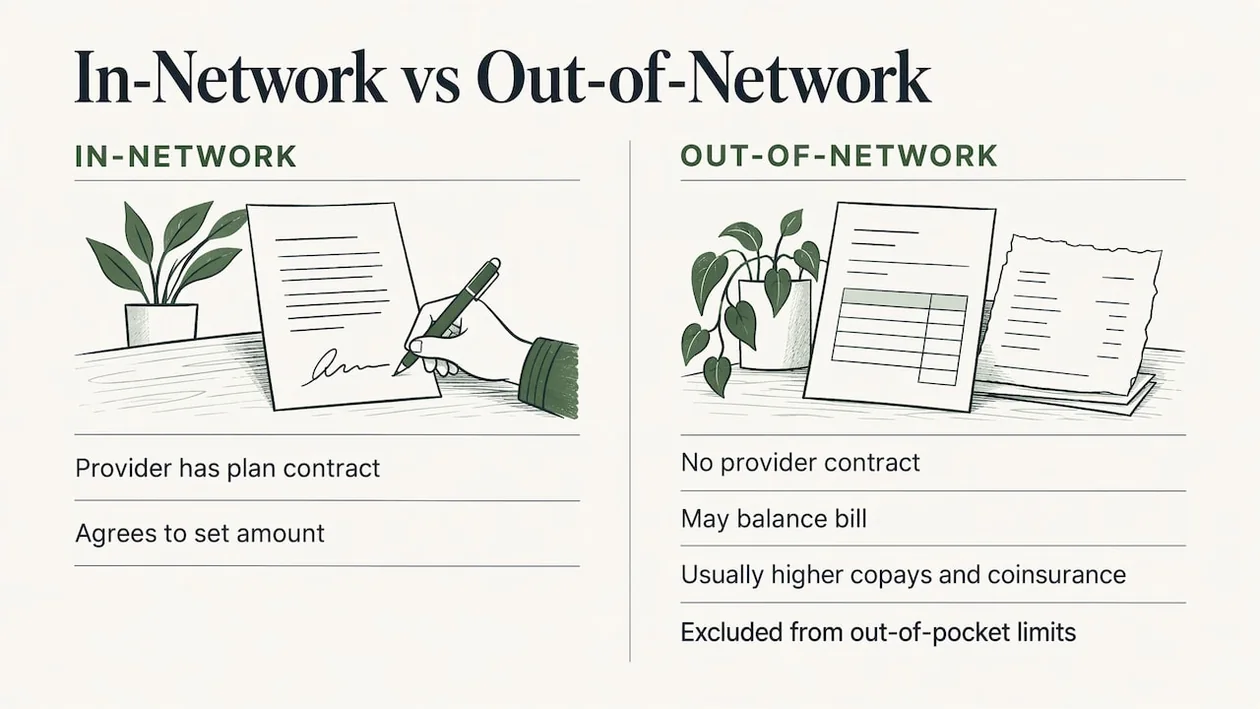
So when you choose a therapist, ask two questions: is this person in my plan’s network, and what will my share be per session?
Mental health is covered on par with physical health
Texas requires fully insured plans sold to individuals, small employers and large employers to include mental health and substance use disorder benefits at the same level as physical illness benefits, according to the Texas Department of Insurance. That covers financial requirements such as copays and deductibles, as well as limits on treatment. The federal parity law works the same way: a professional guide to the Mental Health Parity and Addiction Equity Act explains that plans cannot apply more restrictive copays, coinsurance, visit limits or prior authorization to mental health than to medical care.
Parity does not require a plan to cover every kind of treatment. It requires that rules be applied no more strictly to mental health than to medical care. Small self-insured employer plans (50 or fewer employees) are exempt, so check which kind of plan you have. If you buy your own coverage, a guide on finding affordable health insurance in Texas walks through the plan options.
The Bridge Therapeutic Services
Consider Support for Your Next Step
Visit The Bridge to learn about compassionate, faith-informed counseling for individuals, couples, families, and children.
The Bridge Therapeutic Services
3800 Paluxy Drive, Suite 240, Building 2, Tyler, TX 75703
How to find your real cost before the first session
This takes about 15 minutes and removes most billing surprises.
- Find your behavioral health benefits. Look at your insurance card for a member services number, or log in to your plan’s portal. Ask about “outpatient mental health” or “behavioral health” benefits, not just “therapy.”
- Ask four questions. What is my deductible and how much have I met this year? What is my copay or coinsurance for outpatient therapy? Do I need a referral or prior authorization? Is telehealth covered the same as in-office visits?
- Confirm the therapist’s network status. Ask the practice directly whether they are in network with your specific plan, not only the insurance company. One insurer can run many plans with different networks.
- Estimate a month and a year. Weekly sessions mean roughly four to five visits a month. Multiply your per-session cost by the number of sessions you expect, and compare it with your out-of-pocket maximum.
- Ask about cancellation terms. Many practices charge for late cancellations, and insurance usually does not reimburse that fee.
If you want help sorting this out, we are happy to talk through payment options before you commit. Reach out through The Bridge Therapeutic Services.
Paying out of pocket: your right to a Good Faith Estimate
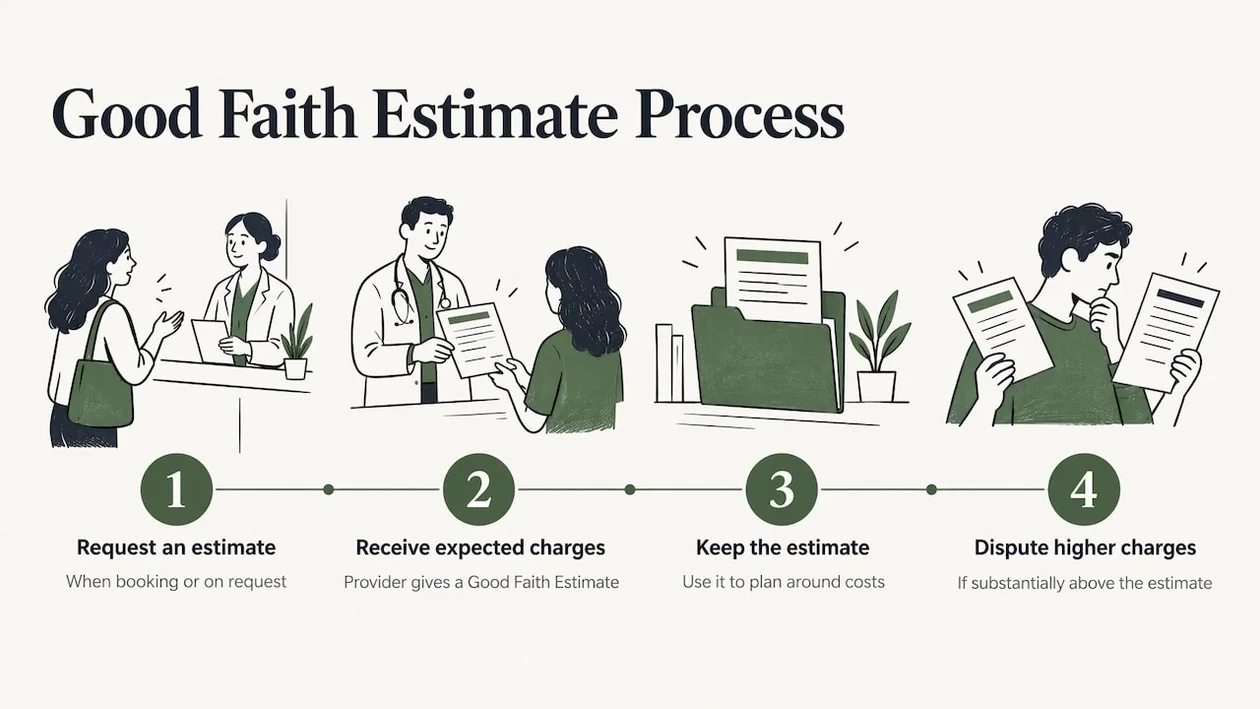
If you have no insurance or choose not to use it, federal rules under the No Surprises Act apply. The Centers for Medicare & Medicaid Services explains that providers must give an uninsured or self-pay person a Good Faith Estimate of expected charges when care is scheduled at least three business days in advance or when an estimate is requested. A bill at least $400 above a provider’s estimate may qualify for the patient-provider dispute process. Scheduling lead time affects when the estimate is due; CMS explains the timing. These rules do not apply to people covered by Medicare, Medicaid, Indian Health Services or Veterans Affairs programs.
A Good Faith Estimate turns a vague “it depends” into a figure you can plan around. Ask for one when you book, and keep it.
Lower-cost ways to pay for therapy in Texas
If the numbers feel tight, there are several legitimate ways to bring them down:
- Use your benefits fully. A plan with a low copay can make weekly therapy more affordable than paying the full fee, even with a deductible.
- Ask about sliding scale fees. Sliding scale means the fee is adjusted to your income. Some practices offer a few such slots, and some community agencies base fees on income.
- Consider telehealth. Online sessions can cut the cost of travel, childcare and time off work. Our online therapy across Texas lets you meet from home anywhere in the state.
- Check your employer benefits. Some employers offer an employee assistance program with a small number of free sessions.
- Use HSA or FSA dollars. Health savings and flexible spending accounts can often pay for counseling. Ask your plan administrator.
- Check public programs. If you have Medicaid or the Children’s Health Insurance Program, ask your plan which counselors are covered. Seniors on Medicare can read about Medicare coverage for therapy and counseling.
What you get for the fee
Price is only half of the question. The other half is whether the sessions work for you. A good fit with your therapist, a clear plan for your goals and a method suited to your concern keep you from paying for sessions that do not move you forward.
At The Bridge Therapeutic Services, our therapists use evidence-based methods tailored to each client, and we work with anxiety, depression, trauma, grief, ADHD, life transitions, relationship challenges and adoption and foster issues. For readers who want their faith included, our Christian counseling integrates psychological principles with Christian values. A session that addresses what you actually need, in a framework you trust, is where the value in a fee lies.
Our perspective on cost
Most people who call us worry about price before they worry about anything else, and that is reasonable. Therapy is an investment of money, time and trust, and you should know what you are walking into.
We believe cost conversations belong at the start. You deserve to know how fees work, how insurance may apply and what a realistic course of care looks like before the first appointment. A plan that fits your life is one you can keep, and consistency is where change tends to happen.
We also believe the fee should buy care built around you: evidence-based methods, a therapist who takes your whole story seriously and, if it matters to you, a faith-informed perspective that honors your values. Whether you come as an individual, a couple, a family or a parent bringing a child, our goal is that you feel seen and leave with tools you can use.
If cost is the thing standing between you and getting help, tell us. We would rather have that conversation than have you go without support.
Jennifer Wood, LPC-S
Counseling at The Bridge Therapeutic Services
The Bridge Therapeutic Services provides Christian counseling in Tyler, Texas, for individuals, couples, families, children and teens, with telehealth available across the state. We accept private pay and health insurance. Whether you are looking for help with anxiety, a struggling marriage or a child who is having a hard time, we can tell you what to expect and how payment works before you schedule.

Start with the service that fits your situation: individual counseling, couples counseling or family counseling. You can also visit our main page to get in touch.
FAQ
What is a normal cost for therapy in Texas?
There is no single normal fee. Private-pay rates vary by clinician, session length and type of care, and statewide figures should not be treated as a quote for your own sessions. With insurance, you typically pay a copay or coinsurance instead. Ask for the specific rate and your plan’s cost share before you book.
Does insurance cover therapy in Texas?
Often yes. Texas requires fully insured plans to cover mental health at the same level as physical health, according to the Texas Department of Insurance. Your deductible, copay and network still determine what you pay, so check your plan’s behavioral health benefits.
What is sliding scale therapy?
Sliding scale therapy adjusts the session fee based on what you can afford, usually according to income. Availability depends on the practice, and slots can be limited. Ask any practice you are considering whether they offer it and how it works.
What is a Good Faith Estimate?
It is a written estimate of expected charges that providers must give uninsured or self-pay patients when care is scheduled at least three business days in advance or an estimate is requested, under federal No Surprises Act rules. It helps you budget and gives you a basis to dispute charges that come in substantially higher.
Is online therapy cheaper than in-person therapy?
Not always on the session fee itself, but telehealth often saves on travel, childcare and missed work. It also widens your choice of therapists across Texas. See our online therapy page for how it works.
The Bridge Therapeutic Services
Talk Through Your Therapy Cost Questions
Call to ask about counseling options at The Bridge, which serves individuals, couples, families, and children with a faith-informed approach.
Sources
- 2026 Texas Health Coverage Guide, Texas Department of Insurance
- Mental Health Parity and Addiction Equity Act Comparative Analysis Guide, 2024
- No Surprises Act Good Faith Estimate requirements, CMS
- How to Find Affordable Health Insurance in Texas
- Medicare and Mental Health Coverage Options for Therapy and Counseling