

Adjustment disorder is treated mainly with talk therapy. Counseling gives you a place to make sense of a stressful change, rebuild your routine and learn coping skills, and many people improve over time; the pace of recovery varies. At The Bridge Therapeutic Services in Tyler, Texas, we counsel individuals, couples, families, children and teens through divorce, job loss, illness, a move or a loss, in person or by telehealth anywhere in Texas. This guide explains what therapy involves, which approaches are used, what to expect session by session, and when to reach out right away.
The Bridge Therapeutic Services
thebridgetherapy.com
Find Support Through Life’s Changes
The Bridge offers faith-informed counseling for individuals, couples, families, children and teens facing stress, grief, trauma or relationship challenges.
VisitAt a glance
- Psychotherapy is the main treatment for adjustment disorder, and it can be individual, group or family-based.
- Common approaches include cognitive-behavioral, interpersonal, supportive, psychodynamic and family therapy, matched to you and the stressor.
- Symptoms usually begin within three months of a stressful event and typically ease within about six months once the stressor and its effects settle.
- Children and teens often do best when family is part of treatment; couples can work on the strain the stressor puts on the relationship.
- If you are thinking about suicide, call or text 988 right away.
Table of Contents
- What adjustment disorder is, and why counseling fits it
- How adjustment disorder therapy helps
- Types of therapy used for adjustment disorder
- Counseling for children, teens, couples and families
- What happens during treatment, and how long it lasts
- Where medication fits
- Start counseling in Tyler or anywhere in Texas
- When to get help right away
- FAQ
- Sources
What adjustment disorder is, and why counseling fits it
An adjustment disorder is an outsized emotional or behavioral reaction to an identifiable stressor: a divorce, a layoff, a diagnosis, a death, a move, a new baby, a change at school. You are not weak and you are not overreacting for needing help. The reaction is stronger than you or others would expect, or it gets in the way of work, school or relationships.
Because the problem is tied to a specific event, the work is practical. According to Mayo Clinic, talk therapy is the main treatment. It can provide emotional support, help you return to your usual routine, help you understand why the event hit you so hard, and teach stress management and coping skills.
Timing matters too. Verywell Health notes that symptoms start within three months of the stressful event and typically resolve by six months after the stressor and its consequences are gone. Symptoms can improve with support, though some people need longer-term care, particularly when the stressor continues.
Common signs that you may need support
Symptoms look different from person to person. Adults often describe a mix of the following:
- Persistent sadness, tearfulness or hopelessness
- Worry, feeling on edge or overwhelmed
- Trouble sleeping or concentrating
- Pulling away from friends and family
- Irritability, arguments, or acting out
- Dropping performance at work or school
Children and teens may show it through behavior: new anger, clinginess, falling grades, or refusing activities they used to enjoy. A licensed clinician makes any diagnosis. If you recognize yourself or your child here, a counseling consultation is a sensible first step.
How adjustment disorder therapy helps
Good therapy for an adjustment disorder usually does four things.
- Names what happened and what it means to you. A stressor is rarely just an event. A job loss can touch identity, finances and your sense of being a provider. Counseling helps you see which part of the change is hurting most.
- Rebuilds routine. Sleep, meals, movement, work and time with people you trust tend to slip first. Restoring them is part of treatment, not an afterthought.
- Builds coping and stress-management skills. Problem-solving, communication, calming strategies and ways to challenge unhelpful thoughts give you tools you keep after sessions end.
- Strengthens support. Mayo Clinic lists staying connected with positive loved ones, doing something each day that brings joy and purpose, getting good sleep and physical activity, practicing mindfulness such as journaling or prayer, and planning ahead for problems as ways to build resilience.
The Johns Hopkins Psychiatry Guide describes the main goals of treatment as relieving symptoms and restoring you to your baseline level of functioning, or better.
Types of therapy used for adjustment disorder
No single method is right for everyone. The MSD Manual lists cognitive-behavioral, psychodynamic, family, interpersonal and supportive psychotherapy among the approaches used with adjustment disorder. A clinical practice guideline from a Philadelphia behavioral health system stresses an individualized, patient-centered approach with shared decision-making, so treatment reflects your values and preferences as well as the clinical picture.
| Approach | What it focuses on | Often a good fit when |
|---|---|---|
| Cognitive-behavioral therapy (CBT) | Building skills to manage stressors and changing unhelpful thought and behavior patterns | A clear event such as divorce, job loss or illness set off the symptoms |
| Interpersonal therapy | Communication and relationships | The stressor strained a relationship or changed your social role |
| Supportive psychotherapy | Steady emotional support while you adjust | You need space to process and feel understood |
| Family therapy | Changes within the family system | A child or teen is struggling, or the whole household is affected |
| Couples therapy | How two people face the stressor together | The change is straining your marriage or partnership |
| Group or peer support | Shared experience and social skills | Isolation is part of the picture |
The Australian Psychological Society points to skills such as activity scheduling, problem solving, anger management, stress management and relaxation as useful elements, because adjustment disorder is tied to how well a person copes with stress.
Where faith fits in
For many people in East Texas, faith is part of how they cope with loss, change and uncertainty. Prayer is among the mindfulness practices Mayo Clinic mentions for resilience. At The Bridge Therapeutic Services, we integrate psychological principles with Christian values, so your beliefs can be part of the conversation when you want them to be. You can read more on our Christian counseling page.

When trauma is part of the story
Sometimes the stressor was frightening or painful enough that trauma symptoms sit alongside the adjustment struggle. In that case, our articles on how EMDR therapy helps heal trauma and PTSD and on trauma and PTSD counseling explain how we approach it.
The Bridge Therapeutic Services
Explore Counseling in Person
At The Bridge, clients can receive compassionate, faith-informed counseling for adjustment challenges, with telehealth also available across Texas.
The Bridge Therapeutic Services
3800 Paluxy Drive, Suite 240, Building 2, Tyler, TX 75703
Counseling for children, teens, couples and families
An adjustment problem rarely stays with one person. A parent’s job loss changes the whole household, and a child’s reaction to a move changes the parents’ evenings.
Children and teens
Cleveland Clinic states that family therapy is recommended for a child or teenager with adjustment disorder. Johns Hopkins Medicine describes treatment for adolescents as potentially including individual cognitive-behavioral work on age-appropriate problem-solving, communication, impulse control, anger management and stress management, family therapy aimed at needed changes within the family system, and peer group therapy to build social skills.
In practice, that means a young person gets a space of their own, and parents get a role in the plan. Our child and teen counseling and parenting support services are built for exactly that combination. If attention and focus are also a concern during a hard season, we offer ADHD counseling as well.
Couples and families
When a stressor lands on a marriage, partners often react differently: one withdraws, the other pursues. Couples therapy lets you face the change as a team rather than as opponents. Our marriage and couples counseling is for partners in that spot, and our family counseling brings everyone affected into the room. If you are entering a big transition on purpose, such as an engagement or remarriage, premarital and marital enrichment counseling can help you prepare.
Adults on their own
If the stressor is yours to carry, individual counseling gives you a steady weekly space to sort through it. Our article on how counseling can guide you through change covers what that process looks like during life transitions.
What happens during treatment, and how long it lasts
A typical course starts with an assessment: what the stressor is, when symptoms began, how they affect sleep, work, school and relationships, and whether anything else, such as depression or anxiety, needs attention. From there you and your counselor set goals together, such as sleeping through the night, handling a hard conversation, or getting back to the gym or church.
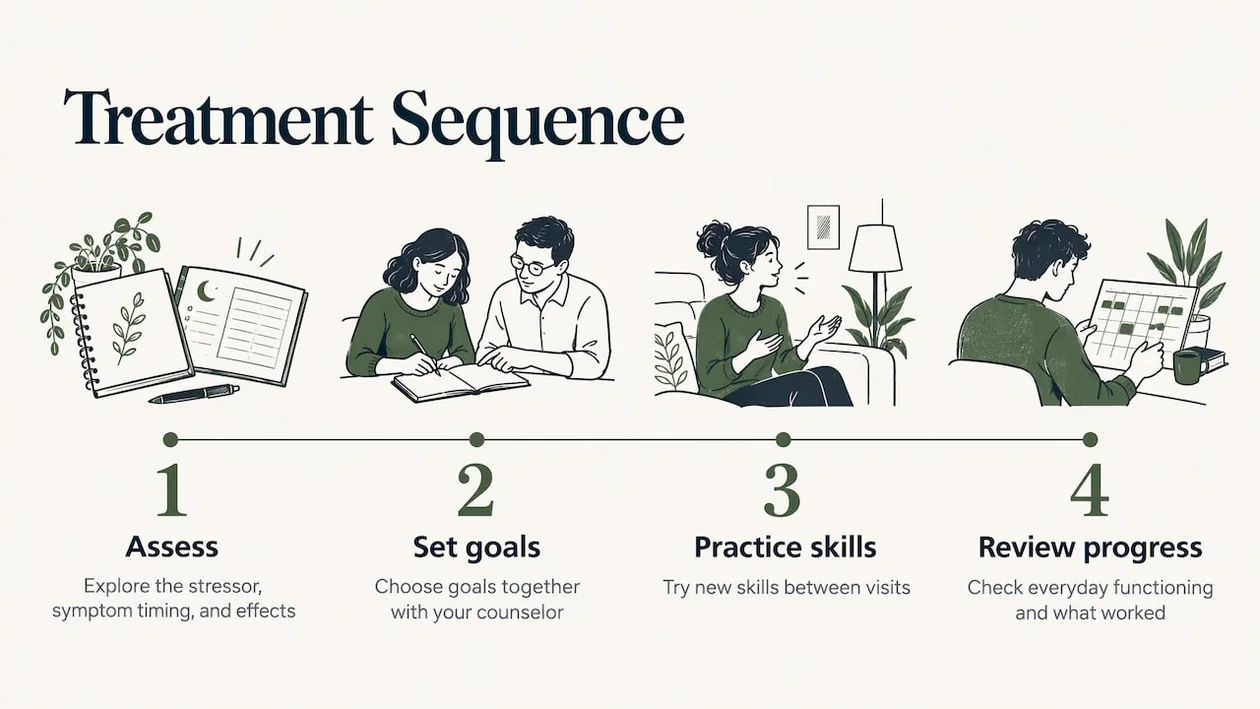
Sessions then combine understanding and practice. You talk through the event, try new skills between visits, and review what worked. Progress is measured by how you function: are you sleeping, working, parenting and connecting more like yourself?
The Johns Hopkins Psychiatry Guide notes that a full, planned course of time-limited therapy, or extra visits after symptoms resolve, may help ensure continued resolution.
How long will it take?
Cleveland Clinic says symptoms usually go away after six months, and that some cases persist longer. It also notes that continuing treatment after you feel better can lower the risk of symptoms returning when other stressors arrive. The number of sessions depends on the stressor, your history and your goals. If the stressor is ongoing, such as a chronic illness or a long custody process, support may run longer, and that is a normal part of care.
If symptoms last beyond six months, or new ones appear, your counselor will reassess. The Johns Hopkins guide lists persistence past six months and signs of another condition such as major depression or PTSD as reasons to look at the diagnosis again, which is why a careful assessment matters.
Where medication fits
Therapy is the foundation, and some people also benefit from medication for specific symptoms. Mayo Clinic states that antidepressants or anti-anxiety medicines may be used alongside talk therapy to help with depression and anxiety, and that people may need them only for a few months. Cleveland Clinic adds that medications shouldn’t be the only form of treatment.
Medication decisions belong to your physician or a psychiatric prescriber. If you are already taking medication or wondering whether you need it, bring that to your doctor, and let your counselor know so your care stays coordinated. Our article on anxiety therapy versus medication explains how the two work together.
Start counseling in Tyler or anywhere in Texas
If a recent change has left you struggling, you do not have to wait for it to get worse before you talk to someone. The Bridge Therapeutic Services offers individual, couples, family and child and teen counseling in Tyler, with faith-informed care built on evidence-based methods and tailored to each client. We accept private pay and health insurance.

If you cannot come to the office, our online therapy and telehealth counseling across Texas brings the same care to you. You can reach us through The Bridge Therapeutic Services to begin.
When to get help right away
Make the call sooner rather than later in these situations:
- You are thinking about suicide. Mayo Clinic states that the risk of suicide can be higher in people with adjustment disorders. In the U.S., call or text 988 to reach the 988 Suicide & Crisis Lifeline, available 24 hours a day. Veterans and service members can call 988 and press 1, or text 838255. For Spanish-language support, call 988 and press 2, or text AYUDA to 988. If you are in immediate danger, call 911.
- You cannot get through each day. Mayo Clinic advises talking with a doctor or mental health professional if you continue to struggle or have trouble functioning.
- Symptoms last beyond six months or new ones appear. This can signal that something beyond an adjustment disorder needs attention.
- Your work, relationships or parenting are seriously affected. Impairment in these roles is one of the triggers the Johns Hopkins guide lists for referral.
Perspective
In our counseling room, we rarely meet someone who is simply “overreacting.” We meet people whose life changed faster than they could absorb it, and who are tired of being told to push through. Adjustment is not a personal failing. It is what a person does when something they counted on is taken away.
We believe the most helpful counseling treats the whole person. That means evidence-based skills for sleep, worry and conflict, and also room for what the loss means to your faith, your marriage and your family. When those pieces are held together, people tend to feel seen, and feeling seen is where change starts.
We also believe adjustment rarely happens alone. A child’s struggle belongs to the family, and a husband’s job loss belongs to the marriage. That is why we offer individual, couples, family and child and teen counseling under one roof, so the right people can be in the room together. Whatever the stressor, our aim is to equip you with tools you keep long after the hard season passes.
Jennifer Wood, LPC-S
FAQ
What is the best therapy for adjustment disorder?
There is no single best option, because treatment is matched to you and the stressor. Cognitive-behavioral, interpersonal, supportive and family therapy are all used. A clinical guideline recommends an individualized approach with shared decision-making, so you and your counselor choose together.
Is adjustment disorder counseling the same as therapy?
In everyday use, the two terms mean the same thing: talk with a trained counselor to process a stressor and build coping skills. Mayo Clinic names talk therapy as the main treatment. It can be individual, group or family-based.
Does adjustment disorder go away on its own?
Often symptoms ease within about six months once the stressor and its consequences settle. Counseling can make that stretch more manageable and help prevent the same struggle from returning with future stress. If symptoms continue past six months or worsen, a fresh assessment is the right next step.
Can my child or teen get help for adjustment problems?
Yes. Family involvement is recommended for children and teens, and individual sessions can build skills such as communication and anger management. Our child and teen counseling in Tyler is designed for young people and their parents together.
Can I do adjustment disorder therapy online?
Yes. We offer telehealth counseling to clients across Texas, so you can meet from home if distance, schedule or health makes coming in difficult.
TThe Bridge Therapeutic Services
Talk About Adjustment Challenges
Call The Bridge to ask about counseling support for stress, grief, trauma or relationship challenges through a faith-informed approach.
Sources
- Adjustment disorders: Diagnosis and treatment, Mayo Clinic
- Adjustment disorders: Symptoms and causes, Mayo Clinic
- Adjustment Disorders: What They Are, Symptoms & Treatment, Cleveland Clinic
- Adjustment Disorders, Johns Hopkins Medicine
- Adjustment Disorder, Johns Hopkins Psychiatry Guide
- Adjustment Disorders, MSD Manual Professional Edition
- Trauma and Stressor-Related Disorders clinical practice guideline, CBH Philadelphia
- Treatment guidance for common mental health disorders, Australian Psychological Society
- Adjustment Disorder and Its Symptoms, Causes, and Treatment, Verywell Health