

Most marriage communication problems are not about a lack of love or effort. They come from patterns: how a conversation starts, how each spouse hears the other, and what happens when stress is high. Patterns can be seen, named and changed. This guide covers the problems couples report most, why they take hold, specific habits that improve communication in marriage, and when it makes sense to bring in a counselor.
The Bridge Therapeutic Services
Work Toward Better Conversations
The Bridge offers couples counseling that integrates evidence-based methods with Christian values, in Tyler and through telehealth across Texas.
VisitTL;DR
- The most common trouble spots are money, parenting, time together, trust, intimacy and unmet expectations. The way you talk about them matters more than the topic.
- Four patterns do the most damage: criticism, contempt, defensiveness and stonewalling. Each has a practical antidote.
- Stress makes good communicators worse. Research on newlyweds links financial strain and stressful events to more negative communication.
- Small habits help: a gentle start, “I” statements, a real pause when you are flooded, and a short daily check-in.
- If the same fight keeps returning, if one of you has gone silent, or if there is any abuse, a counselor can help. The Bridge Therapeutic Services offers couples counseling in Tyler and by telehealth across Texas.
Table of Contents
- What marriage communication problems actually look like
- The four patterns that do the most harm
- Why communication breaks down even when you know better
- How to communicate better: habits that work
- A worked example
- Perspective: what we see in the counseling room
- When it is time to bring in a counselor
- Work on your marriage with The Bridge Therapeutic Services
- FAQ
- Sources
What marriage communication problems actually look like
Communication trouble rarely announces itself as “we have a communication problem.” It shows up as a household argument that becomes a character attack, a spouse who answers “fine” and leaves the room, or a conversation about the budget that ends two days later in silence.
Psych Central’s overview of common communication problems in marriage lists breaches of trust, built-up resentment, difficulty being vulnerable, financial disagreements, too little time together, insecure attachment, parenting conflicts and unrealistic expectations. A licensed counselor quoted in another Psych Central guide to communication in marriage adds chores, jealousy, intimacy and tidiness to the list.
Notice that these are ordinary subjects. Almost every couple deals with money, kids and housework. What separates couples who handle them from couples who spiral is rarely the subject. It is the pattern around it. Here are the patterns that show up most.
Kitchen-sink arguments and old resentment
A disagreement about one dishwasher load turns into every grievance of the last five years. Nothing gets solved because nothing specific is on the table. The fix is narrow: one issue, one conversation. If other topics rise, write them down for another day.
Mind reading and jumping to conclusions
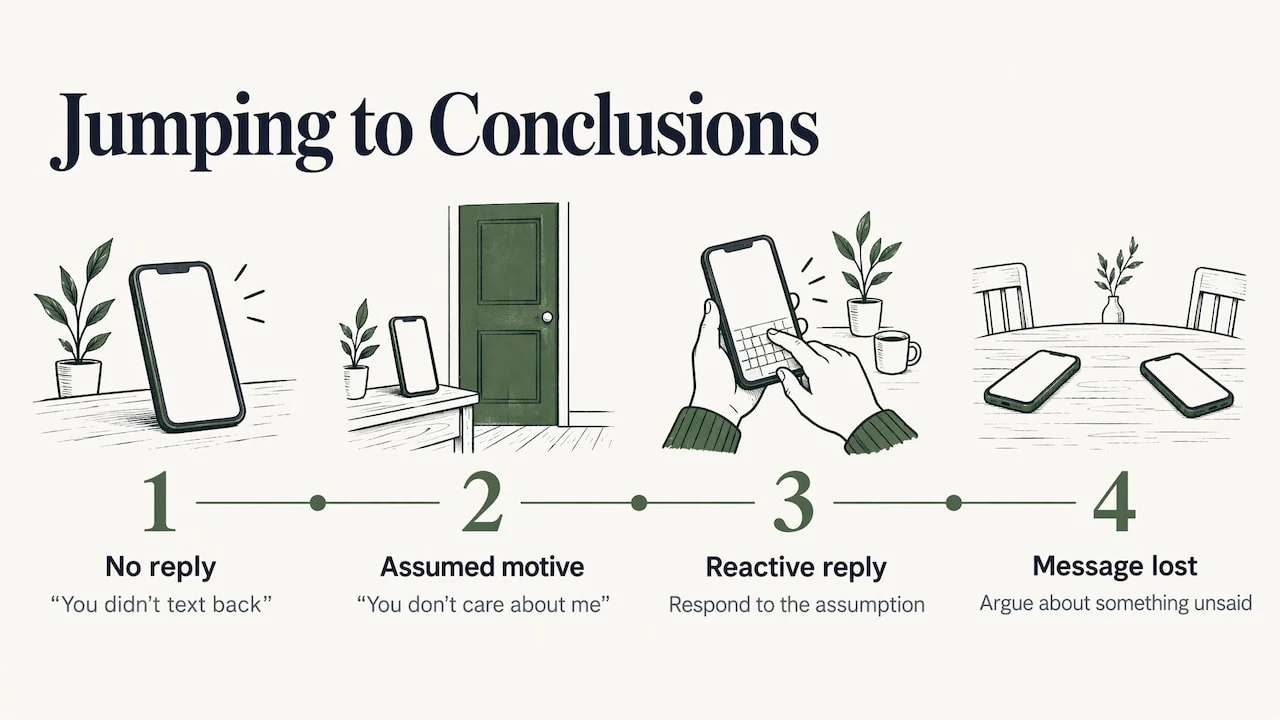
Psychiatry Online’s chapter on communication in couples therapy describes how trouble begins when partners jump to conclusions without checking what they heard, assign motives that may be wrong, and then react to the response so the original message gets lost. “You didn’t text back” becomes “you don’t care about me,” and now you are arguing about something nobody said.
The silent subject
The same source notes that some spouses learn to censor themselves because certain topics have produced strong emotion or frightening behavior in the past. Over time, many issues go unspoken and the relationship stays on the surface. A couple can look calm for years and still be far apart.
Different goals in the same conversation
One spouse wants to fix the problem. The other wants to feel understood first. Each feels the other is not listening. Naming the goal at the start (“I just need you to listen right now” or “I’d like us to come up with a plan”) removes a lot of friction.
The Bridge Therapeutic Services
Explore Support for Your Relationship
The Bridge offers couples counseling grounded in psychological principles and Christian values, supporting partners as they work through relationship challenges.
The Bridge Therapeutic Services
3800 Paluxy Drive, Suite 240, Building 2, Tyler, TX 75703
The four patterns that do the most harm
The researcher John Gottman spent roughly four decades studying thousands of couples and identified four communication pitfalls frequently found in highly stressed marriages, as summarized by Singapore’s government-run Family Assist resource. Utah State University Extension describes each one in its guide to resolving conflicts.
| Pattern | What it looks like | What helps instead |
|---|---|---|
| Criticism | Attacking your spouse’s character or personality (“You’re so lazy”) | Describe one behavior and how it affects you (“I felt alone when the dishes piled up”) |
| Contempt | Eye-rolling, name-calling, sarcasm, mockery, acting morally superior | Rebuild daily appreciation: name one thing you respect or enjoy about your spouse |
| Defensiveness | Counter-attacking or making excuses, which escalates conflict and shuts down listening | Own your part, even a small one, before explaining |
| Stonewalling | Withdrawing and refusing to engage, the adult silent treatment | Ask for a break, say when you will return, and come back |
The Family Assist summary says that among the four, Gottman’s research identifies contempt as the strongest predictor of divorce. That is worth taking seriously, and it is also good news in a practical sense: contempt is a habit of tone and attitude, and it is something a couple can work on. Couples who catch sarcasm or eye-rolling early, and replace it with respect, change the temperature of the whole relationship.
The American Psychological Association makes a similar point in its guidance on healthy relationships: couples who use destructive behavior during arguments, such as yelling, personal criticism or withdrawing, are more likely to break up.
Why communication breaks down even when you know better
Many couples say, “We know how to talk. We just don’t do it when it counts.” Research supports that experience.
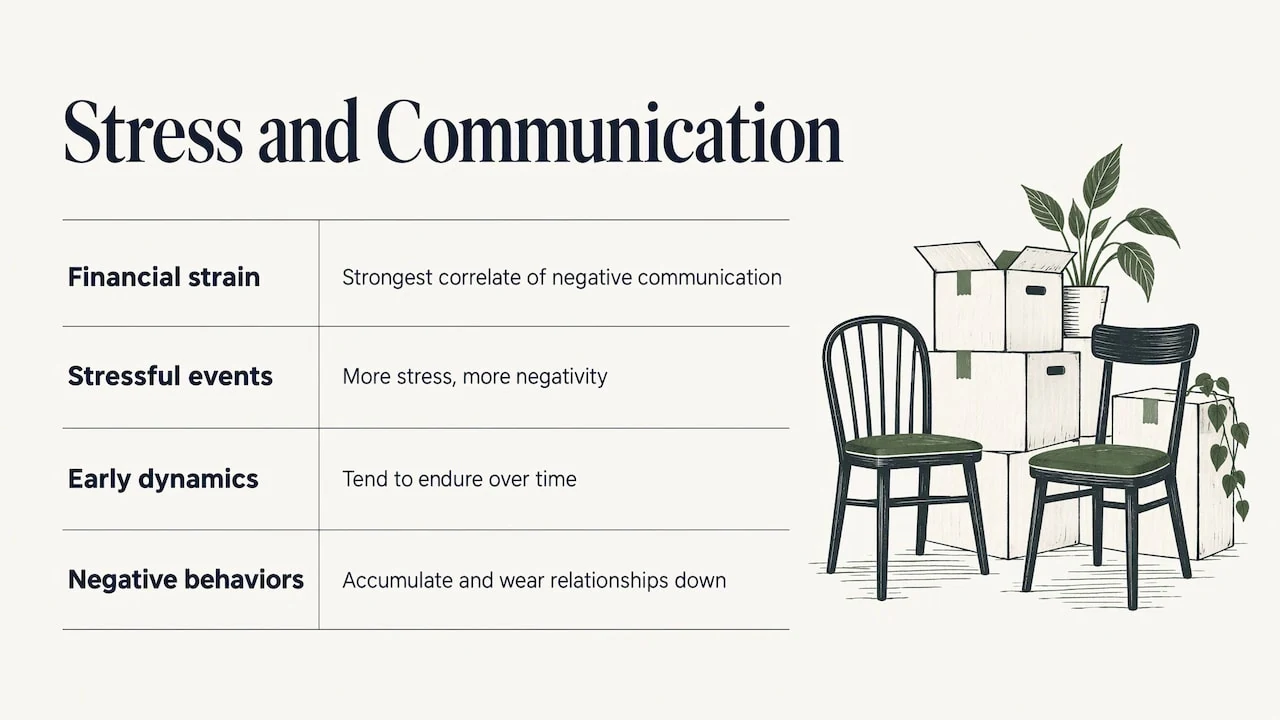
A study of 414 diverse newlywed couples, published in PMC, found that financial strain and stressful life events were the strongest correlate of negative communication: the more stress, the more negativity. The authors describe the Vulnerability-Stress-Adaptation model, which holds that even when couples have the skills to keep a relationship healthy, stressful circumstances can undermine their ability to use those skills when they need them most.
In practice, that means a job loss, a new baby, a move, a health scare or a season of grief can make a kind, capable spouse sound harsh. It is not a character flaw. It is a signal that the marriage needs support and margin.
A second line of research looks at how patterns last. A 2020 study of newlywed communication, also in PMC, found that communication behavior is fairly consistent over time, so early dynamics tend to endure. It also describes a model in which negative behaviors such as criticism and contempt accumulate and wear a relationship down. The takeaway is encouraging for anyone who acts early: habits formed in the first years matter, and habits you change now start to compound in the other direction.
Faith, stress and unspoken expectations
Many couples we talk with carry expectations they never said out loud: who initiates, who leads in prayer, who handles the money, how in-laws are treated, what “rest” means. When those expectations are unspoken, every missed one feels like a failure of love. Writing down what each of you assumed, then comparing notes, often removes months of tension in one evening.
How to communicate better: habits that work
The habits below come from the research above and from what we see working in the counseling room. Pick one or two, not all at once.
1. Start softly
Simply Psychology’s review of Gottman’s research says the first minutes of a conflict conversation tend to predict how the whole conversation goes. You do not have to memorize the statistic to apply it. Compare “We need to talk about your spending, again” with “I’m feeling anxious about our budget and I’d like to work on it with you this week. Is tonight or tomorrow better?” The second opening invites a partner in rather than putting them on trial.
2. Use “I” statements honestly
“I feel unheard when I’m interrupted” lands differently than “You never listen.” The first describes your experience. The second is a verdict. “I” statements are not magic words. They work only when the rest of the sentence is also free of blame.
3. Take a real break when you are flooded
If your heart is racing and you are rehearsing comebacks, you are not listening. The University of Florida IFAS Extension’s guide to communication skills advises that disengaging before something hurtful is said should last at least 25 minutes or longer for a person to really calm down. The same publication says that raising a complaint about a specific issue or behavior is one of the healthiest things a couple can do.
Two rules make a break work:
- Say that you are taking a break and when you will return (“I need 30 minutes, then I want to finish this”). Otherwise it feels like stonewalling.
- Use the time to calm down, not to build a case.
4. Check tone and body language
Utah State University Extension points out that body language and tone often speak louder than words. If your words say “I’m listening” while your arms are crossed and your eyes are on your phone, your spouse believes the body. Speak calmly, make eye contact, and keep an open, relaxed posture.
5. Check what you heard before you respond
Because misunderstandings often come from assumptions, try a simple loop: “What I’m hearing is ___. Did I get that right?” Your spouse corrects you or confirms, and only then do you respond. It feels slow and a little awkward for the first week, then it saves hours.
6. Make a daily check-in
The APA notes that healthy couples make time to check in regularly, spending a few minutes each day on deeper or more personal subjects. Ten minutes after dinner, phones away, is enough. Ask each other two questions: “How are you really doing?” and “Is there anything between us that needs attention?” Small, steady conversation prevents the buildup that explodes later.
7. Build connection outside of conversation
Communication is not only words. Shared activities, touch and play lower the tension that makes hard talks harder. Some couples find that guided movement together, like couples yoga poses for bonding, gives them a low-pressure way to be physically close and attentive to each other before a difficult conversation.
8. Repair quickly
Even strong couples say the wrong thing. What matters is the repair: a touch, a bit of humor, “I’m sorry, let me try that again,” or “can we slow down?” Make repair attempts easy to give and easy to accept. If your spouse tries to repair and you refuse because you are still angry, notice that, and meet them halfway.
A worked example
Imagine a couple in their mid-thirties with two young children. He works long hours. She feels she carries the household alone. The conversation usually goes like this:
She: “You never help around here. I’m done.” He: “I work all day so you can be home. You don’t appreciate anything.”
Both lines contain criticism and defensiveness, and in two sentences the conversation is lost. Here is the same moment with a few changes:
She: “I’m exhausted, and I’m feeling alone with the evening routine. Can we figure out together how to share it?” He: “I didn’t realize it felt that heavy. I’m tired too, but I want to work on this. What would help most?”
Nothing about the problem changed. The start, the framing and the willingness to hear did. That is what most couples learn in counseling: not new feelings, but a safer way to bring the old ones forward.
Perspective: what we see in the counseling room
When couples come to us, they usually describe the problem as “we can’t communicate.” What we usually find is two people who care a great deal and who have each gotten stuck in a protective pattern. One pursues, one withdraws. One explains, one defends. Neither is the villain.
At The Bridge Therapeutic Services, we bring evidence-based methods together with a Christian perspective, because many couples want their faith to be part of how they heal. We do not treat communication as a technique to be mastered in isolation. We look at stress, family history, expectations and the spiritual life of the marriage, and we give couples practical tools they can use at the kitchen table that same week.
Our encouragement is simple: do not wait for a crisis. Couples who come early, while there is still goodwill, tend to find that the patterns shift faster than they feared. Asking for help is not a sign that the marriage is failing. It is a way of taking it seriously.
Jennifer Wood, LPC-S
When it is time to bring in a counselor
Self-help works for many couples. Reading, practicing the habits above and talking honestly may be all you need. But some situations call for a professional.
Consider counseling when:
- The same argument keeps returning with no resolution.
- Contempt, name-calling or constant criticism have become the normal tone.
- One or both of you has withdrawn and stopped trying. Prolonged withdrawal usually means one or both spouses are in considerable pain.
- Trust has been broken, whether by secrets, infidelity or financial dishonesty.
- A major stressor, such as grief, a new baby, a job loss, or depression or anxiety in one spouse, is making everything harder.
- You are avoiding certain subjects because you fear your spouse’s reaction.
If there is any abuse (verbal, emotional, physical, sexual or spiritual), or if you fear for your safety or your children’s, treat that as urgent. Couples communication exercises are not the right first step. Contact a licensed professional on your own, and call 911 if anyone is in immediate danger. When abuse is present, individual support comes first, and a counselor can help you plan next steps. Our individual counseling is one place to begin.
If kids are feeling the tension, family counseling can help everyone in the house learn healthier ways to talk. If you are engaged or newly married, premarital and marital enrichment counseling is a good way to build these habits before stress tests them.
Work on your marriage with The Bridge Therapeutic Services
The Bridge Therapeutic Services provides Christian counseling in Tyler, Texas, for individuals, couples, families and children. Our therapists use evidence-based methods and a faith-informed approach, so you do not have to choose between good psychology and your beliefs. Our marriage and couples counseling helps spouses understand the patterns behind their arguments, and gives them practical tools for listening, repairing and reconnecting.

We see clients in person in Tyler, and our online therapy and telehealth counseling is available across Texas, so distance and busy schedules do not have to stand in the way. We accept private pay and health insurance. To learn more about faith in our work, see our Christian counseling page, or start at thebridgetherapy.com.
FAQ
What is the most common communication problem in marriage?
No single problem tops every list, but the pattern that does the most harm is negativity that goes unchecked: criticism, contempt, defensiveness and stonewalling. Money, parenting, chores and time together are the usual topics. How a couple talks about those topics, more than the topics themselves, tends to decide whether they grow closer or further apart.
How can we improve communication in our marriage without counseling?
Start with a gentle opening to hard conversations, use “I” statements, and take a break of at least 25 minutes when emotions run high. Add a short daily check-in, even ten minutes, on how each of you is really doing. Pick one habit at a time and practice it for a few weeks before adding another.
Is it normal for stress to make us communicate worse?
Yes. Research on newlyweds has found that financial strain and stressful events are associated with more negative communication, and that stress can keep couples from using skills they already have. If a hard season is behind a rough patch, extra support and rest can help, and counseling can speed things up.
Does my spouse have to come to counseling for it to help?
Not necessarily. A spouse can begin with individual counseling to understand their own patterns, work through stress or hurt, and learn healthier ways to respond. Many spouses join couples sessions later once they see change. If your spouse is willing, couples counseling usually offers the most direct way to change the shared pattern.
Can Christian counseling help with marriage communication problems?
Yes, for couples who want faith to be part of the process. At The Bridge Therapeutic Services, we combine evidence-based psychological methods with a Christian perspective, so the practical tools for listening and conflict sit alongside spiritual support. Sessions are available in person in Tyler and by telehealth across Texas.
T
The Bridge Therapeutic ServicesTalk About Your Relationship
Call The Bridge to learn about couples counseling and its faith-informed approach to relationship challenges.
+1 903 283 8729
Sources
- How to Fix Communication Problems in Marriage, Psych Central
- Your Guide to Communication in Marriage, Psych Central
- Chapter 1. Communication, Psychiatry Online
- Improving Communication, Family Assist
- Effective Communication Skills: Resolving Conflicts, Utah State University Extension
- Happy couples: How to keep your relationship healthy, American Psychological Association
- Financial Strain and Stressful Events Predict Newlyweds’ Negative Communication, PMC
- The development of communication behavior over the newlywed years, PMC
- 9 Important Communication Skills for Every Relationship, University of Florida IFAS Extension