

Christian grief counseling is professional therapy for loss that makes room for your faith. A trained counselor helps you work through the pain of losing someone, using clinical methods and, if you want it, prayer, scripture and your own beliefs about God, death and hope. It is not a replacement for your church or pastor, and it does not ask you to grieve in a tidy or “strong” way. It gives you a steady, trained person to sit with you while you grieve.
At The Bridge Therapeutic Services in Tyler, Texas, we offer grief and bereavement counseling in person and by telehealth across Texas. This guide explains how the work looks in practice, so you can decide whether it fits.
The Bridge Therapeutic Services
thebridgetherapy.com
Grieve With Faith-Informed Support
The Bridge offers compassionate, evidence-based grief counseling that makes room for your Christian faith, in person or through telehealth.
VisitTL;DR
- Christian grief counseling combines licensed, evidence-based therapy with your faith, so you do not have to choose between clinical care and spiritual comfort.
- Sessions can include your story of the loss, anger or doubts toward God, practical coping tools and, if you wish, prayer or scripture.
- Look for a counselor who treats the whole person, explains the process up front and never blames your grief on weak faith.
- Grief that stays disabling a year or more after a loss, or any thought of self-harm, calls for prompt professional help.
- The Bridge Therapeutic Services offers in-person counseling in Tyler and telehealth across Texas.
Table of Contents
- What Christian grief counseling is
- How faith and evidence-based care work together
- What sessions may cover
- Who may benefit
- What to look for in a Christian grief counselor
- When grief needs more than spiritual support
- How to decide if a faith-based approach fits
- Grief counseling at The Bridge Therapeutic Services
- FAQ
- Sources
What Christian grief counseling is
Grief counseling helps people adjust to a death or other major loss. The Christian version keeps that purpose and adds a shared spiritual language. You can talk about the funeral and the empty chair at the table, and also about the prayer that felt unanswered or the verse people keep quoting that does not help right now.
People search for this under several names: spiritual grief counseling, faith-based grief therapy, biblical grief counseling, Christian grief support. The labels overlap, but the settings differ in useful ways.
| Type of support | Who provides it | What it is best for |
|---|---|---|
| Christian grief counseling | A licensed mental health professional who integrates faith | Ongoing, structured work on grief, including complicated or traumatic loss |
| Pastoral care | A pastor or church leader, under the authority of a church | Spiritual guidance, prayer, funerals, congregational presence |
| Peer grief groups | Trained volunteers or fellow mourners | Community, shared stories, feeling less alone |
The three work well together. A counselor can support you in therapy while your pastor visits and your church brings meals. One distinction is worth knowing: licensed counselors answer to state ethical standards, which in some jurisdictions limit how they promote personal religious beliefs, while pastoral counselors work under a church’s authority. In a good therapy room, faith is brought in at your lead, not pressed on you.
How faith and evidence-based care work together
Faith-informed therapy does not mean setting science aside. The goal is care that honors your beliefs and also uses methods with a research base. At The Bridge Therapeutic Services, our approach is designed to integrate psychological principles with Christian values, so the practical tools and the spiritual understanding support each other.
Here is how that can look.
- Naming and making room for the loss. Therapy gives you permission to say what happened, in your own words, as often as you need to.
- Working with the body and the mind. Grief affects sleep, concentration, appetite and mood. Your counselor can teach grounding and coping skills for those days.
- Using faith as a resource. Prayer, lament, scripture, memories of loved ones and trust in eternal hope can be woven into sessions when they comfort you.
- Treating trauma directly when needed. When a loss was sudden or violent, grief and trauma can tangle together. Our team can draw on approaches such as faith-based EMDR therapy alongside talk therapy.
Research points the same direction. A review of the literature notes that religious beliefs and practices often help people cope with bereavement, and that counselors working with religious families can draw on those spiritual resources. Faith is not a magic fix, but for many mourners it is a real source of strength, and good therapy uses it.
The Bridge Therapeutic Services
Explore Grief Support In Person
Meet with therapists who integrate psychological principles and Christian values while supporting people through grief and other mental health concerns.
The Bridge Therapeutic Services
3800 Paluxy Drive, Suite 240, Building 2, Tyler, TX 75703
What sessions may cover
No two courses of grief counseling look alike, but several themes come up again and again.
Your story of the loss
Early sessions often center on who you lost and what happened. You may tell the same story many times. That repetition is part of how the mind absorbs something it did not want to accept.
Hard questions about God
Anger, confusion and silence toward God are common in grief, and they do not mean your faith has failed. Many believers find relief in saying these things aloud to someone who will not flinch or hurry to correct them. Scripture itself is full of lament, and a Christian counselor can help you hold both honest sorrow and trust.
Living with exhaustion
Grief is tiring. Clinicians who work with bereaved families note that grief can be exhausting and can limit a person’s ability to multitask or remember complex information, which should shape how care is delivered. In practice that means a good counselor goes slowly, repeats key points, writes things down and does not expect you to be at your best. If your body is also struggling, this piece on physical symptoms of grief may help you recognize what is happening.
Anxiety, depression and sleep
Grief often brings anxiety, low mood or both. If those are growing, we can address them directly through depression counseling or anxiety therapy in the same relationship.
Rituals, anniversaries and meaning
Birthdays, holidays and the anniversary of a death can hit hard. Sessions can plan for them: a candle, a prayer, a visit to a grave, a new tradition that carries your loved one forward. Over time, many people move from only missing the person toward also remembering with gratitude.

Who may benefit
Christian grief counseling is not only for people who have lost a spouse or parent. It can help when you are facing:
- A sudden or traumatic death, such as an accident, suicide or the loss of a child.
- The death of a parent, sibling, close friend or grandparent.
- Loss through miscarriage or stillbirth.
- The end of a marriage or another major relationship.
- A major change that brings grief, such as a move, a job loss or a health diagnosis. Our article on how counseling can guide you through change speaks to this.
Grief is also a family matter. Children grieve differently from adults, often in short bursts, through play, or through behavior changes. Our child and teen counseling can give a young person their own space, while family counseling helps a household grieve together when each person mourns in a different way. Couples who lose a child or a parent often find their grief styles clash, and marriage and couples counseling can help you stay on the same side.
Our perspective on grieving with faith
In our experience, the people who come to us in grief rarely need to be fixed. They need to be accompanied. A Christian counselor can do that in a way that treats the whole person: mind, body, relationships and spirit.
We believe faith and clinical care belong in the same room. Evidence-based methods give structure and relief when sleep, focus and mood are slipping. A Christian perspective gives language for lament, hope and meaning that many clients tell us they cannot find elsewhere. When both are present, you do not have to translate your grief into someone else’s vocabulary.
We also believe grief should never be rushed or judged. Doubt, anger and tears are not failures of faith. Our goal is that you feel seen, supported and equipped with practical tools for the days ahead, whether you meet with us in Tyler or by telehealth.
Jennifer Wood, LPC-S
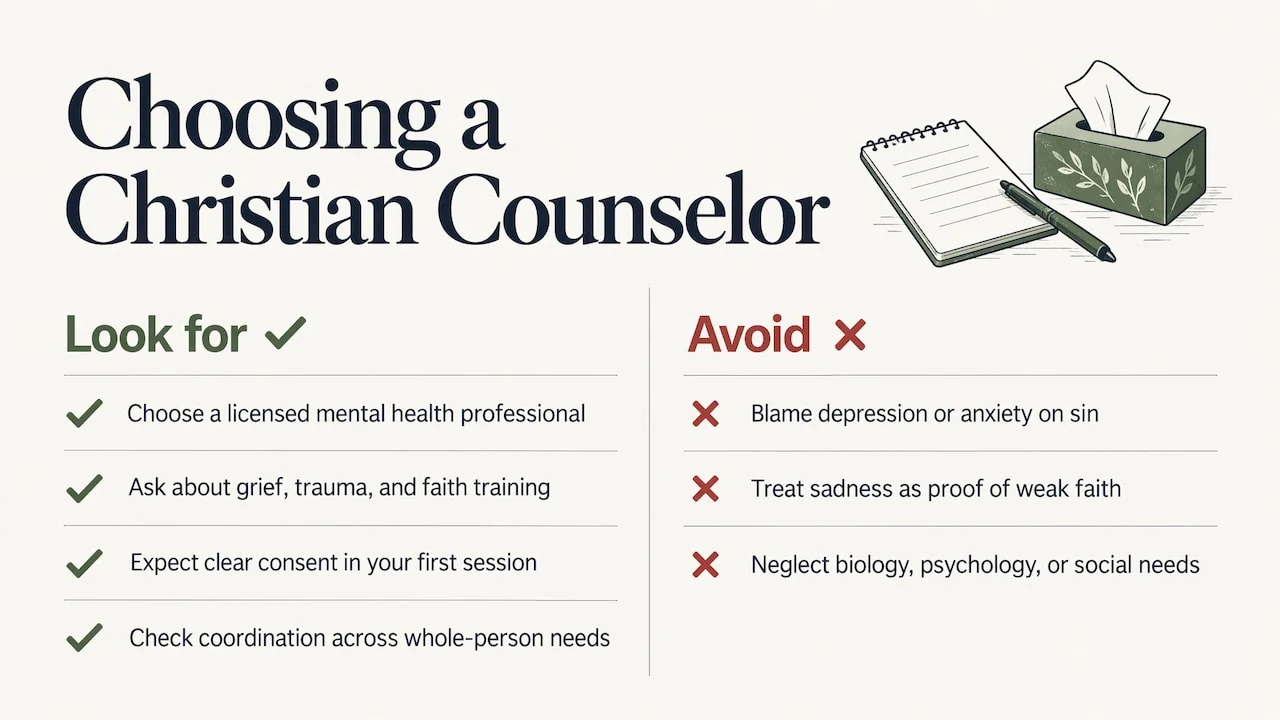
What to look for in a Christian grief counselor
Because this work is deeply personal, it helps to know what good care looks like.
Licensure and training. Look for a licensed mental health professional. Ask about their training in grief and trauma, and how they integrate faith.
Clear informed consent. The AACC Code of Ethics requires Christian counselors to obtain informed consent, so you understand the nature of counseling, the time commitment and the limits of the relationship. Expect a plain explanation in your first session.
Whole-person care. The same code describes sound case management as considering the whole person, coordinating across biological, psychological, social and spiritual areas. In other words, your counselor should care about your sleep, your doctor’s input and your family as well as your prayer life. If you are curious about gentler, whole-person practices that can sit alongside therapy, these holistic grief healing practices are one place to start.
No blame. A thoughtful Christian counselor does not attribute depression or anxiety to sin or a lack of faith and does not ignore the biological, psychological and social sides of what you feel. If anyone tells you that deep sadness proves weak faith, that is a sign to look elsewhere.
Continuity of care. Counselors have an ethical duty to avoid client abandonment, which means ensuring treatment continues, with them or through a referral, if they can no longer provide it.
When grief needs more than spiritual support
Grief is not an illness. Most people feel the sharpest pain ease gradually, even if it never fully disappears. But some situations need prompt professional attention.
- Grief that does not lift. Prolonged grief disorder is a recognized diagnosis. In the DSM-5-TR it requires that the death occurred at least 12 months ago for adults, or 6 months for children and adolescents, along with intense, persistent longing or preoccupation that disrupts daily life. Only a qualified clinician can diagnose it, and effective treatment exists.
- Thoughts of suicide or self-harm. Call or text 988, the Suicide and Crisis Lifeline, at any hour. In an immediate emergency, call 911.
- Not functioning. If you cannot eat, sleep, work or care for children for weeks, tell your doctor or a counselor.
- Increased drinking or substance use to numb the pain.
- A traumatic death that brings nightmares, flashbacks or avoidance. This is where trauma-focused therapy can matter.
Seeking this help is not a sign of weak faith. Many pastors encourage members to see a counselor alongside spiritual care, and a counselor can coordinate with your doctor when medical concerns arise.
How to decide if a faith-based approach fits
Ask yourself a few honest questions.
- Is my faith part of how I grieve? If you pray through hard days or want to talk about heaven, a Christian counselor can meet you there.
- Do I want faith in the sessions, or only in the background? You can set the pace. Some clients want daily scripture, others only want a counselor who understands their worldview.
- Am I wrestling with God? Doubt is welcome, and a faith-informed counselor can sit with it rather than shut it down.
- Do I need practical tools? If sleep, panic or focus are suffering, make sure your counselor uses evidence-based skills, not just encouragement.
- What is easiest to attend? If travel is hard, telehealth removes that barrier. We serve clients online across Texas.
If you are unsure, a first conversation costs you nothing but a few minutes. You can learn how the counselor works and whether you feel at ease. You can also read what we believe on our Christian counseling page.
Grief counseling at The Bridge Therapeutic Services
The Bridge Therapeutic Services provides compassionate Christian counseling in Tyler, Texas for individuals, couples, families and children. Our therapists use evidence-based methods tailored to each client, with a faith-informed perspective that you can lean on as much or as little as you choose. You can meet with us in person in Tyler or by telehealth anywhere in Texas, and pay privately or through health insurance.

If you are carrying a loss, start with our grief and bereavement counseling page, or explore individual counseling if you want one-on-one support. You can also reach us through our website.
FAQ
Is Christian grief counseling the same as talking to my pastor?
No. A pastor offers spiritual guidance, prayer and presence under a church’s authority. A Christian grief counselor is a licensed mental health professional who uses clinical methods and can integrate faith. Many people benefit from having both.
Do I have to be very religious to try it?
No. You can come with questions, doubts or only a loose connection to faith. A good counselor follows your lead and does not push beliefs on you.
How long does grief counseling take?
There is no standard timeline. Some people need a few months of support through a hard season, while others stay longer after a traumatic loss. Your counselor will talk through goals with you and review them as you go.
Can children and teens get Christian grief counseling?
Yes. Young people grieve differently from adults, and counseling can give them a safe place to express it. Parents can also be supported, since a grieving household often needs help together.
Is it normal to feel angry at God after a loss?
Yes, many believers do. Anger and questions are a common part of grief, and they can be explored openly in counseling without judgment.
TThe Bridge Therapeutic Services
Talk About Grief Counseling
Call The Bridge Therapeutic Services to ask about compassionate, faith-informed counseling for grief and bereavement.
Sources
- Validation of the new DSM-5-TR criteria for prolonged grief disorder
- AACC Code of Ethics 2023
- Licensing Program for Christian Counselors
- Counseling Ethics for Counselors in Grief or Christian Counseling
- Caring for the SUDC Family
- Religion and Spirituality in Adjusting to Bereavement
- Faith-Based Therapy: What to Expect