
Religious trauma therapy is trauma-informed counseling for people hurt by a religious environment, a leader, or a belief system. It works on safety, shame, trust, identity and belonging. Its goal is not to push you toward or away from faith. A good therapist helps you heal at your own pace and leaves the decision about what you believe to you.
This guide covers what religious trauma is, how it shows up, whether it is a formal diagnosis, what therapy involves (including EMDR), and how to find a therapist you can trust. We are a Christian counseling practice in Tyler, Texas, and we write for people at every point on the faith spectrum: still believing, questioning, or done with church altogether.
TL;DR
- Religious trauma is the psychological and spiritual harm that can follow controlling, frightening or abusive religious experiences. It often overlaps with other kinds of trauma.
- Common effects include shame, fear, anxiety, depression, trouble trusting, difficulty making decisions and a sense of being cut off from your body or community.
- “Religious trauma syndrome” is a descriptive term, not a separate DSM-5 or ICD diagnosis. Your suffering is still real and treatable.
- Effective care is trauma-informed, paced by you and free of any agenda about what you should believe. EMDR is one evidence-based option for PTSD when clinically appropriate.
- Look for a licensed therapist with trauma training who welcomes your questions, whatever direction your faith takes.
Table of Contents
- What religious trauma is
- Signs and effects of religious trauma
- Is religious trauma syndrome a diagnosis?
- What religious trauma therapy looks like
- EMDR and other trauma-focused approaches
- How to choose a therapist
- Early steps you can take now
- Our perspective
- Support in Tyler and across Texas
- FAQ
- Sources
What religious trauma is
Religious or spiritual trauma can overlap with physical, sexual or emotional trauma. According to the American Counseling Association’s Counseling Today, it can affect identity, core beliefs and values, perceived safety, and your relationship with the sacred and with your community. That last part matters. Many people lose more than a belief system. They lose friends, family closeness, routines, a sense of purpose and the language they used to make sense of their lives.
The same article reports that a 2022 systematic review of 25 studies found three common elements of religious or spiritual abuse: misuse of power by leaders, psychological harm and spiritual harm.
In practice, religious trauma can come from experiences like these:
- Teaching that uses fear of hell, punishment or abandonment by God to control behavior.
- Leaders who demand obedience and treat questions as rebellion.
- Purity culture messages that tie worth to sexual behavior and produce lasting guilt.
- Being shunned, or threatened with shunning, for doubting or leaving.
- Spiritual authority used to excuse or hide physical, sexual or emotional abuse.
- Decisions about your relationships, career or body made for you “in God’s name.”
Not everyone who grew up in a strict church is traumatized, and many people carry deep, healthy faith from the same traditions. Trauma is defined by the harm and its lingering effects, not by the denomination. Hurt can also come from a single leader or congregation in an otherwise healthy tradition.
Signs and effects of religious trauma
People describe religious trauma in very different ways. A survey of 2,500 respondents discussed in Psychotherapy Networker reported fear, powerlessness, shame, chronic unworthiness, overwhelm, isolation, distrust, disconnection from the body, feeling unsafe, tension, hopelessness and confusion. The author also notes hypervigilance, flashbacks, relationship difficulty, chronic illness, anxiety and depression.
A 2024 article in PubMed Central lists further features that have been associated with religious trauma syndrome: trouble making decisions, low self-worth, nightmares, sleep and eating problems, sexual difficulties, grief, guilt and loneliness.
Spiritual struggle
The VA’s National Center for PTSD describes how trauma can bring spiritual struggles: feeling abandoned or punished by God, anger at a higher power, doubts about faith, guilt, loss of meaning, conflict with religious communities and difficulty with forgiveness. The Center also notes that spiritual struggle is consistently linked with poorer mental health after trauma, while positive spiritual resources can offer meaning and hope for some people.
That balance is worth holding onto. Faith itself is not the problem for everyone, and it is not automatically the solution either. Good care looks at what your faith, or your loss of it, means to you.
How it shows up day to day
Some patterns we hear about in counseling rooms:
- A harsh inner voice that sounds like a preacher or parent and labels normal needs as sinful.
- Panic or dread when you hear certain songs, phrases or Bible passages, or walk into a church.
- Trouble saying no, because boundaries were treated as selfishness.
- Not knowing what you want, because wants were always filtered through someone else’s approval.
- Guilt about enjoying things that were once forbidden, even years later.
- Feeling like you belong nowhere: unwelcome in your old community and uncertain among new ones.
If these sound familiar, you are not weak or dramatic. These are well-recognized responses to environments that made you feel unsafe.
Is religious trauma syndrome a diagnosis?
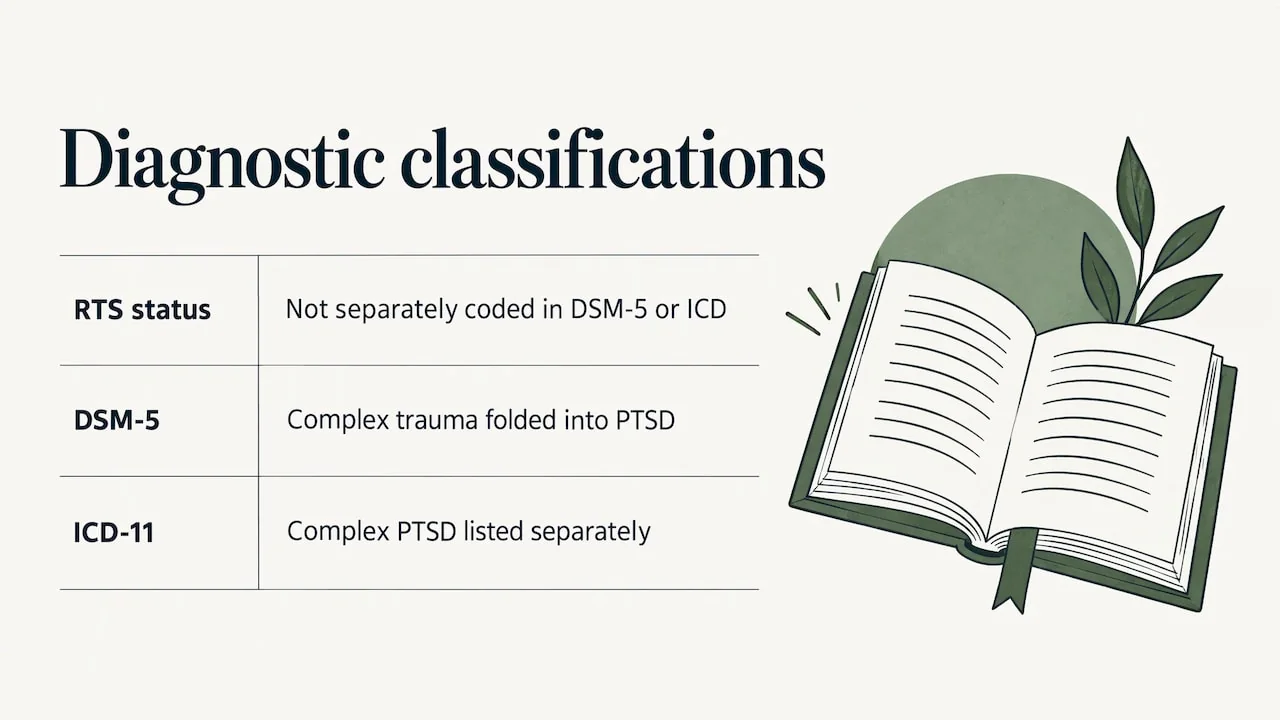
Not formally. Psychologist Marlene Winell used the phrase “religious trauma syndrome” for symptoms that can emerge when someone leaves a fundamentalist or manipulative tradition. The Counseling Today article adds that the DSM does not distinguish diagnoses by trauma type. The 2024 PubMed Central article states directly that RTS is not listed in the DSM-5 or ICD and is not a separately coded diagnosis.
The National Center for PTSD explains that DSM-5 folds complex trauma responses into PTSD, while ICD-11 lists complex PTSD separately. Neither recognizes religious trauma syndrome as its own condition.
What does that mean for you? A therapist will usually work with the diagnoses that fit your symptoms, such as PTSD, anxiety, depression or an adjustment problem, while treating the religious context as central to your story. The lack of a dedicated code does not make your experience less valid, and it does not limit the treatments available.
What religious trauma therapy looks like
Research gives a fairly consistent picture of good care. A 2024 scoping review on addressing harm from adverse religious and spiritual experiences recommends trauma-informed care built on safety, autonomy, prevention of retraumatization, individualized coping skills, grounding, and attention to triggers and dysregulation.
Safety and pacing come first
You do not have to retell every painful detail in your first session. Counseling Today recommends building safety together, asking permission before trauma questions, letting the client control the pace, and assessing risks such as suicide, self-harm and further trauma at the start and throughout treatment. If you are in crisis right now, call or text 988, the Suicide & Crisis Lifeline, or call 911.
What the work can include
According to the scoping review, a therapist can help you:
- Identify triggers and tell helpful coping from harmful coping.
- Practice boundaries and assertive communication.
- Reduce guilt and shame.
- Rebuild self-trust and a sense of identity.
- Grieve what was lost, including community and certainty.
- Find safe social support and a new sense of belonging.
The same review frames therapy as a non-coercive relationship in which your safety, autonomy, grief, values and spiritual questions are respected. The goal is not to make you stay, leave, return or adopt a particular belief. The American Counseling Association likewise notes that people in recovery may keep their beliefs, change them, abandon them or stay conflicted, and all of those can be part of healing.
The American Psychological Association’s 2025 Monitor article on rebuilding a full life after leaving organized religion reports that treatment can be individualized to support a person’s healing journey.
Why spirituality belongs in the room when it matters to you
The National Center for PTSD says spiritually conscious care assesses religion and spirituality when relevant, because skipping those dimensions may make treatment less helpful for some trauma survivors. Its guidance is to assess each person individually rather than assuming religion helps or harms. For one client, that means exploring a lost faith. For another, it may mean finding out whether prayer or scripture can again become a source of comfort rather than fear.
EMDR and other trauma-focused approaches
The VA/DoD guideline from 2023 recommends prolonged exposure, cognitive processing therapy and EMDR as the trauma-focused psychotherapies with the strongest evidence for PTSD. Religious trauma is not identical to PTSD. A therapist can assess whether PTSD or another condition is present and whether these methods fit your treatment plan.
EMDR (Eye Movement Desensitization and Reprocessing) is the one people ask about most. The VA describes the process as:
- history-taking and preparation, including stress-management skills;
- choosing a target memory and rating distress and the belief attached to it;
- processing with alternating bilateral stimulation, usually eye movements or tapping;
- a body scan;
- installing a more adaptive view of yourself.
The VA also notes there is ongoing debate about exactly how EMDR works and whether the bilateral stimulation is necessary.
The American Psychological Association describes EMDR as an eight-phase structured therapy and says processing a specific memory is generally completed within one to three sessions. It also points out that EMDR does not require extended exposure, detailed descriptions of the trauma, challenging dysfunctional beliefs or homework, which some people find makes it easier to start.
Is it okay for Christians to do EMDR?
EMDR is a clinical technique for processing memories, not a spiritual practice. Many Christian clients use it alongside their faith. If you have questions, ask your therapist how a session works and how your beliefs will be respected. You can read about how we use it on our EMDR therapy page.
How to choose a therapist
The scoping review and Counseling Today point to the same qualities. Look for:
- A licensed U.S. mental-health professional with trauma training and experience with religious or spiritual abuse.
- Clear explanations of confidentiality and how treatment works.
- Permission-based pacing: they ask before probing, and you can say stop.
- Awareness of power dynamics, since you may have been taught that authority figures are never to be questioned.
- Comfort with uncertainty: the therapist can sit with your doubts without hurrying to resolve them.
- No agenda, religious or anti-religious, about where you should land.
The review also recommends that therapists stay aware of their own biases, validate clients, and empower them as they work through their beliefs and identities. These are fair standards for any therapist, including a Christian one.
If your hurt came from a church and you still want faith-informed care
Some people want a counselor who understands their faith language without using it against them. Others want a fully secular space. Both are legitimate. What matters is that you choose, and that the therapist follows your lead. If you are unsure, say so in your first conversation. A good therapist will welcome that question.
Early steps you can take now
The scoping review suggests starting with safety, pacing, grounding and support rather than forcing yourself to decide what you believe or recounting every detail. Some practical starting points:
- Slow down big decisions. You do not need to settle your beliefs this month.
- Ground yourself when triggered. Name five things you can see, feel your feet on the floor, and breathe out longer than you breathe in.
- Choose your inputs. Boundaries can include limiting contact with unsafe people or communities and deciding which conversations, practices or information you will engage with.
- Find one safe person. One friend, relative or counselor who does not need you to perform a certain belief is a strong start.
- Notice the inner critic. Ask whose voice it is. That question alone can begin to loosen its grip.
If your symptoms include nightmares, flashbacks, panic, or thoughts of harming yourself, do not wait. See a licensed mental-health professional, and use 988 in a crisis.
Our perspective
We meet many people who feel they have to choose between their pain and their faith, or who fear that asking for help means being told what to believe. We see it differently. Healing starts with safety, and safety means you are heard without being pushed.
At The Bridge, we combine evidence-based psychological care with a faith-informed perspective, and we try to keep both in service of the person in front of us. For some clients, that means working through hard experiences with the church. For others, it means finding that their faith can stand on firmer ground once shame and fear are addressed. We will not hand you a script for either outcome.
Our trauma work is designed to be paced by you, individualized, and grounded in practical tools alongside spiritual understanding. A whole-person view matters here: body, mind, relationships and spirit all carry the effects of what happened. If you want a counselor who takes both your psychology and your spiritual questions seriously, that is what we aim to offer.
Support in Tyler and across Texas
If you are ready to talk with someone, The Bridge offers trauma and PTSD counseling in Tyler, and individual counseling where you can set the pace and the focus. If you live elsewhere in the state, our online therapy across Texas lets you meet with a therapist by telehealth.

You can pay privately or use health insurance. Tell us what you are looking for when you reach out, whether that is trauma processing, a place to ask hard questions about faith, or both, and we will help you find the right fit. Start at thebridgetherapy.com.
FAQ
How do you break free from religious trauma?
There is rarely a single moment of breaking free. Recovery usually means building safety first, then working on shame, boundaries, grief and identity at a pace you control. A trauma-informed therapist can guide that process and does not need you to reach any particular conclusion about faith.
What are some examples of religious trauma?
Examples include fear-based teaching about hell, controlling or abusive leaders, purity culture shame, being shunned for doubting or leaving, and spiritual authority used to excuse abuse. Researchers describe common elements as misuse of power, psychological harm and spiritual harm. The effects can include anxiety, depression, isolation and difficulty trusting.
What is religious trauma syndrome?
It is a descriptive term attributed to psychologist Marlene Winell for symptoms that can follow leaving a fundamentalist or manipulative religion. It is not a separate diagnosis in the DSM-5 or ICD. Clinicians typically treat the symptoms through recognized conditions such as PTSD, anxiety or depression.
Does religious trauma therapy mean I have to give up my faith?
No. Ethical care does not aim to make you stay, leave, return or adopt any belief. The American Counseling Association notes that people may keep, change, abandon or struggle with their beliefs during recovery, and all of these paths are valid.
How long does EMDR take for a religious trauma memory?
The American Psychological Association says processing a specific memory is generally completed within one to three sessions. The full treatment includes preparation and history-taking first, so your total timeline depends on how many memories are targeted and on your pace. This is general guidance, not a guaranteed timeline for religious trauma treatment.
Sources
- Helping clients navigate religious trauma, Counseling Today
- Treating the Trauma in Religious Trauma, Psychotherapy Networker
- Religious trauma syndrome: The futile fate of faith, PubMed Central
- Addressing Religious or Spiritual Dimensions of Trauma, National Center for PTSD
- Complex PTSD: History and Definitions, National Center for PTSD
- Addressing Harm From Adverse Religious/Spiritual Experiences in Psychotherapy
- Rebuilding a full life after walking away from organized religion, APA Monitor
- Overview of Psychotherapy for PTSD, National Center for PTSD
- Eye Movement Desensitization and Reprocessing for PTSD, National Center for PTSD
- Eye Movement Desensitization and Reprocessing (EMDR) Therapy, American Psychological Association