
The right anxiety therapist in Texas is a licensed clinician who is trained in evidence-based treatment, fits your schedule and budget, and is someone you feel safe talking to. If you want that care to respect your faith, The Bridge Therapeutic Services offers anxiety counseling in Tyler, TX in person and by telehealth for clients across the state.
This guide walks through how to search, what to verify, what sessions involve, and what to ask before you book. It is written for adults, couples, parents and teens who are tired of white-knuckling worry and want a clear way to start.
The Bridge Therapeutic Services
Find Faith-Informed Anxiety Support
Explore counseling that combines evidence-based methods with Christian values, with in-person and telehealth options for clients across Texas.
TL;DR
- Texas licenses therapists through the Texas Behavioral Health Executive Council, and you can look up any clinician’s license and disciplinary history for free before booking.
- Telehealth works anywhere in Texas, as long as the therapist is authorized in Texas and uses a secure, HIPAA-compliant platform.
- Cognitive behavioral therapy (CBT) is one of the evidence-based approaches used for anxiety. Ask any therapist what training and method they actually use.
- Fit matters as much as credentials. Ask about fees, insurance, session length, and emergency availability in the first call.
- If faith is central to how you cope, a Christian counselor can work with both the psychology and your beliefs. The Bridge Therapeutic Services does exactly that.
Table of Contents
- What an anxiety therapist actually does
- Therapist, counselor, psychologist, psychiatrist: who is who
- How to verify a Texas therapist in five minutes
- In person or telehealth in Texas
- What treatment for anxiety can look like
- Anxiety looks different at different ages
- When faith is part of how you cope
- What to ask before you book
- Paying for therapy
- We believe anxiety care should be whole-person
- Start with a conversation
- FAQ
- Sources
What an anxiety therapist actually does
An anxiety therapist is a licensed mental health professional who helps you understand why your body and mind keep sounding an alarm, and teaches you skills to respond differently. That might mean racing thoughts at 2 a.m., a tight chest before meetings, avoiding driving on the highway, constant “what if” loops about your kids, or a dread you cannot name.
Therapy for anxiety is not just venting. A good therapist helps you identify triggers, challenge the thought patterns that feed worry, practice calming skills, and gradually face what you have been avoiding. Sessions are usually weekly at first. The work between sessions is part of the treatment.
The Texas Health and Human Services Commission describes cognitive behavioral therapy as a service that aims to reduce symptoms and improve daily functioning, offered in individual, family and group formats. That range is useful to know: anxiety is not only an individual matter. A parent’s worry shapes a household, and a teen’s panic often needs the family in the room.
Therapist, counselor, psychologist, psychiatrist: who is who
The titles can be confusing, and you do not need to master them. Here is the short version.
| Title | What it generally means | Typical role in anxiety care |
|---|---|---|
| LPC (Licensed Professional Counselor) | Master’s-level counselor | Talk therapy, skills training |
| LMFT (Licensed Marriage and Family Therapist) | Master’s-level therapist focused on relationships | Anxiety within couples and families |
| LCSW (Licensed Clinical Social Worker) | Master’s-level clinician | Talk therapy, connecting you to resources |
| Psychologist | Doctoral-level clinician | Therapy and psychological assessment |
| Psychiatrist | Medical doctor specializing in mental health | Diagnosis and medication management |
The Anxiety and Depression Association of America notes that master’s-level therapists and counselors may be licensed as LPCs, LMFTs or LCSWs, and it recommends checking education, training, licensure, anxiety specialization and experience.
Most people with anxiety begin with a therapist, because talk therapy is where skills are built. A psychiatrist is a medical doctor who can prescribe medication, and some people see both. If you are weighing the two paths, our short explainer on anxiety therapy versus medication lays out how they differ. Your primary care doctor can also be a good first stop if you have physical symptoms such as chest pain or dizziness that need to be checked.
How to verify a Texas therapist in five minutes
Before you book, confirm the license. In Texas, most counselors, marriage and family therapists, social workers and psychologists are regulated through the Texas Behavioral Health Executive Council. Its public search shows license status, the date of the first license, expiration, specialty designations and any publicly available disciplinary history.
Here is a simple routine:
- Get the full name and license type from the therapist’s website or first call.
- Search the name on the state’s license verification page.
- Check that the status is active and that the license type matches what they advertise.
- Read any disciplinary history that appears.
- Ask about anxiety experience: how many clients with anxiety they see and what methods they use.
The American Psychological Association’s guidance for choosing a therapist points to the same basics: ask whether the clinician is licensed, experienced with your concern, and uses evidence-based treatment.
You can see the clinicians at our Tyler practice on our therapists page and read about the team on meet the team.
In person or telehealth in Texas
Texas is big. A drive from the Rio Grande Valley to the Panhandle is longer than many states are wide, and even within a metro area traffic can make a weekly appointment hard to keep. Telehealth removes that barrier, and for anxiety it can be a comfortable way to start, since you are in your own space.
Two rules matter when you choose telehealth:
- Location decides licensing. The Texas Behavioral Health Executive Council’s FAQ explains that licensure is based on where the client is physically located, so a provider serving you while you are in Texas generally needs Texas authorization.
- The platform must be secure. The same FAQ says telehealth should use secure, HIPAA-compliant platforms, and that public-facing social media video chat is generally inappropriate for therapy. HIPAA is the federal privacy law that protects your health information.
In-person sessions suit people who want a room away from home, parents bringing younger children, and families working through something together. Telehealth suits busy schedules, rural addresses, teens who open up more easily on a screen, and weeks when you are traveling or unwell. Many people mix both.
The Bridge Therapeutic Services offers in-person counseling in Tyler and online therapy and telehealth counseling across Texas, so you can choose the format that you will actually keep showing up for.
The Bridge Therapeutic Services
Explore Anxiety Support in Person
Visit The Bridge Therapeutic Services to learn about compassionate, faith-informed counseling for anxiety and other mental health concerns.
The Bridge Therapeutic Services
3800 Paluxy Drive, Suite 240, Building 2, Tyler, TX 75703
What treatment for anxiety can look like
There is no single script, but a typical course of anxiety counseling moves through a few stages.
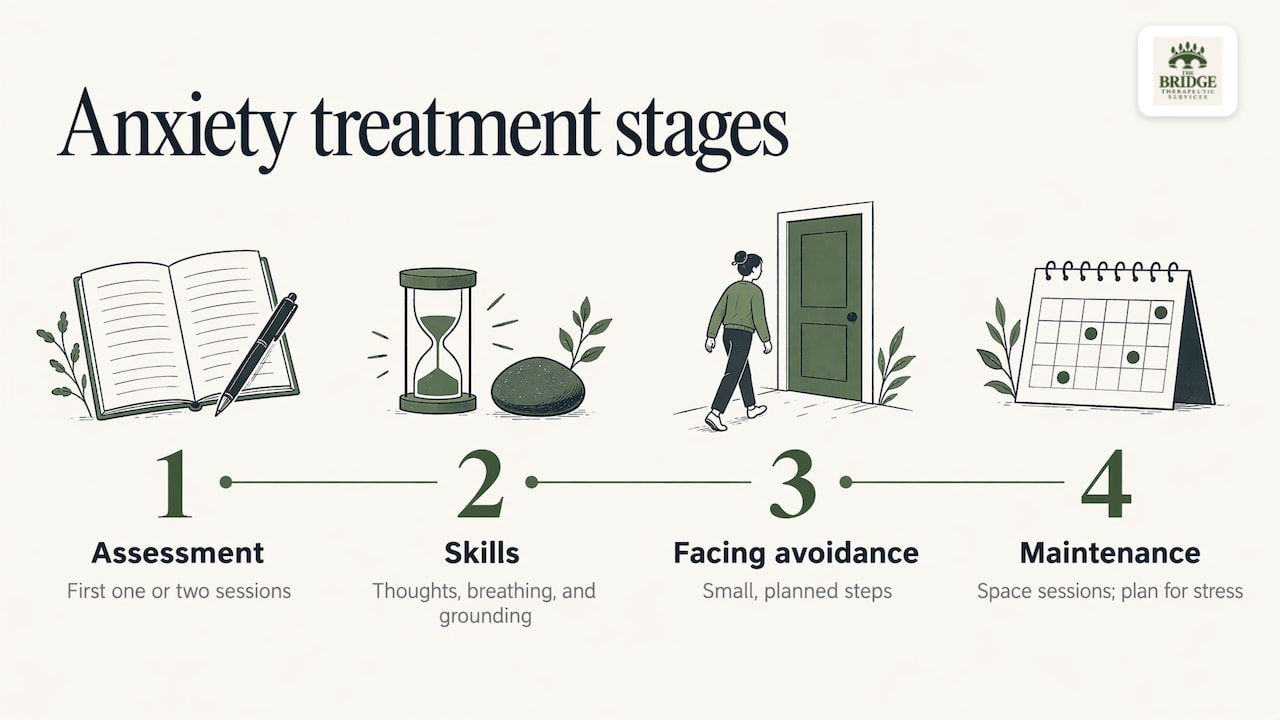
Assessment. The first one or two sessions focus on your story: when the anxiety started, what it feels like, what you have tried, what your days look like, and what you want to be different.
Skills. CBT-style work teaches you to notice the thoughts that escalate worry and test them against reality. You also learn practical regulation tools, such as paced breathing and grounding, so your body can settle during a spike.
Facing what you avoid. Avoidance feels like relief but feeds anxiety over time. Your therapist helps you approach feared situations in small, planned steps.
Maintenance. As symptoms ease, sessions space out and you build a plan for stressful seasons.
The Anxiety and Depression Association of America lists CBT as one evidence-based treatment that some therapists provide and advises confirming the clinician’s actual training and approach. So ask directly: “What methods do you use for anxiety, and how were you trained in them?”
If you want to know what a first appointment looks like at our practice, we explain it in What Is Anxiety Therapy? and in our guide to Christian anxiety counseling: what to expect.
Anxiety looks different at different ages
The person who needs help is not always the one who makes the call.
Adults often describe work stress, health fears, sleep trouble or a constant sense of being on edge. Individual counseling gives you a private place to work on these patterns.
Couples may find that one partner’s anxiety shows up as control, withdrawal or conflict. Working on it together keeps the relationship from becoming the place where anxiety plays out. See marriage and couples counseling.
Children and teens rarely say “I feel anxious.” You may see stomachaches, school refusal, meltdowns, perfectionism or irritability. Child and teen counseling helps them name what they feel and gives parents tools to respond.
Parents carry their own worry. Parenting support can help you stay steady when your child is struggling, and family counseling brings everyone into the same conversation.
If attention and focus problems seem tangled up with worry, ADHD counseling is another place to start, since the two often show up together in daily life.
When faith is part of how you cope
For many Texans, prayer, church and Scripture are central to how they make sense of fear. Some worry that a therapist will dismiss that, or that they must choose between “real” therapy and their faith. You do not have to.
Christian counseling integrates psychological principles with Christian values. At The Bridge Therapeutic Services, our approach combines evidence-based methods tailored to each client with a faith-informed perspective, so you can talk about both the racing heart and the questions about trust, worth and God that often come with it. You can read more about our Christian counseling and what we believe.
What to ask before you book
A short consultation call is the best way to judge fit. The American Psychological Association says there is no single therapist who is right for everyone, and that trust and personal fit matter. It also suggests asking about these points:
- Fees and charges for missed sessions
- How long treatment is likely to last
- Session schedule and availability
- What happens in an emergency
- Whether treatment is individual, group, short-term or long-term
- Insurance coverage and limits on covered sessions
Add a few of your own:
- What do you do for anxiety specifically, and how will we know it is working?
- How do you handle faith in sessions, if that matters to me?
- Do you offer telehealth, in-person, or both?
- How involved will my spouse, child or parent be?
Pay attention to how you feel on the call. Do you feel heard? Did the therapist explain things in plain language? Many people also find it steadying to pair therapy with their own spiritual practices, such as the traditional novena to St. Dymphna, patron saint of anxiety. Those practices complement the skills you build in sessions.
Paying for therapy
Cost is a real barrier, and there is no single Texas price to quote, because fees depend on the clinician, the length of the session and your coverage. The practical steps are the same everywhere: call your insurer, ask whether outpatient mental health visits are covered, ask about copays, deductibles and any cap on sessions, and confirm whether the therapist is in your network.
The Bridge Therapeutic Services accepts private pay or health insurance, and we do not publish session prices on our site, so ask us about rates and coverage when you reach out. Counseling sessions are billed to you or reimbursed through your health insurance.
If cost is the main obstacle, Texas Health and Human Services notes that the state contracts with 37 local mental health authorities and two local behavioral health authorities for community mental health services. They are worth knowing about when you need public options.
We believe anxiety care should be whole-person
Anxiety is rarely just a thinking problem. It lives in the body, in relationships, in sleep, and for many people in their faith. When someone sits across from me and says they cannot stop worrying, I want them to hear first that they are not broken.
At The Bridge Therapeutic Services, we pair evidence-based psychological methods with a Christian perspective, and we tailor the work to the person in front of us. For one client that means learning to slow a panic response. For another it means untangling a fear that God is displeased with them. For a family, it may mean learning to talk to one another without the anxiety running the conversation.
We also believe that healing travels. A calmer parent changes a home. A couple who understand each other’s fears argue differently. That is why we see individuals, couples, families and children, and why we offer telehealth for people across Texas. You deserve care that sees the whole of you.
Jennifer Wood, LPC-S
Start with a conversation
If you are ready to talk to someone, The Bridge Therapeutic Services offers counseling for anxiety in Tyler and by telehealth across Texas, for individuals, couples, families, children and teens. Our individual counseling page is a good place to begin, and you can reach us from our home page.

We will help you find the right clinician and format. You can bring the questions from the checklist above.
If you are in crisis or thinking about harming yourself, call or text 988, the Suicide and Crisis Lifeline, or call 911 in an emergency.
FAQ
How do I know if I need an anxiety therapist?
Consider it when worry is hard to control, lasts for weeks, or starts to interfere with sleep, work, school, relationships or things you used to enjoy. You do not need a crisis to begin. A first appointment is also a way to find out whether what you are feeling is common stress or something that deserves ongoing support.
Can I see a therapist by telehealth if I live outside Tyler?
Yes. Texas licensing is based on where the client is physically located, so your therapist needs to be authorized to practice in Texas, and the session should run on a secure, HIPAA-compliant platform. The Bridge Therapeutic Services offers telehealth counseling across Texas.
How long does anxiety therapy take?
It varies with the person and the kind of anxiety. Some people notice progress in a matter of weeks, while others work for longer on deeper patterns. Ask your therapist at the start how they expect treatment to go and how you will measure progress together.
Can my child or teen see an anxiety counselor?
Yes. Children and teens often show anxiety through physical complaints, avoidance or irritability, and counseling can help them name and manage it. Parents are usually involved. Learn more about child and teen counseling in Tyler.
Does Christian counseling use real therapy methods?
At The Bridge Therapeutic Services, yes. Our approach integrates evidence-based psychological methods with a Christian perspective, tailored to each client, so you do not have to set your faith aside to get professional care.
The Bridge Therapeutic Services
Talk About Anxiety Counseling
Call to discuss counseling support grounded in evidence-based methods and Christian values for individuals, couples, families, and children.
Sources
- Online Search/Verify a License, Texas Behavioral Health Executive Council
- Virtual Practice and Mobility FAQs, Texas Behavioral Health Executive Council
- Adult Mental Health, Texas Health and Human Services
- Choosing the Right Mental Health Provider for Anxiety, Anxiety and Depression Association of America
- How Do I Find a Good Therapist?, American Psychological Association