

Insurance generally pays for counseling because of who provides it and why you need it, not because of the faith of the session. If your counselor is a licensed mental health professional, your plan covers a diagnosed need, and the counselor is in your network, a Christian approach does not change how the claim is handled. At The Bridge Therapeutic Services in Tyler, Texas, sessions are billed either as private pay or through health insurance, so the practical question is how to confirm your own plan’s benefits before you book. This guide walks you through that.
The Bridge Therapeutic Services
Explore Faith-Informed Counseling
The Bridge offers counseling for individuals, couples, families, and children, with private pay or health insurance billing.
TL;DR
- Coverage depends on the counselor’s licensure, your plan’s behavioral health benefits and whether the counselor is in your network, not on whether faith is part of the conversation.
- Pastoral or ministry-only counseling is a different thing from licensed therapy. Medicare Part B covers certain outpatient mental health services, including family counseling when its main purpose is to help with your treatment. Ask Medicare or your provider whether your specific service is covered. Since January 1, 2024, eligible Medicare-enrolled marriage and family therapists can bill Medicare independently for the diagnosis and treatment of mental illness.
- Call the number on your insurance card and ask about copays, deductibles, session limits, referrals and telehealth before your first visit.
- If a counselor is out of network, you may pay up front and submit a receipt called a superbill for partial reimbursement.
- The Bridge Therapeutic Services bills private pay or health insurance and offers in-person sessions in Tyler and telehealth across Texas.
Table of Contents
- Does health insurance cover Christian counseling?
- Licensed therapy versus pastoral or biblical counseling
- What mental health parity means for you
- How to find a Christian counselor in your network
- Questions to ask your insurer and your counselor
- What you may owe: copays, deductibles and coinsurance
- When a counselor is out of network
- Telehealth counseling and insurance
- Care at The Bridge Therapeutic Services
- Our perspective on faith and coverage
- FAQ
- Sources
Does health insurance cover Christian counseling?
Three things decide it.
- The provider. Plans pay licensed professionals, such as licensed professional counselors, clinical social workers, marriage and family therapists and psychologists. A licensed therapist who also holds Christian beliefs and invites faith into the work is still a licensed therapist.
- The reason for the visit. Plans generally pay for services that are medically or psychologically necessary for a mental health condition, such as anxiety, depression, trauma or grief that has become a clinical problem. The TRICARE manual, for example, pays only for services necessary for a mental disorder.
- The network. A network is a group of providers that have an agreement with your health plan. Plans may call these providers “preferred” or “participating,” and using one outside the network may cost you more or not be covered at all.
Notice what is not on the list: the word “Christian.” Insurers do not usually pay for a service because it is faith-based, and they do not usually refuse it for that reason either. They look at the credential, the diagnosis and the plan.
Licensed therapy versus pastoral or biblical counseling
People searching for Christian counseling often mean one of two different services, and insurance treats them differently.
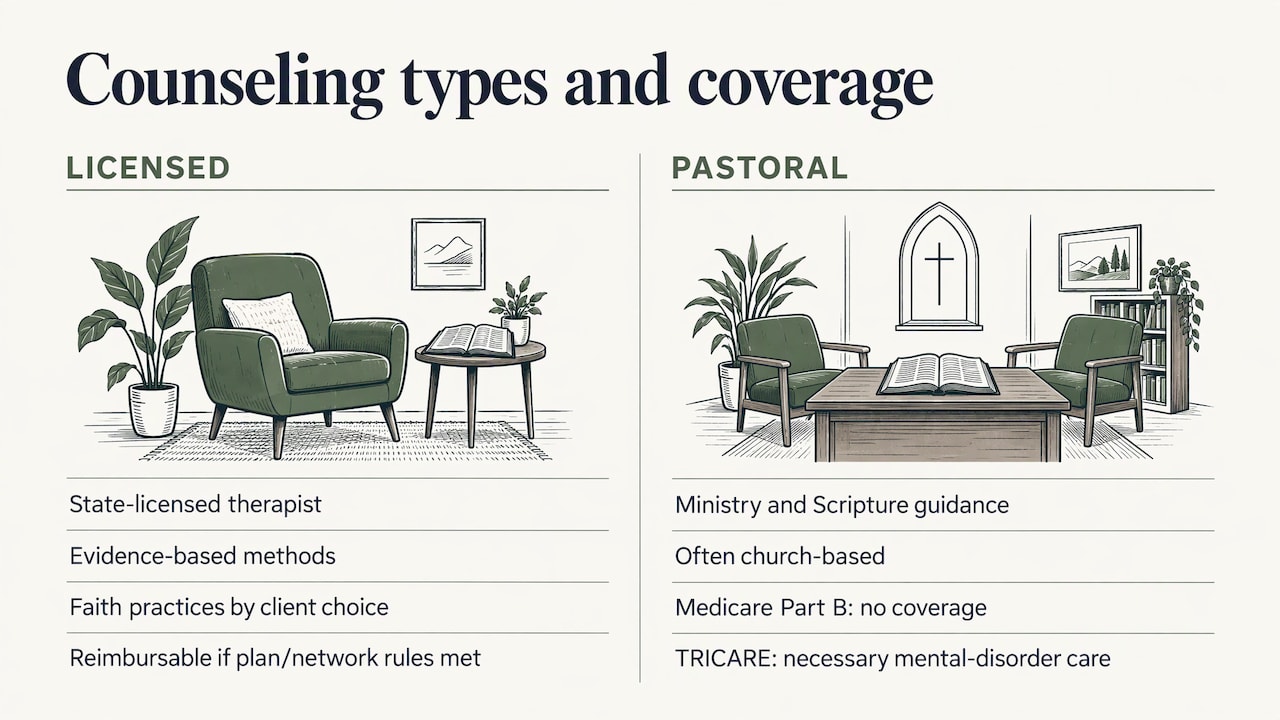
Licensed counseling that integrates faith. A state-licensed therapist uses established psychological methods and also welcomes prayer, Scripture or spiritual questions when the client wants them. This is the type of care that health plans are built to reimburse, provided the plan and network rules are met.
Pastoral or biblical counseling. This is guidance grounded in ministry and Scripture, often offered through churches. It is valuable for many people, but it is a separate category. Medicare Part B covers certain outpatient mental health services, including family counseling when its main purpose is to help with your treatment. Ask Medicare or your provider whether your specific service is covered. See Medicare’s outpatient mental health coverage.
Since January 1, 2024, eligible Medicare-enrolled marriage and family therapists can bill Medicare independently for the diagnosis and treatment of mental illness. CMS explains the eligibility and enrollment requirements. These are Medicare’s coverage and billing rules, not confirmation that The Bridge or any particular therapist accepts Medicare.
The TRICARE manual shows the picture is not identical across programs: it lists pastoral counselors among qualified mental health providers, but only for services that are necessary for a mental disorder. Rules vary by program, so the plan you hold is the authority.
At The Bridge Therapeutic Services, our Christian counseling pairs evidence-based psychological care with a Christian perspective, so you do not have to choose between clinical care and a faith-informed one.
What mental health parity means for you
The Mental Health Parity and Addiction Equity Act (MHPAEA) may apply to many private health plans and certain Medicaid and CHIP plans. Where it applies, mental health and substance use disorder benefits must meet parity requirements relative to medical and surgical benefits. The U.S. Department of Labor explains the protections for cost sharing and treatment limits. Federal MHPAEA parity rules do not apply to Medicare; Medicare has its own coverage rules.
For plans subject to MHPAEA, federal guidance gives two examples of what a plan may not do:
- Limit mental health care to 20 outpatient visits a year when no such limit applies to medical and surgical care.
- Charge a separate $250 mental health deductible on top of a $250 medical deductible in the same category.
Both examples come from the federal self-compliance tool for MHPAEA and ERISA requirements. If you think your plan is applying a limit like these, ask the plan to explain it in writing.
How to find a Christian counselor in your network
Directories are a starting point, not a guarantee. A reliable routine looks like this:
- Call your plan or check its directory. The Centers for Medicare & Medicaid Services (CMS) tells members to call the health plan or state Medicaid or CHIP office, or use the plan’s website or member handbook, and to confirm that the information is current.
- Narrow by what you need. Look for licensed counselors who treat your concern, whether that is anxiety, grief, trauma, parenting or marriage.
- Confirm with the counselor’s office. When you make the appointment, give your Member ID and group number from your card and ask whether the office accepts your plan. Networks change, so the CMS guidance says to re-check at scheduling.
- Keep a note of who you spoke with and when. If a bill surprises you later, the date and name help.
Directories are often wrong, which is why step 3 matters. A New York Attorney General report notes that the No Surprises Act, effective January 1, 2022, requires private plans to keep accurate online directories, verify them at least every 90 days and apply in-network cost sharing when a provider was wrongly listed as in network. That is a protection worth knowing, though it is best to avoid the problem by confirming before the first session.
If you are in Texas, the quickest check is to contact us. We bill private pay or health insurance, and our team can tell you how your coverage would apply to individual counseling, couples work or care for a child.
Questions to ask your insurer and your counselor
Counseling falls under “behavioral health,” which can have its own rules, reimbursement and procedures separate from your medical benefits, as Northwestern University’s counseling center explains. Call the number on the back of your insurance card and ask:
- Does my plan cover outpatient counseling, and at what rate?
- What is my copay or coinsurance per session, and how much of my deductible is left?
- How many visits are covered per year?
- Do I need a referral from a doctor, or prior authorization?
- Which providers are preferred or in network near me?
- Is telehealth covered, and does it cost the same as an office visit?
- Are free case managers available? SAMHSA says this is worth asking.
When you contact the counselor’s office, the CMS roadmap suggests asking whether the provider is accepting new patients, accepts your insurance, what you may pay out of pocket, what conditions they treat and whether telehealth is offered.
For a child or teen, call the plan using the policyholder’s information and ask whether dependents have the same behavioral health benefits. For couples or family counseling, ask how the plan handles sessions where the diagnosis belongs to one person, because plans often need a diagnosis for one member of the family.
The Bridge Therapeutic Services
Explore Counseling in Person
At The Bridge, experienced therapists offer faith-informed counseling for individuals, couples, families, and children, with evidence-based methods tailored to each client.
The Bridge Therapeutic Services
3800 Paluxy Drive, Suite 240, Building 2, Tyler, TX 75703
What you may owe: copays, deductibles and coinsurance
Insurance does not mean free. What you pay per session depends on your plan design:
| Cost type | What it means | When you pay it |
|---|---|---|
| Copay | A flat fee per visit | At each session |
| Deductible | An amount you pay before the plan starts sharing costs | Early in the plan year |
| Coinsurance | A percentage of the session cost after the deductible | At each session or on a later bill |
| Out-of-pocket maximum | The most you pay in a plan year for covered care | Until the limit is reached |
To show how widely this varies, the New York State of Health’s 2026 standard plan chart lists office-visit copays such as $15 for Platinum plans, $30 for the first outpatient mental health visit on Silver plans and $50 for the first three visits on Bronze plans. The chart also says mental health cost sharing may be lower than listed to comply with parity. Those are New York examples, not Texas figures, and your own plan documents set your amount.
SAMHSA notes that Medicare covers most treatment costs in most cases, while Medicaid and CHIP cover some mental health treatment, with amounts and services depending on the state. For Texas families on Medicaid or CHIP, the state program’s own member services line can confirm what applies.
For a look at how pricing works in our state, see our guide on how much therapy costs in Texas.
When a counselor is out of network
Some plans include out-of-network benefits. In that case, Northwestern University explains, members typically pay in full at each visit, ask the provider for a paid invoice called a superbill, send it to the insurer’s claims department and receive a reimbursement for part of the session cost. Out-of-network benefits usually come with higher deductibles and higher copays or coinsurance.
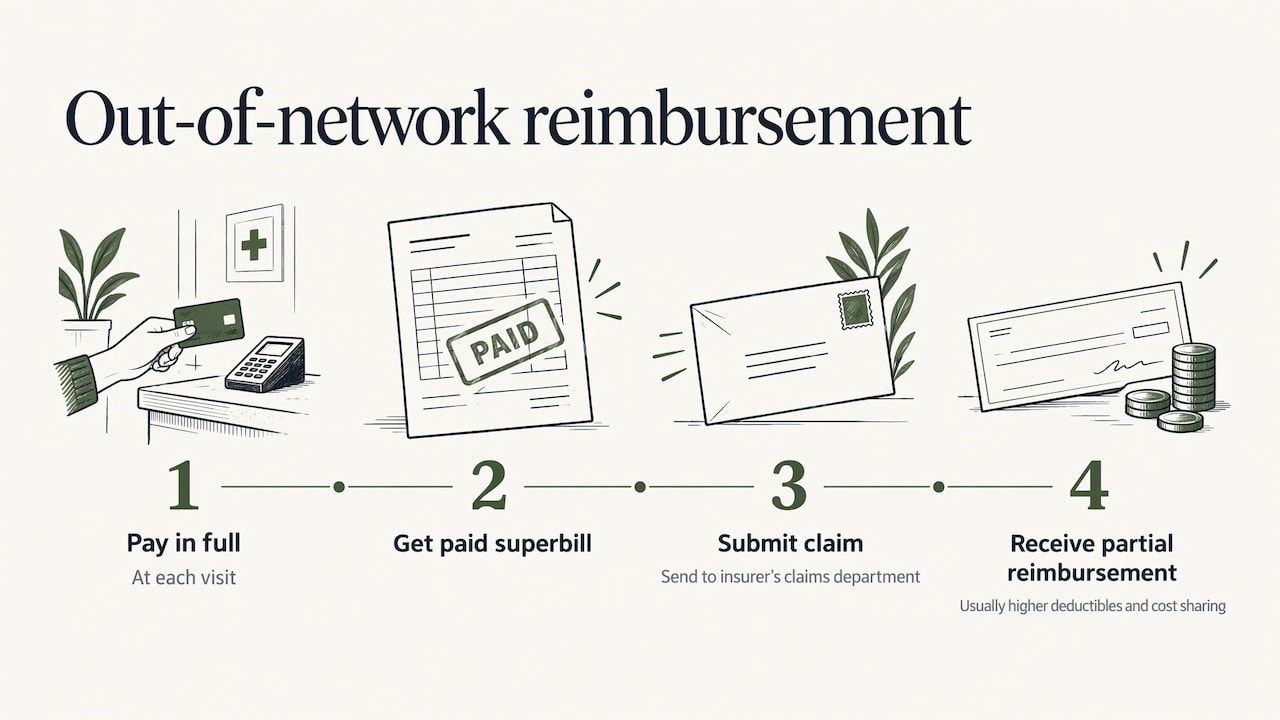
Before choosing this route, ask your plan three things: whether you have out-of-network mental health benefits, what the reimbursement percentage is, and how long you have to submit claims.
Telehealth counseling and insurance
Many families in Texas use video sessions because of distance, schedules or a child’s comfort at home. Coverage rules for telehealth differ by plan, so ask whether your plan covers video counseling and whether the cost matches an office visit. Billing details also matter on the provider side: claims must be coded correctly, and guidance on telehealth place of service billing explains why a wrong code can lead to denied claims.
The Bridge Therapeutic Services offers online therapy and telehealth counseling across Texas, alongside in-person sessions in Tyler.
Care at The Bridge Therapeutic Services
The Bridge Therapeutic Services provides Christian counseling in Tyler, Texas, for individuals, couples, families and children. Our team works with anxiety, depression, trauma, grief, ADHD, life transitions, relationship challenges and adoption or foster care issues, using evidence-based methods combined with a faith-informed approach. Sessions are paid privately or billed to health insurance, and you can start by reaching out through our Christian counseling page so we can talk through your coverage.

If the person who needs support is a child or teen, our child and teen counseling is a good place to begin. Couples can look at marriage and couples counseling, and parents can look at parenting support.
Our perspective on faith and coverage
Families often tell us they assumed they had to pick: either a licensed professional their insurance recognizes, or a counselor who shares their faith. You do not have to pick.
We believe good care starts with sound psychological practice. That means a careful assessment, evidence-based methods and a plan shaped around the person in the room. Faith is then woven in the way the client wants it, through prayer, Scripture, or simply being understood by someone who takes spiritual life seriously.
Paying for care should not be a second source of stress. We bill private pay or health insurance, and we would rather you ask about your coverage before your first session than guess. Bring your insurance card, your questions and whatever you are carrying. We will help you work out the next step, whether that is individual counseling, work with your spouse, help for your child or support for the whole family.
Jennifer Wood, LPC-S
FAQ
Do Christian counselors take insurance?
Many do, but it depends on the practice and the plan. Licensed Christian counselors can bill insurance like any other licensed therapist, while pastoral and ministry-based counselors often do not. The Bridge Therapeutic Services bills private pay or health insurance, and you can contact us to confirm how your plan works.
Will my insurer know the counseling is Christian?
Your insurer receives billing information such as the provider, date, service code and diagnosis, which relate to the clinical care. The faith-informed approach is part of how the counselor works with you, not a billing category.
How many counseling sessions does insurance cover?
It varies by plan. Some plans set a yearly visit limit, and where parity rules apply, a mental health limit cannot be more restrictive than limits on comparable medical and surgical benefits. Call the number on your card and ask how many visits are covered per year and whether any need prior authorization.
Does insurance cover couples or family counseling?
Coverage differs by plan and often depends on whether the sessions address a diagnosed condition for one family member. Medicare Part B covers certain outpatient mental health services, including family counseling when its main purpose is to help with your treatment. Ask Medicare or your provider whether your specific service is covered. Since January 1, 2024, eligible Medicare-enrolled marriage and family therapists can bill Medicare independently for the diagnosis and treatment of mental illness. See the Medicare coverage details and CMS provider billing requirements.
What if I cannot use insurance?
You can pay privately for sessions. If your plan has out-of-network benefits, you may be able to submit a superbill for partial reimbursement. Our guide to therapy costs in Texas explains what to expect.
The Bridge Therapeutic Services
Ask About Counseling Coverage
Call The Bridge to discuss counseling options, including private pay or health insurance billing, and whether its services fit your needs.
Sources
- Understanding Your Mental Health and Substance Use Disorder Benefits, U.S. Department of Labor
- Mental Health Treatment: What Does Health Insurance Cover? SAMHSA
- Self-Compliance Tool for MHPAEA and ERISA Requirements
- Roadmap to Behavioral Health, CMS
- Inaccurate and inadequate: Health plan’s mental health provider network directories, New York State Attorney General
- Standard Plan Cost-Sharing Chart, New York State of Health
- Using Your Health Insurance for Mental Health Care, Northwestern University
- TRICARE Policy Manual, Military Health System
- Marriage and Family Therapists & Mental Health Counselors, CMS
- Mental Health Care (Outpatient), Medicare.gov