
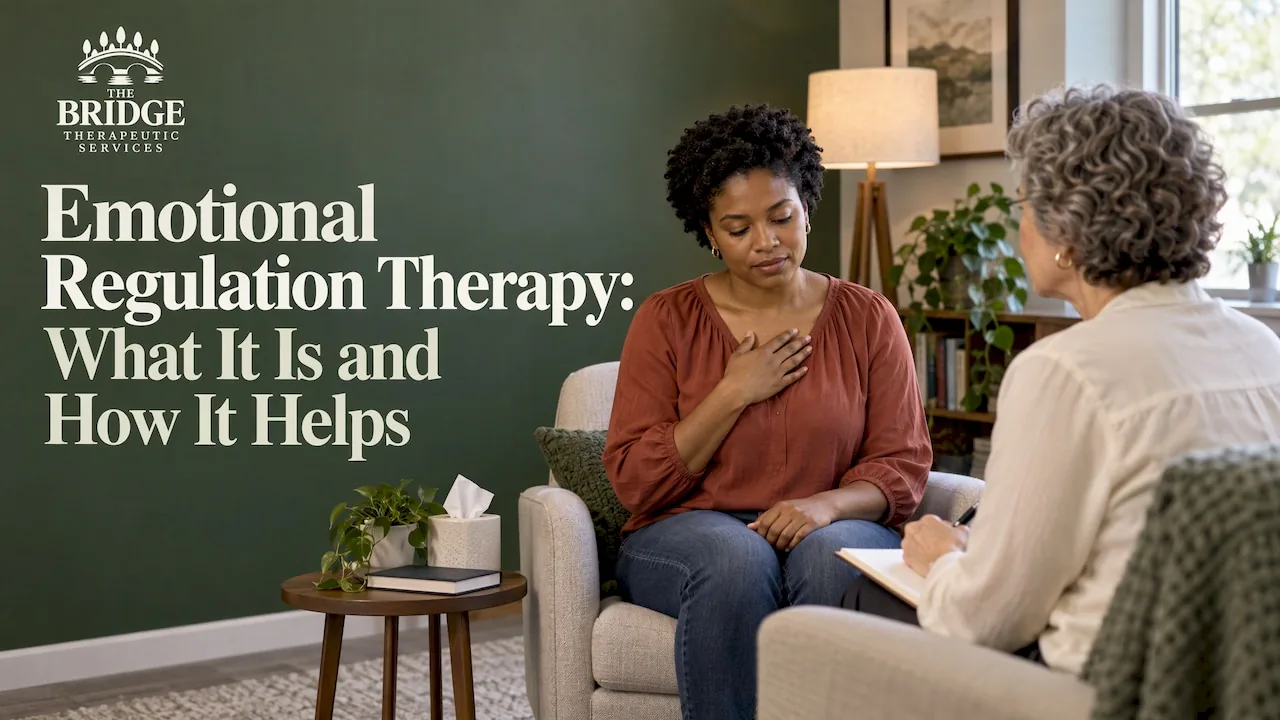
Emotional regulation therapy helps you notice what you feel, understand where it comes from, and respond in a way that fits the moment instead of reacting on impulse. It is skills-based, so you leave sessions with things to practice, and it works best with a counselor who can coach you through the hard moments and involve your spouse or your child’s parents when the problem lives in the relationship. At The Bridge Therapeutic Services in Tyler, Texas, individuals, couples, families, children and teens can work on these skills in person or by telehealth anywhere in Texas, with evidence-based methods that respect their faith.
The Bridge Therapeutic Services
Build Skills for Emotional Regulation
The Bridge offers evidence-based, faith-informed counseling for individuals, couples, families, children and teens facing emotional challenges.
VisitTL;DR
- Emotional regulation is a set of learned skills, not a personality trait, so it can be taught and strengthened with practice.
- Therapy does not erase hard feelings. It helps you respond to them rather than be run by them.
- Research on emotion regulation methods in therapy has found large average improvements from the start to the end of treatment.
- For teens, parent involvement matters: the strongest-evidence approaches teach caregivers specific ways to respond too.
- Call 911 for immediate physical danger or a medical emergency. For suicide or mental health crisis support when emergency response is not needed, call or text 988. A crisis may need immediate support even when there is no physical danger.
Table of Contents
- What emotional regulation actually means
- How dysregulation shows up in daily life
- What emotional regulation therapy involves
- Teens and emotional regulation
- Couples and families: regulating together
- When to get help
- Why faith-informed care can fit
- Our perspective
- Getting started with us
- FAQ
- Sources
What emotional regulation actually means
The American Psychiatric Association describes emotional regulation as the ability to notice, understand and respond to emotions in ways that fit the situation and support your well-being. It does not mean staying calm or positive all the time. A regulated response might be pausing before you reply to a hurtful comment, naming what you feel, asking someone for support, or choosing a coping strategy before things escalate.
Emotional dysregulation is the opposite pattern: feelings that run hotter, longer or faster than the situation calls for, and that are hard to bring back down. It can look like explosive anger, crying that will not stop, shutting down, or numbing out. The same source notes that biology, life experiences, chronic stress, poor sleep, substance use and environment can all contribute.
The most useful idea for a newcomer comes from Yale School of Medicine: emotion regulation is a set of learned, intentional skills that take modeling, instruction and practice. It has two sides, self-regulation (what you do on your own) and co-regulation (how people calm each other). And it does not remove painful feelings. It teaches you to respond thoughtfully rather than react.
How dysregulation shows up in daily life
Most people do not walk in saying “I have trouble regulating emotions.” They say things like:
- “I snap at my kids and then feel awful.”
- “My husband and I fight over small things and can’t stop.”
- “Anxiety hits and I can’t think straight.”
- “My teenager goes from fine to furious in seconds.”
- “I go quiet and numb whenever there’s conflict.”
Yale’s review of the research lists the cost of leaning on habits like rumination, avoidance, suppression, yelling and aggression: higher risk of anxiety, depression and substance misuse, poorer memory and decision-making under suppression, strained relationships, disrupted sleep, and weaker performance at school and work. Sleep is a common thread. When stress keeps you wired at night, you wake up with less capacity to handle the next day, and the cycle feeds itself. This overview of stress-related insomnia explains how that loop works.
None of this is a character flaw. It is a pattern, and patterns can change.
What emotional regulation therapy involves
The phrase covers a family of approaches rather than a single script. What they share is that you learn to catch emotion early, tolerate it, and choose what to do next.
One formal model, Emotion Regulation Therapy (ERT), has been described in the research literature as a 16-week program in two phases: first building mindful emotion regulation skills, then taking actions that line up with your personal values and sense of meaning. Its authors describe teaching people to act on emotional cues as they first arise, instead of reacting after things have already boiled over. Many counselors draw on similar ideas without following a fixed manual, shaping the work to the person in the room.
What does the evidence say about whether this kind of work helps? A 2023 meta-analysis of 26 studies found a large average improvement in emotion regulation from the start to the end of treatment (g = 0.82), with both therapist-led emotional work and structured skills training linked to gains. The authors also stress that good therapy is not only about coping with emotions after they happen but about helping people experience more adaptive emotions in their place, and that a counselor has to consider the client’s cultural background when judging what counts as healthy expression.
Skills you are likely to practice
Exactly what you learn depends on your counselor and your goals, but these are the building blocks you will meet most often:
- Naming the feeling. Putting a precise word on an emotion (frustrated, ashamed, lonely) takes some of its charge away and gives you something to work with.
- Calming the body first. Slow breathing and grounding lower physical arousal so you can think. The NIH’s Emotional Wellness Toolkit points to breathing exercises, mindfulness, and movement such as yoga or tai chi.
- Looking at the situation differently. Asking “what else could be true here?” before reacting.
- Lowering the load. The NIH toolkit also suggests sorting what must get done from what can wait, and saying no to new tasks when you are overwhelmed.
- Asking for support. Reaching out early, before a rough day becomes a crisis.
- Acting on your values. Choosing the next step based on who you want to be, not on the urge of the moment.
A worked example: Maria, a mother of two, notices her chest tighten when the kids argue at dinner. In session she learns to label the feeling (overwhelmed, not “angry at them”), take three slow breaths with a long exhale, and say one sentence she has rehearsed: “I need a minute, then we’ll sort this out.” The first weeks, she remembers the plan only afterward. Over time the pause comes earlier. That gradual shift, with a counselor adjusting the plan each week, is what therapy adds to reading about skills on your own.
The Bridge Therapeutic Services
Explore Support for Emotional Growth
Meet with therapists who use evidence-based methods and a faith-informed approach to support individuals, couples, families, children and teens.
The Bridge Therapeutic Services
3800 Paluxy Drive, Suite 240, Building 2, Tyler, TX 75703
Teens and emotional regulation
Teen years combine big feelings, school pressure, social stress and a still-developing brain, so outbursts and withdrawal are common. The question is when they stop being typical and start getting in the way.
Indian Health Service training material describes dysregulation in young people as emotions, behaviors or energy that do not match the setting: yelling, aggression, oppositional behavior, fidgeting, withdrawal, spacing out or shutting down. The same material suggests that defiance can be an attempt to cope with expected rejection or a reaction triggered by past experiences, which is why punishment alone often fails.
The American Academy of Child and Adolescent Psychiatry (AACAP) adds that similar outbursts can have different roots, such as ADHD-related frustration, an anxiety disorder, or chronic irritability, and that the right treatment can differ accordingly. That is why a proper assessment comes before a plan. Our team also offers ADHD counseling and depression counseling when those are part of the picture.
What helps teens most
AACAP says the strongest-evidence first-line approaches for children’s emotional outbursts are parent management training, which teaches caregivers how to respond to outbursts and reinforce calmer behavior, and cognitive behavioral therapy (CBT), used alone or together. Medication, it notes, is typically an add-on layered over ongoing therapy rather than a first step, and that decision belongs to a physician.
In practice, for a teen, that means:
- Daily check-ins and a growing vocabulary for feelings, so emotions have names before they become behavior.
- Matching the response to the reaction. The IHS material suggests reflective statements for fight responses, and breathing and grounding for flight or freeze.
- Skills the teen chooses. A fifteen-year-old will use a technique she helped pick; she will ignore one handed down.
- Parents learning alongside. When the adults in a home practice staying steady, the whole household becomes less reactive.
Our child and teen counseling and parenting support are built for exactly this pairing: help for the young person and guidance for the parents who live with the day-to-day.
Couples and families: regulating together
Emotions are contagious inside a home. When one partner escalates, the other often does too, or withdraws, and the argument becomes about the pattern rather than the original topic. This is the co-regulation side Yale describes: people calm, or inflame, one another.
In couples counseling, regulation work typically means slowing down heated exchanges, learning to say what you feel instead of attacking, and hearing your spouse’s side without defending yourself. In family counseling, it means building a shared language for feelings, agreeing on how to take a break, and repairing after a blowup. Our marriage and couples counseling and family counseling sessions give you a place to practice these moves with a counselor present, which is hard to replicate at home in the heat of an argument. Couples preparing for marriage can start early with premarital counseling.
When to get help
Consider scheduling counseling if strong emotions regularly damage your relationships, sleep, work or school, if you rely on alcohol or drugs to cope, or if you feel unable to manage on your own. The NIH toolkit lists those same signs as reasons to talk with a mental health professional.
Some situations are urgent. Call 911 for immediate physical danger or a medical emergency, such as a suicide attempt in progress, an overdose, or a serious injury. For suicide or mental health crisis support when emergency response is not needed, call or text 988. A crisis may need immediate support even when there is no physical danger. SAMHSA explains the difference between 988 and 911. The Crisis Text Line is reached by texting HOME to 741741.
Why faith-informed care can fit
For many people in East Texas, faith is part of how they make sense of pain, forgiveness, marriage and parenting. The 2023 review above notes that culture shapes what people consider healthy emotional expression, so it matters that your counselor respects your worldview. At The Bridge Therapeutic Services, we combine evidence-based psychological methods with a Christian perspective, so practical tools and spiritual understanding work together. You can read more about Christian counseling with us.
If your emotions are tied to trauma, anxiety or panic, we also offer EMDR therapy, and you can read how EMDR can be integrated with Christian counseling.
Our perspective
The people who come to us rarely say they want better emotional regulation. They say they are tired of the yelling, the shutdown, the dread before a conversation. What we tell them first is that this is learnable, and that it is learned best with another person alongside you.
Our approach at The Bridge Therapeutic Services is to pair evidence-based psychological care with a Christian perspective. Skills such as naming a feeling, calming the body and pausing before responding are practical, and they sit comfortably beside faith: patience, grace and self-control are things many of our clients already want to grow in. We tailor the work to the person, whether that is an adult managing anxiety, a couple trying to fight fairly, or a teen whose parents want to understand what is underneath the outbursts.
We also believe the family matters. Children and teens change faster when the adults around them are supported too, which is why we offer individual, couple, family and parenting support under one roof.
Jennifer Wood, LPC-S
Getting started with us
The Bridge Therapeutic Services provides counseling in Tyler, TX for individuals, couples, families, children and teens, and telehealth counseling across Texas. Sessions can be paid privately or through health insurance. If you are not sure which service fits, start with individual counseling for yourself or reach out through our main site and we will help you find the right counselor.

Telehealth works well for busy parents and for teens who are more at ease at home. See our page on online therapy across Texas for details.
FAQ
What is emotional dysregulation?
It is a pattern of emotional reactions that are stronger, longer or harder to calm than the situation warrants. It can show up as anger, tears, panic or shutting down. It is common, it has many causes, and it responds to learning new skills.
How long does emotional regulation therapy take?
It varies by person and by goal. One formal model, Emotion Regulation Therapy, is described in research as 16 weekly sessions, but counseling can be shorter or longer depending on your needs. Your counselor will talk through a timeline with you at the start.
How can I manage overwhelming emotions right now?
Slow your breathing with a long exhale, name the emotion in one word, and step away from the situation if you can. The NIH also suggests reducing your to-do list when you are overloaded. If you feel unable to cope or are thinking of suicide, call or text 988.
How can I help my teenager who struggles with emotions?
Stay calm, name the feeling you see, and check in daily when things are quiet rather than in the middle of a conflict. Learning specific ways to respond to outbursts is one of the best-supported steps for parents, and a counselor can coach you through it.
Do you offer counseling for emotional regulation online?
Yes. The Bridge Therapeutic Services offers telehealth counseling for clients across Texas, as well as in-person sessions in Tyler.
The Bridge Therapeutic Services
Talk About Emotional Support
Call to discuss counseling support for emotional challenges, with care tailored to individuals, couples, families, children and teens.
Sources
- APA: When Emotions Feel Overwhelming
- Yale School of Medicine: Emotion Regulation is the Linchpin for Mental Health
- Emotion Regulation Therapy: A Mechanism-Targeted Treatment (PMC)
- Enhancing emotion regulation: systematic review and meta-analysis (2023)
- NIH Emotional Wellness Toolkit
- AACAP Emotion Dysregulation Resource Center
- Indian Health Service: Simple Strategies for Intervening with Traumatized and Dysregulated Youth
- Stress-Related Insomnia: Why You Can’t Sleep and What Helps