
Therapy for emotional abuse works best when it starts with your safety, goes at your pace, and treats what happened to you as real harm, not a communication problem. For many people that means individual counseling with a licensed therapist trained in trauma. At The Bridge Therapeutic Services in Tyler, Texas, we offer individual counseling in person and by telehealth across Texas, with a Christian perspective for those who want their faith included.
Emotional abuse leaves no bruises, so it is easy to doubt yourself. This guide explains the signs, the therapies with the best research behind them, when couples counseling is and is not safe, and how to find confidential help if the abuse is still happening.
The Bridge Therapeutic Services
thebridgetherapy.com
Find Support After Emotional Abuse
The Bridge offers individual counseling in person and by telehealth, with a Christian perspective for those who want faith included.
VisitTL;DR
- Emotional abuse is a pattern of control, humiliation, threats and isolation. It can cause depression, anxiety and trauma symptoms even with no physical violence.
- No single therapy is the gold standard, but trauma-focused treatments such as CPT, prolonged exposure and EMDR are well supported, and results improve when care is tailored to abuse, delivered one-on-one and given enough time.
- Couples counseling is not recommended when one partner uses abuse to control the other. Individual sessions are the safer first step.
- If the abuse is ongoing, a confidential advocate can help you plan for safety before or alongside therapy.
- Recovery is usually gradual. A therapist who builds trust first and does not rush into the hardest memories is a good sign.
Table of Contents
- What counts as emotional abuse
- How it affects your mind and body
- Which therapies help
- When couples counseling is and is not safe
- If the abuse is still happening
- Helping a child or teen
- Coping while you heal
- Where faith fits
- Perspective
- Taking the first step with us
- FAQ
- Sources
What counts as emotional abuse
Emotional abuse is a pattern of behavior meant to control, frighten or diminish another person. The Office on Women’s Health lists signs such as constant monitoring, demanding your passwords, extreme jealousy, keeping you from friends or family, controlling money, humiliating you in public, making threats and making decisions for you.
The National Domestic Violence Hotline adds red flags such as gaslighting (making you doubt your memory or perception), controlling your time and actions, love bombing followed by cruelty, and threats of suicide during arguments. In its 2020 data, 95% of people who contacted the hotline said they were experiencing emotional abuse.
Emotional abuse happens in marriages and dating relationships, but also between parents and children and within families. The therapy options below apply to adults, and a later section covers children and teens.
How it affects your mind and body
The same federal women’s health page says staying in an emotionally abusive relationship can lead to depression, anxiety and chronic pain. You may question your memory or feel ashamed, guilty, afraid, powerless or manipulated.
These are not signs that you are weak or oversensitive. The National Center on Domestic Violence, Trauma and Mental Health describes an approach that treats symptoms like hypervigilance as survival responses to ongoing threat rather than as defects. A good therapist starts from that view.
The effects can also last after the relationship ends. People often describe flinching at a certain tone of voice, rehearsing what they say before they say it, or feeling responsible for other people’s moods. Those patterns are learned under pressure, and they can be unlearned with support.
Which therapies help
The U.S. Department of Veterans Affairs’ National Center for PTSD states that there is no gold-standard, one-size-fits-all psychotherapy for intimate partner violence. It does name three front-line trauma treatments that can treat PTSD from past abuse: Cognitive Processing Therapy (CPT), Prolonged Exposure (PE) and EMDR. It also describes short individual programs for women, such as 8 to 12 sessions for those no longer in an abusive relationship.
Here is what each approach does in plain terms:
| Approach | What it focuses on |
|---|---|
| Cognitive Processing Therapy (CPT) | Examining beliefs the abuse planted, such as “it was my fault” or “I can’t trust my judgment” |
| Prolonged Exposure (PE) | Gradually approaching memories and situations you have been avoiding, with support |
| EMDR | Processing distressing memories using guided eye movements or other bilateral stimulation |
| Cognitive behavioral therapy (CBT) | Spotting and correcting distorted thinking that fuels anxiety and depression |
| Mindfulness and expressive writing | Building self-awareness and lowering stress |
A 2025 systematic review in the Journal of Family Violence found that treatment programs for emotional abuse often combine CBT, mindfulness, motivational interviewing and expressive writing. In that review, CBT corrects cognitive distortions, mindfulness builds self-awareness that can reduce depression and anxiety, and expressive writing is associated with fewer PTSD symptoms, less perceived stress and less depression.
The National Center on Domestic Violence, Trauma and Mental Health notes that outcomes are significantly better when treatment is adapted for abuse survivors, delivered individually and given enough time. That is a good reason to look for a therapist who works with trauma and relational harm specifically, and to plan for more than a handful of sessions.
EMDR and exposure-based care
If memories of the abuse intrude on your days or nights, a trauma-focused method may fit. A comparison of EMDR and prolonged exposure explains how the two differ in pace and in how much you talk through events. At The Bridge Therapeutic Services we offer EMDR therapy in Tyler and trauma and PTSD counseling. If you are curious about what a session looks like, our guide to what to expect in EMDR sessions walks through it.
Safety and pacing come first
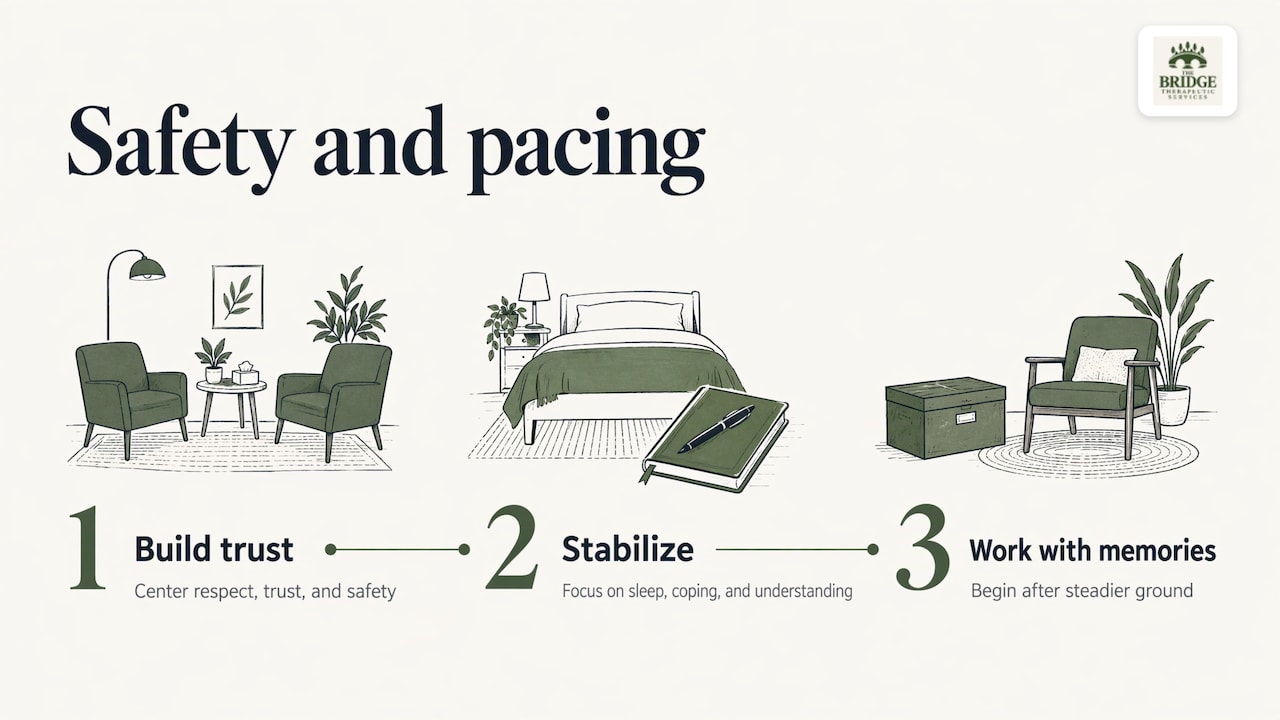
The American Psychiatric Association’s guide for treating women who have experienced partner violence recommends building the relationship on respect, trust and safety. It also cautions providers not to discuss trauma too quickly, because that can raise the risk of dissociation and feeling overwhelmed. It recommends Seeking Safety, an approach where safety is the overarching goal.
In practice, the early sessions may be about stabilizing: sleep, coping skills, and understanding what happened. The harder memory work comes after you have steadier ground.
When couples counseling is and is not safe
Many people begin with couples counseling before they realize the relationship is abusive. That is common, and it is worth understanding the risk.
An American Psychological Association journal article states that couples therapy is not recommended when one partner uses violence or abuse to control and dominate the other. In that situation, joint sessions can give the abusive partner more information, a chance to retaliate and a platform to manipulate. The article says couples work may be appropriate for situational conflict that is low-level, goes both ways and is not used for control, but only after each partner is carefully assessed separately and privately.
The same authors list situations where joint treatment is not appropriate: either partner does not feel safe, the two accounts of violence differ significantly, or either partner wants to end the relationship. A 2023 systematic review in the Journal of Counseling & Development reaches a similar conclusion: couples interventions may suit situational conflict but not power-and-control abuse.
What this means for you:
- If you are afraid of your partner’s reaction to something you say in a session, tell a counselor in an individual session first.
- If you feel controlled, humiliated or threatened at home, start with individual counseling so you can sort out what is happening in a private space.
- If you and your partner both want to repair the relationship and the conflict is mutual, not controlling, marriage and couples counseling can be a good fit once each of you has been assessed individually.
Never raise your concerns with a partner who may react dangerously by saying you are going to a counselor to talk about abuse. Go at the pace that keeps you safe.
The Bridge Therapeutic Services
Explore Support in Person
Meet with The Bridge’s therapists for individual counseling, with a Christian perspective available for those who want faith included.
The Bridge Therapeutic Services
3800 Paluxy Drive, Suite 240, Building 2, Tyler, TX 75703
If the abuse is still happening
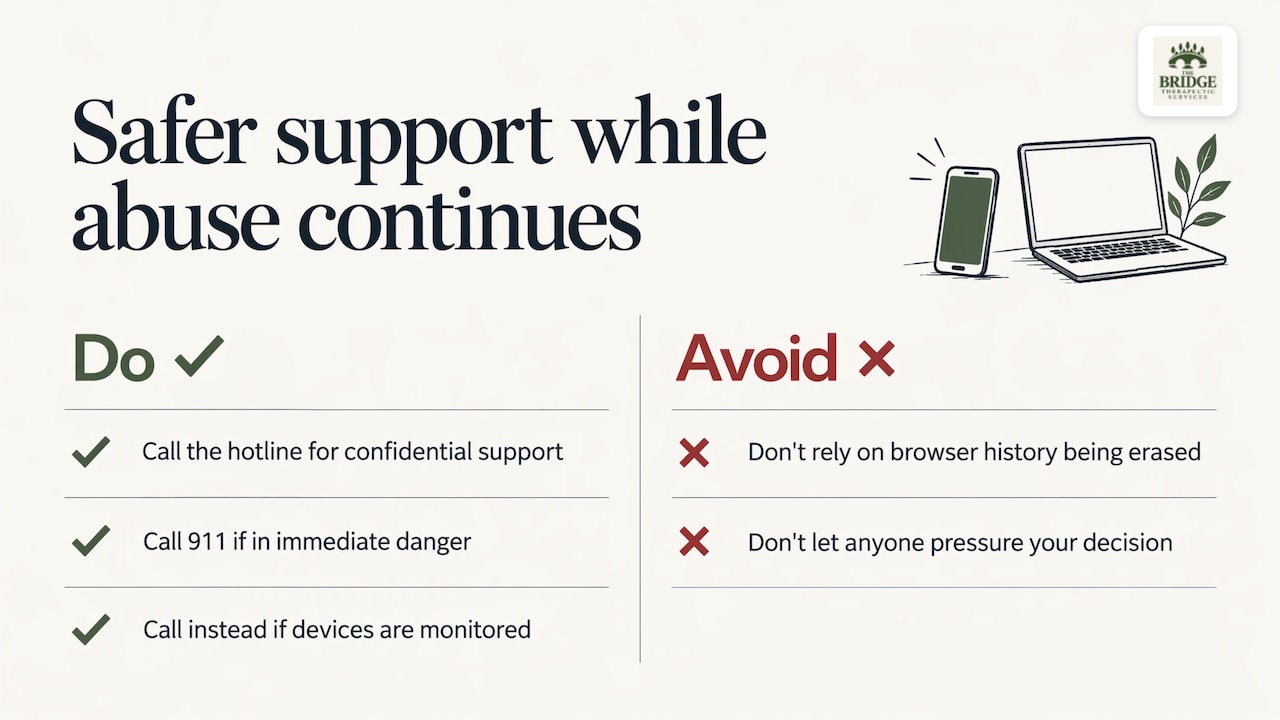
Therapy is possible while you are still in the relationship, but safety planning comes first. The National Domestic Violence Hotline offers free, confidential support 24 hours a day. You can call 1-800-799-7233, chat online, or text START to 88788. The hotline also warns that internet use can be monitored and cannot be erased completely, so if you think someone is watching your devices, call instead and clear your browser history after visiting.
If you are in immediate danger, call 911.
The National Center on Domestic Violence, Trauma and Mental Health points out that when abuse is ongoing, approaches that support the survivor’s own decisions suit better than approaches that push a person toward change. Leaving is a decision that is yours to make and time, and a counselor can help you think it through without pressure.
Telehealth can help when getting to an office is hard or visible. Our online therapy across Texas lets you meet from a private space you choose.
Helping a child or teen
If you are a parent and you suspect a child or teen has been belittled, threatened, isolated or constantly criticized, whether by another adult or by someone in their life, the first job is to make them safe and listened to. Children’s safety organizations advise caregivers to slow down, show you care and reflect back what the child says, and note that play therapy has been shown to help children who experienced emotional abuse.
Children often show distress through behavior: withdrawing, sleep changes, anger, school problems or stomachaches. Our child and teen counseling is for young people facing emotional struggles, and parenting support helps you learn how to respond while your child heals. When the whole household is affected, family counseling is another option, once safety has been assessed.
Coping while you heal
Therapy is the core, but daily habits support it. Baylor College of Medicine’s guidance on healing from abuse suggests:
- Accepting that the abuse happened and placing the blame on the abuser
- Making your recovery a priority
- Talking with someone you trust
- Letting yourself feel the full range of emotions
- Taking care of your body with exercise, sleep and relaxation
- Setting goals and joining a support group
- Seeking professional help for painful feelings and for coping skills
Baylor also notes that recovery can be a long-term process. Progress is rarely a straight line, and a hard week does not erase the work you have done.
Where faith fits
For many people, emotional abuse damages their sense of worth, their trust in others and sometimes their relationship with God. Some have also had Scripture used against them to justify control. If that is part of your story, you may want a therapist who understands both the psychology and the faith questions. Our Christian counseling integrates evidence-based psychological care with a Christian perspective, and our article on religious trauma therapy speaks to the harm that can come when faith has been used to hurt. If you prefer therapy without faith content, tell us, and we will keep the work centered on what you want.
Perspective
When someone first comes to us after emotional abuse, they often start by apologizing, for crying, for being unsure, for taking up our time. Part of our work is helping them see that the doubt was trained into them.
We build the work in stages. First comes safety and trust. Then come coping skills for the body and the mind. Only after that do we turn toward the memories and beliefs that keep the past alive. Evidence-based trauma methods are part of that, and for clients who want it, so is faith: the conviction that you were made with dignity and that no one has the right to diminish it.
Healing does not require you to rush, to forgive on someone else’s schedule, or to stay silent. It requires a steady person beside you and a plan that fits your life.
Jennifer Wood, LPC-S
Taking the first step with us
The Bridge Therapeutic Services provides counseling for individuals, couples, families and children in Tyler, Texas, and by telehealth anywhere in Texas. Sessions are available through private pay or health insurance. If you are not sure which service fits your situation, start with individual counseling or reach out through our website.

You do not need to be certain that what you are living with is abuse. Naming what is happening and having someone take it seriously is a valid reason to call.
FAQ
What therapy is best for emotional abuse?
There is no single best therapy. The VA’s National Center for PTSD says no one-size-fits-all treatment exists, but CPT, prolonged exposure and EMDR are front-line treatments for trauma from past abuse. The best match depends on your symptoms, your safety and your preferences.
Can I start therapy if I am still in the relationship?
Yes. Many people begin while still in the relationship, and individual counseling gives you a private place to sort out what is happening. If you are in danger or need a safety plan, you can also call the National Domestic Violence Hotline at 1-800-799-7233.
Should my partner and I go to couples counseling?
Not if one partner uses fear, threats or control. Research published by the American Psychological Association says joint sessions can increase danger in that situation. Begin with individual sessions, and let a counselor assess each of you separately before deciding whether joint work is appropriate.
How long does recovery take?
It varies. Short, structured programs for trauma symptoms run 8 to 12 individual sessions according to the National Center for PTSD, while Baylor College of Medicine notes that healing from abuse can be a long-term process. Many people see the effects ease gradually as they build safety and skills.
Can children and teens get help for emotional abuse?
Yes. Children often show it through changes in behavior, mood or sleep. Child and teen counseling, together with support for parents, helps young people feel safe and understood.
T
The Bridge Therapeutic ServicesTalk About Your Next Step
Call The Bridge to ask about individual counseling and support for concerns such as trauma, anxiety, and relationship challenges.
+1 903 283 8729
Sources
- Emotional and verbal abuse, Office on Women’s Health
- What is emotional abuse? The National Domestic Violence Hotline
- The National Domestic Violence Hotline: get help
- Addressing the Stress and Trauma of Experiencing Intimate Partner Violence, National Center for PTSD
- Mental Health Treatment in the Context of Intimate Partner Violence, NCDVTMH
- Systematic review on the treatment of emotional abuse, Journal of Family Violence
- Treating Women Who Have Experienced Intimate Partner Violence, American Psychiatric Association
- Couples therapy and intimate partner violence, American Psychological Association
- Counseling interventions for victims of intimate partner violence, Journal of Counseling & Development
- Healing from Abuse and Violence, Baylor College of Medicine
- Protecting children from emotional abuse, NSPCC Learning
- EMDR vs Prolonged Exposure: How the Two PTSD Therapies Differ