

Christian counseling for teens is professional therapy, built on methods with research behind them, delivered by a counselor who treats your family’s faith as part of the picture instead of something to work around. At The Bridge Therapeutic Services in Tyler, Texas, child and teen counseling combines psychological care with a Christian perspective, in person in Tyler or by telehealth anywhere in Texas. This guide explains what that looks like for a teenager or a younger child, how to judge a counselor, and what to check before your first session.
The Bridge Therapeutic Services
thebridgetherapy.com
Support That Respects Your Teen’s Faith
Explore counseling that combines evidence-based methods with Christian values for children and teens facing emotional challenges.
VisitTL;DR
- Faith-informed counseling pairs evidence-based therapy, such as cognitive behavioral therapy (CBT) and play-based work, with your child’s beliefs and your family’s values.
- Teens and younger children are not counseled the same way: school-age children often work through play and with parents closely involved, while teens do more of the talking themselves.
- Good questions to bring to any first conversation: licensure, experience with your child’s concern, the treatment plan, how long it usually runs, fees and insurance.
- The Bridge Therapeutic Services offers in-person sessions in Tyler and telehealth across Texas, and accepts private pay or health insurance.
- A sudden, extreme change in your child’s religious practice, or any talk of self-harm, deserves prompt attention from a trained professional.
Table of Contents
- What Christian counseling for teens actually is
- How children and teens are counseled differently
- How faith and evidence-based therapy fit together
- How to judge a counselor for your teen
- What the first weeks usually look like
- Insurance, cost and access in Texas
- Our perspective
- Starting counseling with The Bridge Therapeutic Services
- FAQ
- Sources
What Christian counseling for teens actually is
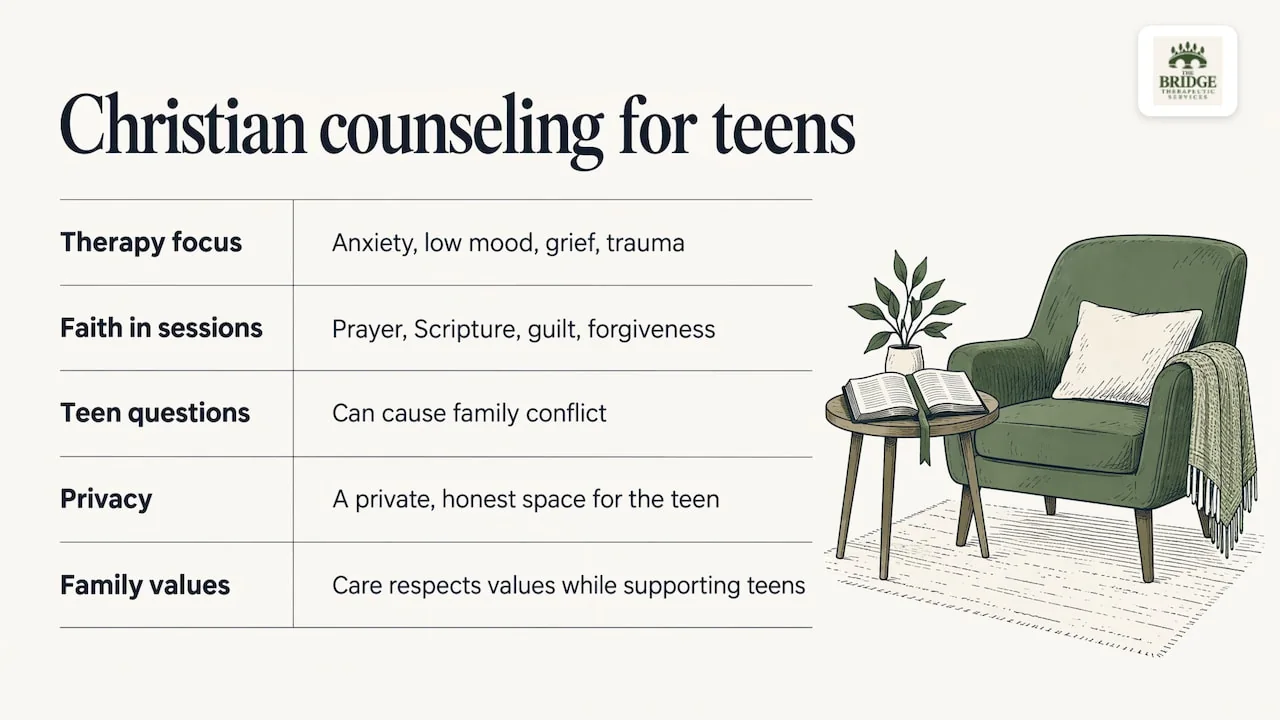
It is therapy first. A licensed counselor works with your teen on the problem that brought you in: anxiety, low mood, grief, trauma, friendship or family conflict, big transitions, or trouble focusing. What makes it Christian is that your teen’s faith can be part of the conversation. Prayer, Scripture, questions about God during suffering, guilt and forgiveness can all be raised and taken seriously, instead of being treated as off limits.
That matters because adolescence is when many young people start asking what they actually believe. The American Academy of Child & Adolescent Psychiatry (AACAP) notes that normal questioning of religious beliefs in adolescence can cause conflict in a family, and that a trained mental health professional can help when that conflict persists. A counselor who understands both the clinical side and the faith side can help a teen ask hard questions without feeling that faith or therapy is being used against them.
It also matters for parents. Many families want a counselor who will not quietly pull their child away from the values they are raising them in. Faith-informed care is built to respect that, while still giving the teen a private, honest space of their own.
Concerns it commonly addresses
The Bridge Therapeutic Services works with children and teens facing anxiety, depression, trauma, grief, ADHD, life transitions, relationship struggles, and adoption or foster care issues. The professional field is paying attention to the same concerns. The American Association of Christian Counselors reports that its 2024 NextGen Conference on Youth Mental Health covered childhood trauma, youth suicide prevention, self-harm, eating disorders, anxiety, depression, substance abuse, grief, and social media use.
If your teen’s struggle is anxiety, our guide to Christian anxiety counseling shows what sessions look like. If it follows a frightening or painful event, Christian trauma counseling explains how to choose care. For attention and focus, there is a page on ADHD counseling and support in Tyler.
How children and teens are counseled differently
Parents searching for “Christian child therapy” and “Christian counseling for teens” are often looking for two different experiences, and the difference is worth understanding before you book.
Younger children usually express what they feel through play, drawing and activity before they can put it into words. A practice parameter in the Journal of the American Academy of Child & Adolescent Psychiatry says clinicians working with children should be knowledgeable about play and skillful at using it in therapy. The same authors describe play as often a goal in itself, because it promotes development. For a child, a session that looks like a game may be doing real clinical work. Faith enters in age-appropriate ways: a simple prayer, a story, the idea that God cares about them and that their feelings are not bad.
Teenagers want to be treated as nearly adult. They tend to want privacy, honest answers and a say in the goals. Sessions lean more on conversation, skills practice and sorting out identity, friendships, pressure and faith questions. Parents are involved, but a teen who feels that the counselor is just a messenger for Mom and Dad will stop talking.
| Younger children | Teens | |
|---|---|---|
| Main way of working | Play, art, stories, simple skills | Conversation, skills practice, reflection |
| Parent role | Closely involved, often joins sessions or gets regular updates | Involved in goals and support at home, with room for the teen’s own space |
| Typical faith content | Simple prayer, Bible stories, reassurance | Doubt, forgiveness, identity, purpose, how faith relates to what they feel |
| What a good fit looks like | Child relaxes and plays | Teen feels heard and not lectured |
When a concern touches the whole household, the work can widen. The Bridge Therapeutic Services also offers family counseling and parenting support, so a parent can build skills at the same time the teen is in sessions.
How faith and evidence-based therapy fit together
The phrase “evidence-based” has a specific meaning. The National Alliance on Mental Illness describes evidence-based practices as treatments shown effective in repeated studies by several investigative teams. One example for young people is CBT, which teaches a young person to notice and change thinking and behaviors that affect their feelings. The same handbook says CBT is effective for anxiety, depression, oppositional defiant disorder, conduct disorder and trauma, and that it typically runs 12 to 16 weeks with weekly sessions of 60 to 90 minutes, with parents reinforcing new thinking at home.
That is the clinical frame. The Christian part is how it is applied. A teen who believes God is punishing them for a mistake has a thought pattern that CBT can examine, and a counselor who shares their faith can address it in language they trust. A grieving child who wonders where a loved one is now can be met with comfort from the family’s own beliefs, not just a coping worksheet.
Faith can also be a strength to draw on. A 2026 AACC conference session by Siang-Yang Tan, Ph.D., reports that most studies in the third edition of the Handbook of Religion and Health find religious or spiritual involvement associated with lower rates of emotional disorders and stronger social support. A church community, a youth group, and a habit of prayer can be resources a counselor helps your teen use.
AACAP adds that a comprehensive child mental health evaluation often includes questions about the child’s and family’s religious and spiritual beliefs, and that with the family’s permission a clinician can consult the family’s religious or spiritual leader. Where faith is part of the family’s life, it belongs in the plan.
The treatment is your family’s to choose
The NAMI handbook states that families keep the right to choose the most appropriate treatment, including when a proposed approach conflicts with their beliefs. For Christian families this is reassuring: you are not asked to set aside your values to get good care. If your family wants to explore approaches such as EMDR (a trauma therapy that uses guided eye movements or similar stimulation) and wonders how they sit with faith, we wrote about how EMDR can be integrated with Christian counseling.
The Bridge Therapeutic Services
Explore Teen Counseling in Person
Visit to learn about counseling that supports teens’ emotional needs while integrating psychological care with a Christian perspective.
The Bridge Therapeutic Services
3800 Paluxy Drive, Suite 240, Building 2, Tyler, TX 75703
How to judge a counselor for your teen
Whether you choose a Christian counselor or not, the same professional basics apply. The American Psychological Association (APA) suggests asking a therapist whether they are licensed, how long they have practiced, what experience they have with your specific problem, whether they work with children and families, what treatments they use, and what their fees and insurance policies are. Its guidance is at how to choose a psychologist. The APA also notes that psychologists must be licensed by the state where they practice and, before practicing independently, complete a supervised internship and at least one year of supervised post-doctoral experience.
AACAP’s guide to choosing treatment lists further questions a parent can bring: why a treatment is recommended, what research supports it, whether it works for families like yours, and what training the clinician has in it. These are ordinary questions in any first conversation, and a good counselor expects them.
For a faith-informed counselor, add a few of your own:
- How do you bring faith into sessions, and how do you follow my teen’s lead on it?
- How will you keep my teen’s trust while keeping me informed?
- How do you involve parents, and when would you suggest family sessions?
- What does a typical course of treatment look like for a concern like ours?
Printed materials can help you start the conversation at home too. Christian counseling brochures are one way families look into what counseling that respects their beliefs involves.
Signs that call for prompt attention
AACAP says a sudden or extreme change in a child’s religious practices may signal an underlying mental health problem, and that families should consult a child and adolescent psychiatrist or another trained mental health professional. That includes a teen who abruptly abandons everything they used to value, or becomes consumed by guilt, fear or rigid religious rules. Talk of self-harm or suicide is an emergency: call or text 988, the Suicide & Crisis Lifeline, or 911 if there is immediate danger.
For a general worry, AACAP’s guide to finding the right care recommends starting with the child’s doctor or school counselor. It also says more than 1 in 5 children have emotional or developmental problems and that there is a shortage of professionals trained to treat them, so an early start helps.
What the first weeks usually look like
Parents often worry about what the start of counseling involves. A first appointment is generally about understanding the concern, the child’s history, and the family’s goals and beliefs. AACAP’s continuum of care guide says the starting point for a parent concerned about a child’s behavior or emotions is an evaluation by a qualified mental health professional, and that parents should ask about the types of treatment, how long it lasts, what it costs and what insurance covers.
A few practical points help the first weeks go well:
- Tell your teen what to expect. Say that counseling is a place for them, not a punishment, and that faith questions are welcome.
- Share the history. Recent losses, a move, a family change, a frightening event, school trouble. Context shapes the plan.
- Give it time. The CBT schedule above shows that meaningful change is measured in weeks, not a single visit.
- Support at home. Parents reinforcing new skills is part of how youth CBT works, and parenting support is available if you want help with that.
Insurance, cost and access in Texas
The Bridge Therapeutic Services bills sessions to the client or to health insurance. We do not publish session fees, so ask us about current rates when you reach out. Our article on Christian counseling and insurance coverage walks through what to check with your plan.
If no suitable in-network clinician is available, ask your plan whether it will authorize out-of-network care and what you would owe. Coverage, referral requirements and costs vary by plan; confirm the arrangement before treatment. AACAP also notes that some programs require insurance or state agency authorization, so call your plan before your first session and ask what it covers for outpatient child and adolescent counseling.
For families outside Tyler, online therapy and telehealth counseling across Texas keeps sessions available without the drive.
Our perspective
Parents usually come to us carrying two worries at once: that their child is hurting, and that getting help will mean giving up what the family believes. We do not think they have to choose. Our approach pairs evidence-based psychological care with a Christian perspective, so a child’s faith is neither ignored nor pushed.
With teenagers, the most important thing is that they feel seen. A teen who senses a lecture will go quiet, and a teen who is met with compassion and practical tools will often start talking. With younger children, we want the work to feel safe and age-appropriate, with parents equipped to carry it home.
Healing rarely belongs to one person in the house. That is why we support individuals, couples, families and children, and why we want parents to leave with tools of their own, not just a report on their child.
Jennifer Wood, LPC-S
Starting counseling with The Bridge Therapeutic Services
If your teen or child is struggling and you want care that respects your family’s faith, The Bridge Therapeutic Services offers child and teen counseling in Tyler and telehealth across Texas, with faith-informed, evidence-based care for anxiety, depression, trauma, grief, ADHD, life transitions and more.

You can also read more about Christian counseling at The Bridge Therapeutic Services or start at our home page.
FAQ
Does insurance pay for Christian counseling for a teen?
Often it can, when the counselor is a licensed professional and the plan covers outpatient mental health care. The Bridge Therapeutic Services accepts private pay or health insurance. Call your plan to confirm benefits, and AACAP notes that if a plan has no suitable in-network professional, you may ask to go out of network.
Is a Christian counselor different from a pastor?
A pastor offers spiritual guidance. A licensed counselor is trained in psychological assessment and treatment, and uses evidence-based methods. Christian counseling combines the clinical training with attention to your family’s faith. Where it helps, with your permission, a counselor can consult your family’s religious leader.
Is EMDR or other trauma therapy compatible with Christian faith?
Many families ask this, and the answer starts with your own convictions and your teen’s needs. We explain how EMDR can be integrated with Christian counseling in our article on faith-based EMDR therapy, and you are free to choose the treatment that fits your family’s beliefs.
How is counseling for children different from counseling for teens?
Younger children tend to work through play and art with parents closely involved. Teens do more conversation and skills practice and value privacy and respect. Both can include faith in a way suited to their age.
Can my teen attend sessions online?
Yes. The Bridge Therapeutic Services offers telehealth counseling across Texas, as well as in-person sessions in Tyler, so distance does not have to stand in the way.
The Bridge Therapeutic Services
Talk Through Your Teen’s Needs
Call to discuss counseling support for your teen, including care informed by evidence-based methods and Christian values.
+1 903 283 8729
Sources
- AACAP: Religion, Spirituality and Your Mental Health Care
- AACAP and NAMI: Choosing the Right Treatment, What Families Need to Know
- JAACAP: Practice Parameter for Psychodynamic Psychotherapy With Children
- APA: How to choose a psychologist
- AACAP: Finding the Right Care
- AACAP: Continuum of Mental Health Care
- AACC: Religion and Health, Empirical Evidence and Clinical Applications
- AACC newsletter, 2026