

Family stress eases when the whole household changes a few daily habits together: naming the stress out loud, pausing before reacting, keeping routines steady and getting support before the strain hardens into patterns. Those habits are within reach for most families, and when they are not enough, counseling gives everyone a structured place to practice them. At The Bridge Therapeutic Services in Tyler, Texas, we work with individuals, couples, parents and children who want that kind of help, in person or by telehealth across Texas.
This guide covers what usually causes family stress, what to do about it at home this week, how to handle the relative who sets you off, how children and teens can cope, and how to tell when it is time to bring in a professional.
The Bridge Therapeutic Services
Find Support for Family Stress
The Bridge offers faith-informed counseling for families, couples, parents, and children, with in-person and telehealth options across Texas.
VisitTL;DR
- Family stress usually comes from changes and pressures such as money, illness, loss, schedules, parenting and marital strain, not from one “difficult” person.
- Talking openly about stress, pausing before you respond and sticking to one issue at a time are the most reliable ways to lower the temperature at home.
- Steady routines, sleep, movement and small daily breaks protect both parents and kids.
- You do not have to resolve every conflict in one conversation, and you can change the subject or agree to disagree.
- When stress keeps interfering with daily life, family counseling, couples counseling or child and teen counseling can help.
Table of Contents
- What actually causes stress in a family
- Start by talking about the stress itself
- How to handle the arguments that do happen
- Dealing with the family member who stresses you out
- Reducing stress at home day to day
- When you are the parent holding everything together
- Helping children and teens cope
- Signs it is time to bring in a counselor
- Perspective: why we bring faith and clinical care together
- Counseling for your family at The Bridge Therapeutic Services
- FAQ
- Sources
What actually causes stress in a family
Families rarely get stressed for no reason. A nursing textbook from OpenStax lists common causes of family stress: the birth of a child, a move, confusion about family roles, the death of a loved one, divorce or marital problems, financial burdens, overloaded schedules, parenting and discipline, serious illness, and the balance between work and home life.
The American Institute of Stress adds family members with conflicting opinions or political views and living in an unsafe or high-stress environment to the list, and notes that how a family handles stress can have a lasting effect on relationships, emotional wellness and physical health.
The same OpenStax section describes what stress looks like when it lands at home: more arguments and poorer communication, leaning on food, alcohol or other substances, exhaustion, money trouble, family roles that go undone, and people withdrawing. If you recognize two or three of those, you are not failing. You are seeing a normal stress response in a household carrying too much.
It helps to sort your own stressors into two piles:
- Changes (a new baby, a move, a job loss, a divorce, a death). These need time, patience and extra support.
- Ongoing pressures (a packed calendar, money worries, disagreements about discipline). These respond well to routines and agreements.
Picking the pile first keeps you from treating a grief reaction like a scheduling problem, or the reverse.
Start by talking about the stress itself
The American Psychological Association (APA) advises families to talk about stress. If children look worried, ask what is on their minds. The APA notes that low levels of parental communication have been associated with poor decision making among children and teens, and it describes open communication as just as important as eating well, exercise and sleep.
A simple way to begin:
- Pick a calm moment, not the middle of a blowup. Dinner, a drive or a walk often works better than a formal sit-down.
- Say what you are noticing without blame: “Things have felt tense since the move. How is it going for you?”
- Listen to the answer without fixing it. Repeat back what you heard.
- Choose one small change together, such as a shorter evening schedule or a shared chore chart.
If your family tends to go quiet instead of fighting, the first step may be smaller: ask each person to name one thing that was hard today and one thing that went well.
How to handle the arguments that do happen
Conflict is not the problem. How it goes is. The APA suggests aiming to understand family members and contribute positively to the relationship rather than to win. It also passes along tips from the University of Texas at Austin: stick to one issue, use “I” statements, listen without interrupting and avoid personal attacks.
Here is what that sounds like in practice:
| Instead of | Try |
|---|---|
| “You never help around here.” | “I feel overwhelmed when the dishes pile up. Can we split evenings?” |
| Bringing up last month’s argument | Staying with tonight’s one issue |
| Talking over the other person | Letting them finish, then summarizing what you heard |
| “You’re just like your father.” | Describing the behavior, not the person |
Pause before you answer. Utah State University Extension lists pausing before responding to disagreements among its tips for healthier family relationships, along with careful listening, keeping promises and expressing gratitude. Even ten seconds and one slow breath can keep a sharp reply from becoming a three-day silence.
You also do not have to finish the conversation. The APA says it can be reasonable to change the subject or agree to disagree when a topic is too contentious, that a conflict need not be resolved in one sitting, and that respectful disagreement can preserve connection.
If arguments in your home are frequent, loud or leaving lasting hurt, our article on how family conflict counseling works and when to start walks through what to expect.
Dealing with the family member who stresses you out
Most people searching this are not looking at the whole family. They are thinking of one person: a parent who criticizes, a sibling who stirs things up, an in-law who oversteps. A few principles hold up in nearly every case.
Decide what you can control. The APA’s family guidance points out that focusing on what you can control is a skill to practice and to teach children. You cannot control another adult’s opinions or tone. You can control how long you stay, which topics you engage with and how you respond.
Set one boundary at a time. Choose a specific, calm line: “I’m happy to talk about the kids, but not about my job. If it comes up, I’ll step outside for a few minutes.” Say it once, kindly, and follow through. A boundary is something you do, not a speech you give.
Plan the visit. Shorten it, arrive with your own transportation, decide in advance who will step in if you are cornered, and have a neutral subject ready.
Do not use substances to get through it. The APA’s resilience guidance says to avoid alcohol or drugs as a way to cope and to seek practical and emotional support from trusted people or professionals.
Know when it is bigger than annoyance. If you feel unsafe, or a relationship involves threats, intimidation or harm, that is not ordinary family friction. If you or someone in your home is in immediate danger, call 911. If you are in emotional crisis, call or text 988, the Suicide and Crisis Lifeline.
For many people, the hardest part is not the relative but the guilt about setting limits. Faith can matter here. Many of our clients want to honor family while still protecting their peace, and our Christian counseling integrates faith-informed care with evidence-based methods so those two values are not set against each other.
Reducing stress at home day to day
Big conversations matter, but most stress relief is small and repeated.
Build connection into ordinary moments
Utah State University Extension recommends small, regular family connections: a few minutes of undistracted attention, gratitude said out loud, promises kept. A ten-minute bedtime chat does more than a rare, elaborate outing.
Make the space feel manageable
The APA cites a University of Connecticut study finding that during extreme stress people leaned on cleaning because it gave them a sense of control. Its guidance says clearing up home space is something a family can control, and that doing it together teaches children to focus on what they can control. Try a fifteen-minute family reset before dinner rather than a weekend overhaul.
Protect sleep, food and movement
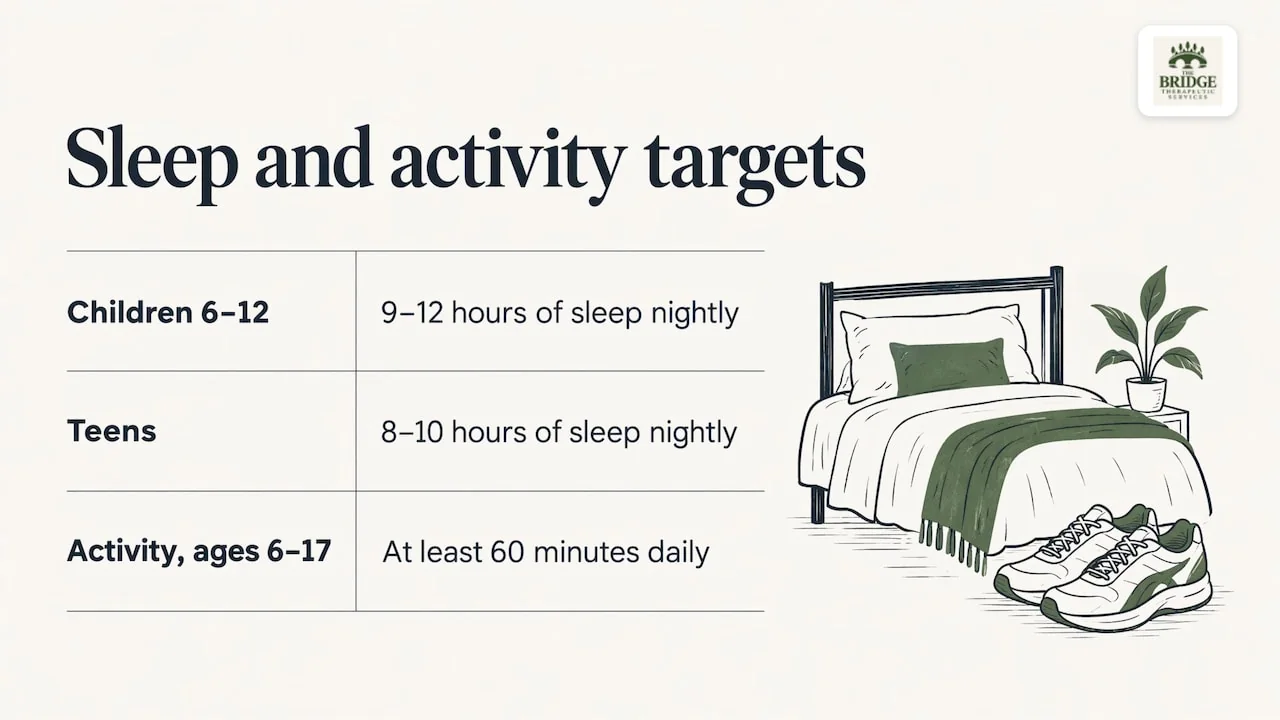
The APA recommends nine to 12 hours of sleep for children ages 6 to 12, eight to 10 hours for teens, and at least 60 minutes of daily activity for ages 6 to 17. Adults are not exempt from the basics. Tired people argue more, and a predictable morning helps everyone. If you want ideas for easing into the day, this piece on a simple morning routine for energy offers a two-week approach you can try as a household.
Keep a calendar that breathes
Overloaded schedules are on the OpenStax list of family stressors for a reason. Look at the week ahead on Sunday night and ask what can move, be shared or be dropped. Leave at least one evening with nothing on it.
Be thoughtful with screens
The APA suggests parents promote media literacy by teaching children to be savvy digital consumers and by limiting screen time. Our own post on screen time recommendations for children is a good starting point for setting household limits.
When you are the parent holding everything together
Parents carry a particular load. In a CDC analysis of U.S. surveys from December 2020 and February to March 2021, parents and unpaid caregivers reported worse mental health outcomes than other adults, and having someone to rely on was associated with lower odds of adverse mental health symptoms. The practical lesson: support is not a luxury. It is part of how you keep the household steady.
What helps in small doses:
- A few minutes a day. HealthyChildren.org, from the American Academy of Pediatrics, suggests taking a few minutes each day in a safe place to do something relaxing: talking to a friend, reading, deep breathing or a short walk.
- Honest conversation with your partner. Utah State University Extension says small self-care practices such as a brief walk, journaling or quiet time, together with honest, nonjudgmental conversation, can help parents restore patience and feel more connected as a couple.
- Care for your own wellbeing. Parenting stress and a child’s emotional regulation affect each other, and this overview of strategies to ease parenting stress offers more ideas for caregivers.
- Breaking problems down. The APA advises splitting large problems into manageable steps. “Fix our finances” is paralyzing. “Sit down Thursday and list every bill” is doable.
If you and your spouse disagree about discipline, that is one of the most common stressors on the list. Our parenting support and marriage and couples counseling pages describe how we help parents get on the same page.
The Bridge Therapeutic Services
Explore Support for Your Family
Visit The Bridge Therapeutic Services to learn about counseling grounded in evidence-based methods and Christian values for families facing challenges.
The Bridge Therapeutic Services
3800 Paluxy Drive, Suite 240, Building 2, Tyler, TX 75703
Helping children and teens cope
Kids absorb household tension even when no one says a word. The APA’s guidance for helping children and teens manage stress includes:
- Talking with a trusted adult.
- Making time for both fun and quiet.
- Getting outside.
- Writing about positive feelings.
- Learning mindfulness.
It also encourages parents to model healthy coping by describing how they handled their own stressful situations, to let kids solve low-stakes problems on their own to build confidence, and to ask children whether their negative thoughts are actually true.
For children living with tension between adults, HealthyChildren.org suggests healthy routines such as reading before bed and eating breakfast, talking about things the child is happy or thankful for, practicing focused deep breathing in a safe space, and connecting the child with programs and groups that offer supportive adults.

With teens, expect shorter conversations and more side-by-side talk: in the car, while cooking, on a walk. Offer a schedule that includes downtime, and do not take silence personally.
Anxiety can look like irritability, stomachaches or refusing to go to school. If you are seeing that pattern, our post What Is Anxiety Therapy? explains how counseling works, and our child and teen counseling page describes how we support young people and their parents.
Signs it is time to bring in a counselor
Self-help habits are a strong start. Consider professional support when:
- Stress keeps interfering with work, school, sleep or daily tasks. The APA recommends professional help when stress or trauma interferes with daily functioning.
- The same argument repeats with no movement.
- A major change, such as divorce, a blended family, adoption, illness or loss, has knocked the household off balance.
- A child’s mood, behavior or grades have shifted and you are not sure why.
- One person is carrying all the emotional work and is running on empty.
Counseling gives a family a structured space to practice the skills above with someone guiding the conversation, so each person is heard and the patterns become visible. Depending on what you are facing, that could be individual, couples, family or child and teen sessions.
Perspective: why we bring faith and clinical care together
When families come to us worn out, they usually assume something is wrong with them. Most of the time, they are carrying more than any one household was meant to carry, and nobody has shown them how to lighten it.
Our approach combines evidence-based psychological methods with a Christian perspective, tailored to the people in the room. For one family, that means learning to communicate without escalating. For another, it means grieving together, or finding steadiness after a move or a divorce. We want each person to feel seen and supported, and to leave with tools they can use at the kitchen table, not just in the office.
We also believe family stress is rarely one person’s fault. Healing tends to start when parents, children and couples stop looking for who is to blame and begin working on the pattern together. That is the work we love doing in Tyler and, through telehealth, across Texas.
Jennifer Wood, LPC-S
Counseling for your family at The Bridge Therapeutic Services
The Bridge Therapeutic Services offers family counseling, couples counseling, individual counseling, child and teen counseling and parenting support, along with specialized help for divorce and blended families and adoption and foster family support. You can meet with us in person in Tyler, or use online therapy and telehealth counseling across Texas. Sessions are paid privately or through health insurance.

If you are not sure which kind of session fits, start at thebridgetherapy.com and reach out. We will help you find the right first step for your family.
FAQ
What is the fastest way to reduce stress at home?
Pause before you respond, and take a few slow breaths. Then name the stress out loud with your family, since open communication is as important as sleep, food and exercise according to the APA. Follow with one small change, such as a shared chore list or a calmer evening routine.
How do I cope with family problems when I can’t fix them?
Focus on what you can control: your response, your boundaries and your own wellbeing. It is fine to agree to disagree, and conflict does not have to be resolved in one conversation. Lean on trusted people and consider counseling if the situation is affecting your daily life.
How can I help my teenager manage stress?
Teens benefit from eight to 10 hours of sleep, at least 60 minutes of daily activity, time for fun and quiet, and a trusted adult to talk to. Keep conversations low pressure and model how you handle your own stress. If worry or irritability seems to be taking over, child and teen counseling can help.
What are the most common causes of family stress?
Financial pressure, divorce or marital problems, illness, the death of a loved one, a new baby, a move, overloaded schedules and parenting disagreements are the most commonly listed. Conflicting opinions among relatives can add to it. Most families face several at once.
Can we do family counseling online?
Yes. The Bridge Therapeutic Services offers telehealth counseling to clients across Texas, as well as in-person sessions in Tyler. Our online therapy page explains how to get started.
The Bridge Therapeutic Services
Talk Through Your Family’s Needs
Call to ask about counseling support for family stress, including services for couples, parents, and children.
Sources
- OpenStax: Role of Stress in Family Health
- The American Institute of Stress: Families
- APA: Managing stress for a healthy family
- APA: Family arguments
- Utah State University Extension: Healthy family relationships
- Utah State University Extension: Keeping your marriage strong
- APA: Resilience guidance
- APA: Helping children and teens manage stress
- HealthyChildren.org: Coping with stress at home
- CDC MMWR: Mental health among parents