
Self-esteem counseling is talk therapy that helps you find where a harsh view of yourself came from, test whether it is true, and replace it with a more accurate and kinder one. It works best with a licensed therapist who uses structured, evidence-based methods and who treats your story, your faith and your relationships as part of the picture. At The Bridge Therapeutic Services in Tyler, Texas, we offer individual counseling in person and by telehealth across Texas, with a Christian perspective for clients who want it.
This guide explains what counseling for low self-esteem involves, what a session looks like, what the research says, and how to find the right kind of help for an adult, a couple, a child or a teen.
The Bridge Therapeutic Services
Build a Kinder View of Yourself
The Bridge offers evidence-based individual counseling with a Christian perspective for clients who want faith-informed support with self-esteem.
VisitTL;DR
- Low self-esteem is a pattern of negative beliefs about yourself, and therapy treats it by finding those beliefs, testing them against evidence and building new ones.
- Cognitive behavioral therapy (CBT) is the best-studied approach: a 2018 meta-analysis found large improvements when people attended weekly sessions.
- Expect a conversation about your history, some gentle challenge of your self-talk and small exercises between sessions.
- Persistent worthlessness, or any thought of self-harm, calls for professional help now, not later.
- Children, teens, couples and families can get support too, in person in Tyler or online anywhere in Texas.
Table of Contents
- What self-esteem counseling is
- Where low self-esteem comes from
- What happens in a session
- How CBT challenges negative beliefs
- Steps you can start on today
- How to tell counseling is the right step
- Support for children, teens, couples and families
- What a faith-informed approach adds
- Get started with The Bridge Therapeutic Services
- Our perspective on building self-worth
- FAQ
- Sources
What self-esteem counseling is
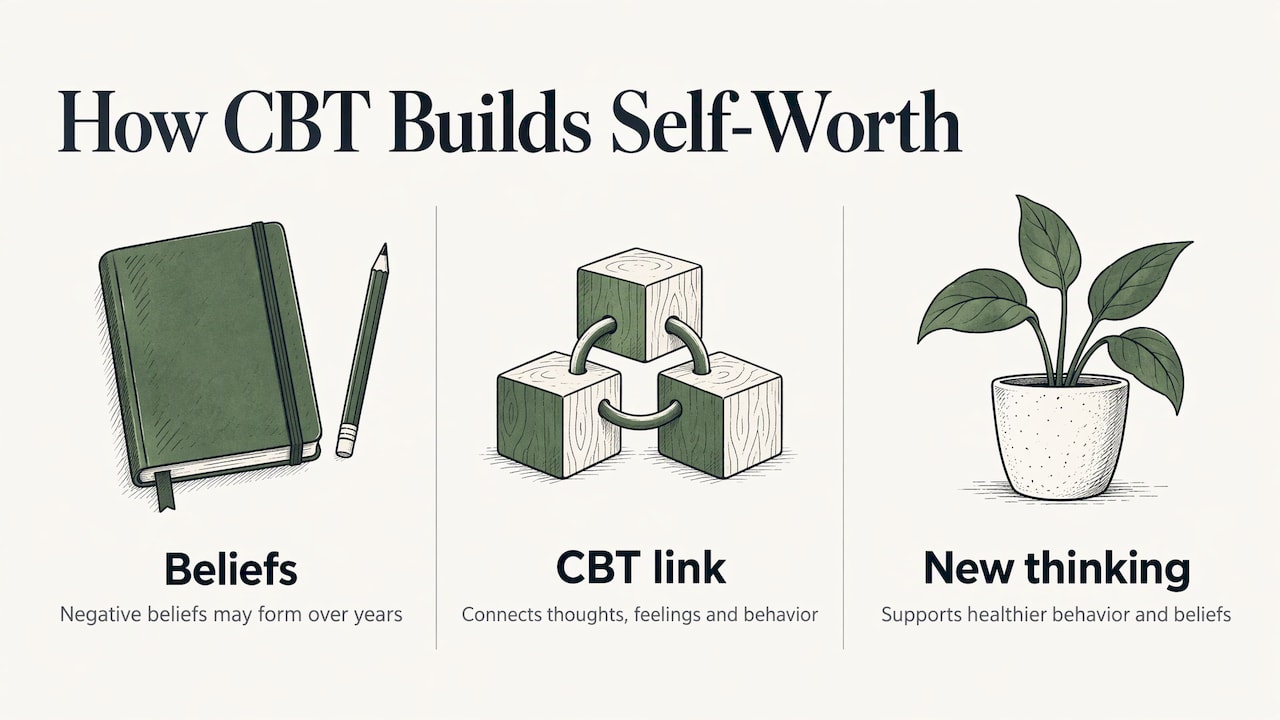
Self-esteem is the overall opinion you hold of yourself: whether you believe you are capable, likable and worth care. Low self-esteem is not a mood you can talk yourself out of with a compliment. It usually rests on deep beliefs formed over years, such as “I am not good enough” or “I always fail.”
Counseling gives you a structured place to examine those beliefs with someone trained to help. Most therapists approach it through the link between thoughts, feelings and behavior. NAMI describes CBT as working on exactly that relationship, so that you and the therapist can build more constructive ways of thinking that lead to healthier behavior and beliefs.
You may also see this called self-esteem therapy or working with a self-esteem therapist. The names differ, but the work is the same: understanding the beliefs, testing them and practicing new ones.
Where low self-esteem comes from
Knowing the roots matters, because the therapy aims at them rather than at the surface symptoms. Mayo Clinic’s page on teen depression lists learned patterns of negative thinking, early trauma such as abuse or loss, inherited traits and long-term bullying or academic problems among the factors that can lower self-esteem.
In practice, adults often describe a few common sources:
- A critical parent, teacher or coach whose voice became their own.
- A painful relationship, divorce or betrayal that left them doubting their worth.
- Years of comparing themselves with others, including on social media.
- A loss, a failure or a hard season of life that shook their sense of who they are.
- Trauma that taught them to expect to be hurt or dismissed.
Low self-esteem rarely arrives alone. It often travels with anxiety, depression and relationship strain, which is why counseling looks at the whole person. Our pages on anxiety counseling and depression counseling explain how those concerns are treated.
What happens in a session
The first sessions are mostly about understanding you. In individual talk therapy, NAMI notes that the therapist often leads the conversation, which can touch on past or current problems, experiences, thoughts, feelings and relationships, while the therapist helps you make connections and gain insight.
A counselor writing in the American Counseling Association’s magazine describes an early “holding” stage in which the counselor listens, stays curious and prompts discussion of your life history, paying attention to cues like a change in tone to ask for more detail. This is where many people feel heard for the first time in a long while.
A typical path looks like this:
- Telling your story. You describe what brought you in and what you notice about how you treat yourself.
- Naming the core beliefs. You and the therapist put words to the harsh statements underneath, such as “I am a burden.”
- Testing the beliefs. You look at the evidence for and against each one, in session and in daily life.
- Practicing new responses. You try small behavior changes, like speaking up or accepting a compliment, and see what happens.
- Preventing a slide back. You plan for the moments when old thoughts return.
What homework looks like
With CBT, NAMI says the therapist works actively with you to uncover unhealthy thought patterns, and you may get homework between sessions, such as replacing negative thoughts with realistic ones or keeping a journal. The goal is not to produce cheerful thoughts. It is to produce accurate ones.

How CBT challenges negative beliefs
CBT is the approach with the most research behind it for low self-esteem. Its core move is to identify a negative or false belief and then test or restructure it. NAMI’s example is replacing “I can’t do anything right” with “I can do this most of the time, based on my prior experiences.” That second sentence is not forced positivity. It is a truer statement.
A 2018 systematic review and meta-analysis of CBT programs for low self-esteem, based on a well-known model by Melanie Fennell, found a summary effect size of 1.12 after treatment for weekly individual or group sessions. One-day workshops produced a smaller effect of 0.34. In plain terms, steady weekly work produced much larger gains than a single event. Depressive symptoms also dropped.
A published CBT program for young people with low self-esteem shows what the work can look like. According to a 2021 study, it used six weekly one-hour individual sessions covering:
- A map of how the low self-esteem formed and is kept going.
- Self-compassionate thought records, which are written notes that reframe a harsh thought.
- Updating “key fears” with new information.
- Positive data logs, which are daily records of evidence that contradicts the negative belief.
- Behavioral experiments, which are small real-life tests of a feared outcome.
A counselor quoted in Counseling Today describes a gently challenging style that uses Socratic questioning, asking the client to trace when they first felt a negative self-belief and then talking it through at the next session. The same article stresses responding to self-talk with accuracy, not forced positivity, and separating feelings from facts.
For a short primer on the grounding and exposure ideas that CBT builds on, see this guide to CBT exposure and grounding techniques.
Other approaches therapists use
CBT is not the only option. A 2017 randomized trial in the Netherlands compared ten weekly EMDR sessions with ten weekly CBT group sessions for low self-esteem. EMDR (eye movement desensitization and reprocessing) is a therapy that helps the brain reprocess painful memories. When low self-esteem is tied to a specific painful experience, it can be part of the plan. You can read how we use it in our articles on EMDR for anxiety, panic and trauma responses and how EMDR helps heal trauma.
Boundary work is another common thread. The counselor in the Counseling Today article finds that clients with low self-esteem often put up with things they dislike because they lack the confidence to speak up, so learning to set physical and emotional limits is often part of the work.
Steps you can start on today
Counseling goes deeper than self-help, but a few habits from CBT are worth knowing, because they are what your sessions will build on. Mayo Clinic’s guide to feeling better about yourself (updated July 2025) suggests:
- Notice the situations that deflate your self-esteem, such as a certain person, a work task or a time of day.
- Listen to your self-talk and write down the exact words.
- Check the thought against facts and logic. Mayo asks whether you would say it to a friend. If not, do not say it to yourself.
- Adjust the thought. Use hopeful statements, forgive yourself and drop “should” and “must” language.
Mayo also describes a different path in which you step back from negative thoughts and accept them, so they lose their power over what you do.
These habits are easier to keep up with a therapist who notices the patterns you cannot see yourself. If you try them alone and the old beliefs keep winning, that is a sign counseling can help, not a sign you failed.
The Bridge Therapeutic Services
Explore Support for Self-Worth
Meet with a therapist for individual counseling grounded in evidence-based methods and, for clients who want it, a Christian perspective.
The Bridge Therapeutic Services
3800 Paluxy Drive, Suite 240, Building 2, Tyler, TX 75703
How to tell counseling is the right step
Everyone doubts themselves at times. Counseling makes sense when the doubt is steady and starts to shape your choices. Common signs include:
- You avoid opportunities because you expect to fail.
- You stay in relationships or jobs where you are mistreated.
- You cannot accept praise, or you apologize constantly.
- You feel worthless or guilty most days.
- Your sleep, appetite, mood or school and work performance are changing.
Mayo Clinic lists feelings of worthlessness or guilt and low self-esteem among the symptoms of teen depression, and says that when symptoms continue, interfere with life or raise safety concerns, families should talk to a doctor or a mental health professional trained to work with adolescents, starting with the family doctor or pediatrician. That advice holds for adults too: a persistent sense of worthlessness is worth bringing to a professional.
If you are having thoughts of harming yourself, call or text 988, the nationwide 988 Suicide & Crisis Lifeline, or call 911 in an emergency. Do not wait for an appointment.
Support for children, teens, couples and families
Low self-esteem looks different at each stage of life, and so does the help.
Children and teens
SAMHSA’s guidance for parents lists low self-esteem among the emotional symptoms of possible distress in young people. It says options include a visit with a pediatrician or behavioral health provider, education about symptoms, and talk therapy, with CBT or Interpersonal Therapy as first-line choices. Parents can also help at home. A Georgetown University guide on teen body image suggests avoiding critical comments about weight or appearance and helping teens value their strengths, such as kindness, courage and talents. Our child and teen counseling and parenting support services are built for these situations.
Couples and families
Self-worth shapes how we love. A partner who feels unworthy may withdraw, cling or expect rejection, and the other partner often feels the strain without knowing why. Marriage and couples counseling lets both people look at these patterns together. In a family, one member’s low self-esteem can change the whole household’s mood, and family counseling helps everyone respond differently. If distance is a barrier, our article on online couples counseling explains what to expect.
Seasons of change
Divorce, a move, a job loss or a new baby can shake your sense of who you are. Our article on how counseling guides you through life transitions covers why those periods are a good moment to begin.
What a faith-informed approach adds
For many people, worth is not only a psychological question. It is also a spiritual one: whether they are loved, forgiven and valued. At The Bridge Therapeutic Services, we integrate psychological principles with Christian values, so clients who want to bring their faith into the room can do so. Our therapists use evidence-based methods tailored to each client, and the spiritual side is shaped around what you want. You can read more on our Christian counseling page.
Get started with The Bridge Therapeutic Services
The Bridge Therapeutic Services provides counseling for individuals, couples, families, children and teens in Tyler, Texas, and telehealth counseling across the state. Sessions can be paid privately or through health insurance. Our approach brings together evidence-based psychological care and a Christian perspective, with a holistic, health-centered focus on emotional and relational challenges.

If low self-esteem is holding you or someone you love back, start with individual counseling, or reach us through our Tyler counseling home page. If you live elsewhere in Texas, our online therapy page explains how telehealth works.
Our perspective on building self-worth
We meet many people who believe they should be able to fix their self-image by trying harder. In our experience, the opposite is closer to the truth: the harder someone pushes against a belief they do not understand, the more firmly it holds.
That is why we start with the story, not the slogan. A belief like “I am not enough” almost always has a history, and once a person sees where it came from, it becomes something they can examine instead of something they simply are.
We also think self-worth grows best in relationship. It develops when someone listens carefully, challenges you gently and does not look away from the hard parts. For many of our clients, it deepens further when they see themselves as valued and loved by God, not as someone who has to earn it.
Our work blends evidence-based methods with faith-informed care, and we tailor both to the person in front of us. We want you to leave with practical tools and a steadier sense of who you are.
Jennifer Wood, LPC-S
FAQ
How long does self-esteem counseling take?
It varies with the person and the history behind the beliefs. In research, structured programs have run as short as six weekly one-hour sessions and as long as ten weekly sessions. Your therapist will set goals with you and review progress along the way.
Can therapy really change how I see myself?
Research supports it. A 2018 meta-analysis found that CBT-based programs delivered in weekly sessions produced large improvements in self-reported self-esteem. Change comes through practice, so the work between sessions matters as much as the hour itself.
Is counseling for self-esteem different from depression therapy?
They overlap. Low self-esteem and depression often appear together, and the CBT methods used for one help with the other. A therapist will assess both and focus on what is troubling you most.
Can I do self-esteem counseling online?
Yes. The Bridge Therapeutic Services offers telehealth counseling to clients across Texas, as well as in-person sessions in Tyler. Online sessions follow the same structure as office visits.
When should I get help right away?
Get help promptly if feelings of worthlessness last, affect your daily life or come with thoughts of harming yourself. In a crisis, call or text 988 or call 911. For a child or teen, begin with the pediatrician or a mental health professional who works with young people.
TThe Bridge Therapeutic Services
Talk About Building Self-Worth
Call to ask about individual counseling and support for self-esteem through The Bridge Therapeutic Services.
Sources
- Psychotherapy | NAMI
- Self-esteem: Tending to the roots and branches | Counseling Today
- Teen depression | Mayo Clinic
- Systematic review and meta-analysis of CBT interventions for low self-esteem | PubMed
- A cognitive behavioural intervention for low self-esteem in stigmatized young people | PMC
- The Effect of EMDR and CBT on Low Self-esteem | PMC
- Self-esteem: Take steps to feel better about yourself | Mayo Clinic
- 988 Suicide & Crisis Lifeline | FCC
- Parenting and Youth Anxiety and Depression | SAMHSA
- Teen body image guidance | Georgetown University