
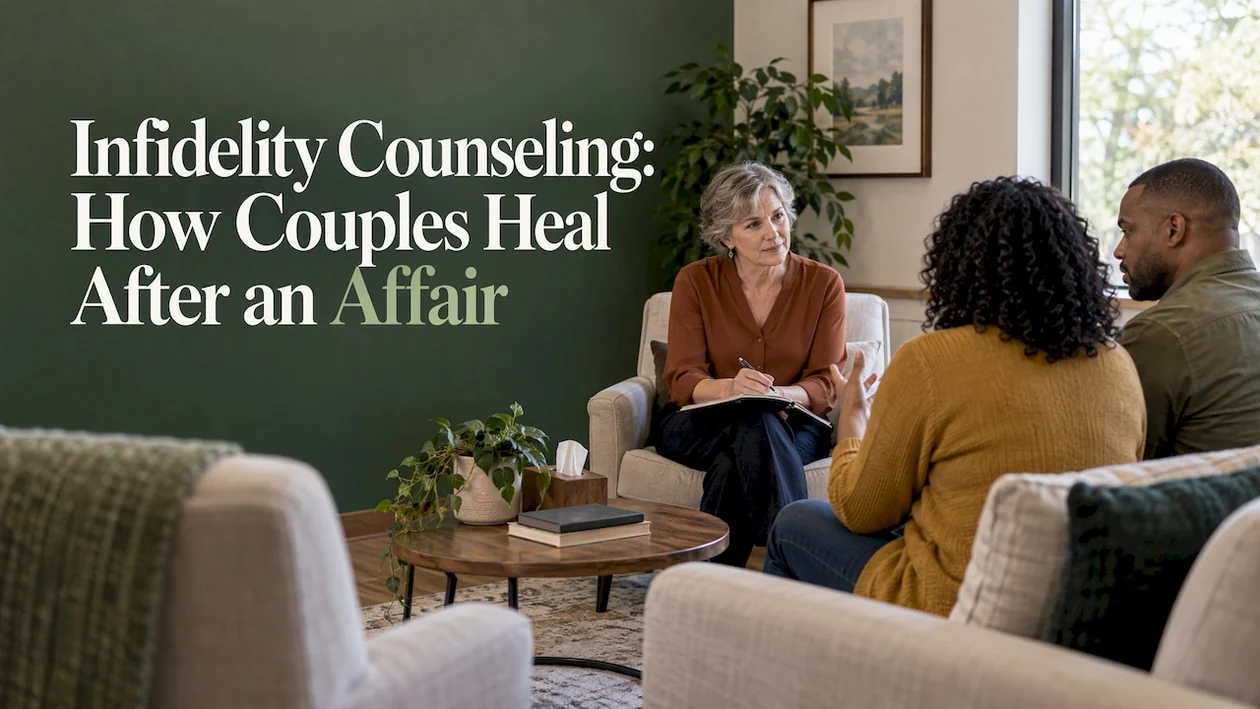
Infidelity counseling is therapy focused on the effects of an affair. A trained therapist helps you address immediate distress, understand what happened, and consider what comes next, whether that means rebuilding or ending the relationship. At The Bridge Therapeutic Services, we offer marriage and couples counseling in Tyler, Texas, and telehealth across Texas, with a Christian perspective for couples who want faith in the room.
After a discovery or confession, it can be hard to concentrate or decide what to do. You do not have to make every decision immediately. This guide explains one commonly used recovery framework, what sessions may involve, and when individual safety and support need to come first.
Find a way forward with support
Counseling can help you discuss boundaries, communication and next steps without promising reconciliation or pressuring you to stay.
At a glance
- One established framework has three stages: stabilize the immediate impact, understand the context, then decide how to move forward.
- Some couples improve after therapy; others separate. Research cannot predict an individual couple's outcome.
- Both partners deserve dignity. Responsibility for an affair is not transferred to the betrayed partner.
- Anger and distress need a safe communication plan, with individual help when needed.
- If there is fear, coercion or violence, seek confidential individual safety support before joint counseling.
Table of contents
- What infidelity counseling is
- The three stages
- What a first session looks like
- What research can tell us
- Anger and safety after an affair
- Choosing the right help
- Starting counseling in Texas
- Common questions
- Sources
What infidelity counseling actually is
Counseling provides structured help around a breach of trust. The aim is not for a therapist to act as a judge, excuse the affair or decide the future for you. It is to support safety, honest discussion and informed choices.
The American Psychological Association's discussion with psychologist Galena Rhoades describes a model developed by Kristina Gordon, Donald Baucom and Douglas Snyder: contain the impact, understand what happened, and consider the relationship's future. This is one useful framework, rather than a required sequence for every couple.
Therapy can draw on cognitive and behavioral methods, attention to emotions and relationship patterns, and an understanding of trauma-related distress. Your therapist should explain the approach, their relevant experience and how the plan fits your needs.
The three stages, in plain terms
Stage 1: Stabilize and contain the damage
Early conversations often focus on immediate needs. A partner may feel intense anger, numbness, intrusive thoughts, sleep disruption or uncertainty. Those reactions deserve care, but they do not by themselves establish a PTSD diagnosis. Assessment can help determine whether individual treatment is appropriate.
Practical work may include:
- Agreeing on when and how to discuss the affair, rather than letting it take over every interaction.
- Setting safe boundaries around contact with the other person involved.
- Considering what children or other family members need to know, without placing them in the middle.
- Making room for sleep, meals, daily responsibilities and trusted support.
- Assessing safety and whether joint sessions are appropriate.
Feeling better for a few days does not necessarily mean the difficult work is finished. The pace should allow room to address what happened without forcing either partner into more detail than they can manage safely. If distress is overwhelming, ask about individual counseling or trauma-related support.
Stage 2: Understand what happened and why
Once things are steadier, the therapist may help you explore the circumstances and patterns surrounding the affair. Understanding context is not the same as excusing choices or blaming the betrayed partner.
Disclosure and questions need a thoughtful plan. Partners may differ about what information they need and when. Utah State University Extension's discussion of rebuilding trust recommends professional support for a formal therapeutic disclosure. A counselor can help you discuss boundaries, expectations and the likely effects of sharing particular details.
Agreements about communication should be voluntary and safe. Honesty does not require accepting coercive monitoring, threats or loss of personal safety. Medical concerns, including possible sexually transmitted infections, should be addressed with an appropriate health care professional.
Stage 3: Decide and move forward
Later work can help clarify whether each partner wants to continue the relationship and what would need to change. Some couples recommit with new agreements; others choose separation. Support should respect your choices rather than guarantee an outcome or hurry forgiveness.
For couples who choose to stay together, the work may include regular check-ins, relationship habits and plans for responding to future problems. Trust usually develops through patterns of behavior over time, not through a single conversation.
What a first session looks like
You do not need to know the future of your relationship before you call. A first session may cover what brought you in, how you are coping, the most urgent concerns, your goals and whether you feel safe.
- Space for each partner: the betrayed partner needs room for pain and questions; the partner who had the affair also needs to engage honestly without the therapist excusing the behavior.
- Clear confidentiality policies: ask how individual meetings, private disclosures and secrets are handled before sharing information.
- A plan between sessions: boundaries, scheduled conversations and practical coping steps may be part of the work.
- An appropriate pace: early work often focuses on stabilization, with deeper discussion when it can be useful and safe.
Some people begin alone, especially when a partner is not ready or when they need confidential support first. Joint and individual work may involve different clinicians; your provider should explain roles and boundaries. If travel is difficult, ask whether online couples counseling is a suitable option.
Does infidelity counseling work? What research can tell us
There is reason for hope, but no reliable promise of reconciliation. A five-year follow-up of behavioral couple therapy examined 19 couples affected by infidelity within a larger trial. Among couples who remained married, the researchers did not find differences in relationship satisfaction or stability compared with couples without reported infidelity.
That result describes a small subgroup that stayed married, not a success rate for all couples beginning treatment. The study also found differences between revealed and secret infidelity, but its small groups and study design do not show that disclosure alone causes recovery. Individual circumstances, safety, accountability, willingness to participate and many other factors matter.
Counseling may help you communicate, understand your needs and make considered choices even when the relationship ends. Improvement and reconciliation are different outcomes. Discuss what meaningful progress would look like for you rather than judging every session by whether you immediately feel close again.
Anger after an affair: coping and safety
Anger, defensiveness, grief and shame can make conversations difficult. When both partners are safe and willing, a planned pause may prevent a discussion from escalating. Agree on how to request a break and when to check back in, rather than using a break to punish or abandon the conversation.
- Choose a time and place. Avoid important discussions when either person is exhausted, intoxicated or unable to engage safely.
- Write first if it helps. Journaling can help you identify feelings and questions before speaking.
- Use specific descriptions. Explain what happened, what you feel and what you need. This does not mean suppressing legitimate anger or taking responsibility for someone else's choices.
- Watch for escalation. Stop the conversation if threats, intimidation or violence enter it. A communication technique is not a substitute for a safety plan.
For additional ideas, see our guide to marriage communication problems. These suggestions are for situations where discussion is safe; they are not instructions to negotiate with an abusive partner.
If you feel unsafe
If there is fear, coercion, threats or physical violence, seek confidential individual support before couples counseling. The National Domestic Violence Hotline is available at 1-800-799-SAFE (7233), or text START to 88788. Use a safer device if your activity may be monitored. Call 911 for immediate danger.
If you are in a mental health crisis or considering harming yourself, call or text 988.
Choosing the right kind of help
There is no single best therapy for every affair. Look for a licensed therapist with relevant couples experience who can explain a plan, assess safety, respect your choices and discuss confidentiality clearly.
- How do you work with the effects of an affair?
- How do you assess whether joint sessions are appropriate?
- How are individual conversations and disclosures handled?
- How will we measure progress without assuming we must stay together?
- Can we include faith, or leave it out, according to our preferences?
For many couples, faith shapes questions about vows, accountability, forgiveness and repair. A faith-informed approach should make room for those questions without using religious pressure to rush reconciliation or keep someone in an unsafe relationship.
Starting counseling at The Bridge
The Bridge provides couples counseling in Tyler and telehealth sessions across Texas. Our approach brings psychological care and Christian values together, with room for the faith conversations you choose. Read about Christian counseling or marriage and couples counseling to learn more.
Contact The Bridge to ask about availability, therapist fit, fees and insurance participation. You can ask about individual support if coming together does not feel possible or appropriate. Our Texas therapy cost guide explains what to check before booking.
Our perspective
Both people deserve dignity. The partner who was betrayed needs honesty and room to grieve. The partner who had the affair needs to face what happened without being reduced to the worst thing they have done. Whatever you decide about your relationship, you deserve compassionate, professional support that is not rushed.
Jennifer Wood, LPC-S
Common questions
What kind of therapy is best for infidelity?
The best fit depends on your needs, safety and goals. Ask a licensed couples therapist about their approach, experience and plan rather than relying only on a method's name.
Can a relationship recover?
Some couples rebuild trust and improve their relationship; others separate. Small studies offer useful information, but no therapist can predict or promise your outcome.
Do we have to forgive or stay together?
No. Counseling can support your choices. Forgiveness, reconciliation and remaining in a relationship are different decisions; none should be forced.
Should I come alone or with my partner?
Either may be appropriate. Individual support can help when a partner is unwilling or when safety or privacy concerns make joint work unsuitable. Discuss the options with a clinician.
Can we meet online?
The Bridge offers telehealth for clients located in Texas. Ask whether it fits your situation and whether each participant can speak privately and safely.
Sources
- American Psychological Association: Why people cheat—and can relationships recover, with Galena Rhoades
- Marín, Christensen and Atkins: Infidelity and Behavioral Couple Therapy—Relationship Outcomes Over 5 Years Following Therapy
- Utah State University Extension: Rebuilding Trust—Guidance for Couples on the Brink
- National Domestic Violence Hotline
- 988 Suicide & Crisis Lifeline
Related reading: blended family counseling and premarital and marital enrichment counseling.