
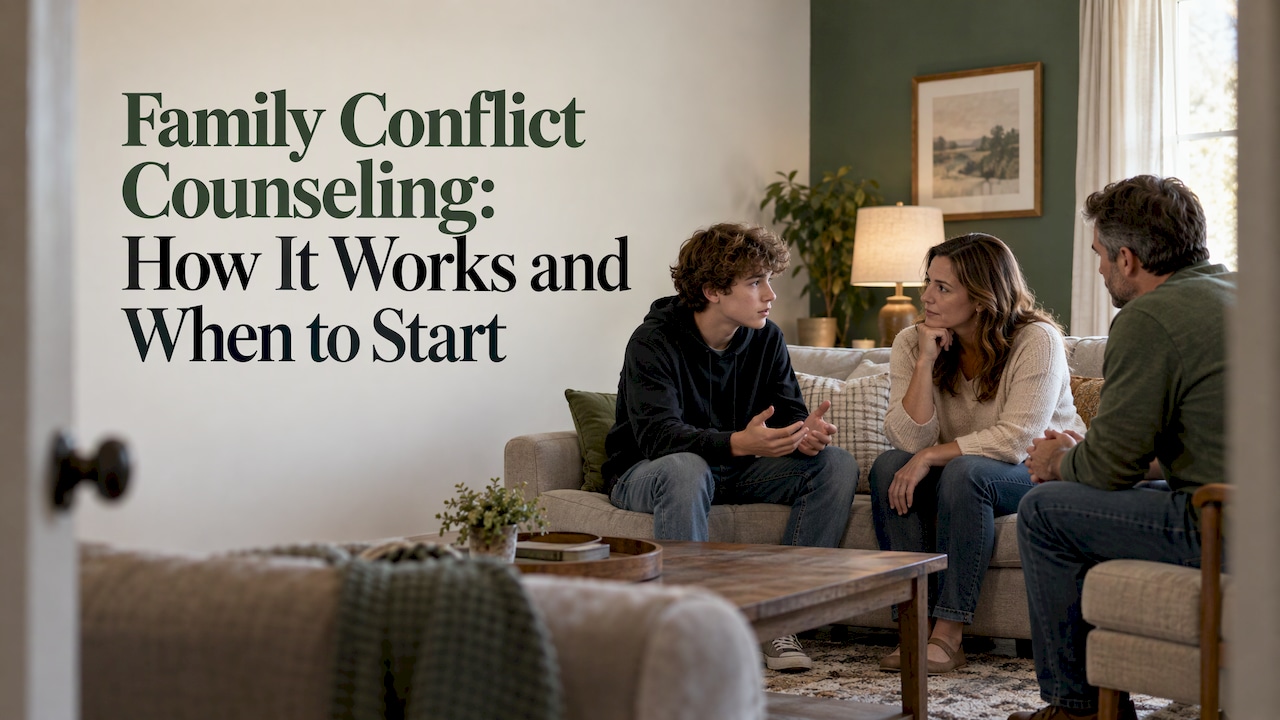
Family conflict counseling gives everyone in the household a structured space to be heard, so the same argument stops running on a loop. A counselor works with the whole family, or with the part of it that is struggling, to change how you talk to each other and not only what you fight about. At The Bridge Therapeutic Services, we offer family counseling in Tyler, TX in person and by telehealth across Texas, with evidence-based methods and a Christian perspective for families who want their faith included.
The Bridge Therapeutic Services
Find a Path Through Family Conflict
The Bridge offers family counseling with evidence-based methods and a Christian perspective for families seeking support with conflict.
VisitTL;DR
- Family conflict is a particular kind of interpersonal conflict, and it affects the psychological and physical well-being of the people in it.
- Counseling helps most when arguments repeat, when talking has turned into blaming, or when a child or teen is carrying the stress.
- Good conflict skills are learnable: listening without fixing, “I” messages, time-outs with a set time to resume, and a plan for the problem.
- You do not need everyone to be eager. One parent, one teen or one couple can start, and the family can join as trust grows.
- The Bridge Therapeutic Services offers family, couples, child and teen, and parenting counseling in Tyler and online across Texas.
Table of Contents
- What family conflict actually is
- What family conflict counseling is
- Signs it is time to get help
- What happens in a session
- Skills that families learn and use
- Parents and teens: why the same fight keeps happening
- When the conflict is between spouses or in a blended family
- What to do between sessions
- A worked example
- How to choose a counselor for your family
- Start with The Bridge Therapeutic Services
- FAQ
- Sources
What family conflict actually is
Every family disagrees. Conflict becomes a problem when it is frequent, intense and never really settled. Sage’s Encyclopedia of Human Relationships describes family conflict as a particular type of interpersonal conflict that greatly affects family members’ psychological and physical well-being. It is different from a disagreement with a coworker because you cannot walk away from it. You live with these people, share money and holidays with them, and love them.
In practice, family conflict shows up in a few familiar ways:
- Parents and teens clashing over rules, phones, grades or independence.
- Spouses whose arguments pull in the children.
- Adult siblings or in-laws split over caregiving, money or old hurts.
- Blended families where loyalties, discipline and routines collide.
- A family that has gone quiet, with everyone avoiding the topic that matters.
The stakes are highest for children. UK government guidance on parental conflict says there is strong evidence that conflict between parents that is frequent, intense and poorly resolved significantly harms children’s mental health and long-term life chances. The point is not that parents must never argue. It is that how conflict is handled matters more than whether it happens.
What family conflict counseling is
Family conflict counseling, also called family therapy, is talk-based therapy in which a trained counselor meets with a family together. Instead of asking one person to fix themselves, the counselor looks at the patterns between people: who speaks, who withdraws, who gets blamed, and what each person is really asking for.
A typical course of counseling has three jobs:
- Slow the fight down. The counselor sets ground rules so each person can speak without being interrupted or attacked.
- Find what is underneath. A shouting match about curfew is often about trust or autonomy. A cold war between siblings can be about feeling unseen.
- Build new habits. The family practices different ways of talking in the room, then takes them home.
Sessions can include the whole household, a parent and child, a couple, or one person working on how they show up in the family. Individual counseling can run alongside family sessions when one member is also dealing with anxiety, depression, trauma or grief that feeds the tension at home.
Signs it is time to get help
Most families wait too long, hoping things will cool down. Consider counseling when you notice any of these:
- The same argument returns every week with the same ending.
- Conversations quickly turn into blame, name-calling or silence.
- A child or teen has changed: withdrawing, acting out, sleeping badly, or dropping in school.
- A big change has shaken the household, such as a divorce, a remarriage, a move, a death, or a new foster or adoptive placement.
- Family members avoid each other, or dread gatherings.
- You have tried talking and it keeps making things worse.
The MGH Clay Center, part of Massachusetts General Hospital, lists seeking professional help among its tips for conflicts that are complicated, in its guide to conflict resolution for families. That fits what we hear from families: the sooner a pattern is named, the easier it is to change.
If anyone in the home is afraid of another person, or there is violence or threats, safety comes first. Call 911 in an emergency, or contact the National Domestic Violence Hotline at 1-800-799-7233. Counseling that brings an abusive and an abused person into one room is not the right starting point, so tell your counselor about safety concerns privately before joint sessions begin.
The Bridge Therapeutic Services
Explore Family Support In Person
Meet with The Bridge Therapeutic Services for family counseling grounded in evidence-based methods and a Christian perspective.
The Bridge Therapeutic Services
3800 Paluxy Drive, Suite 240, Building 2, Tyler, TX 75703
What happens in a session
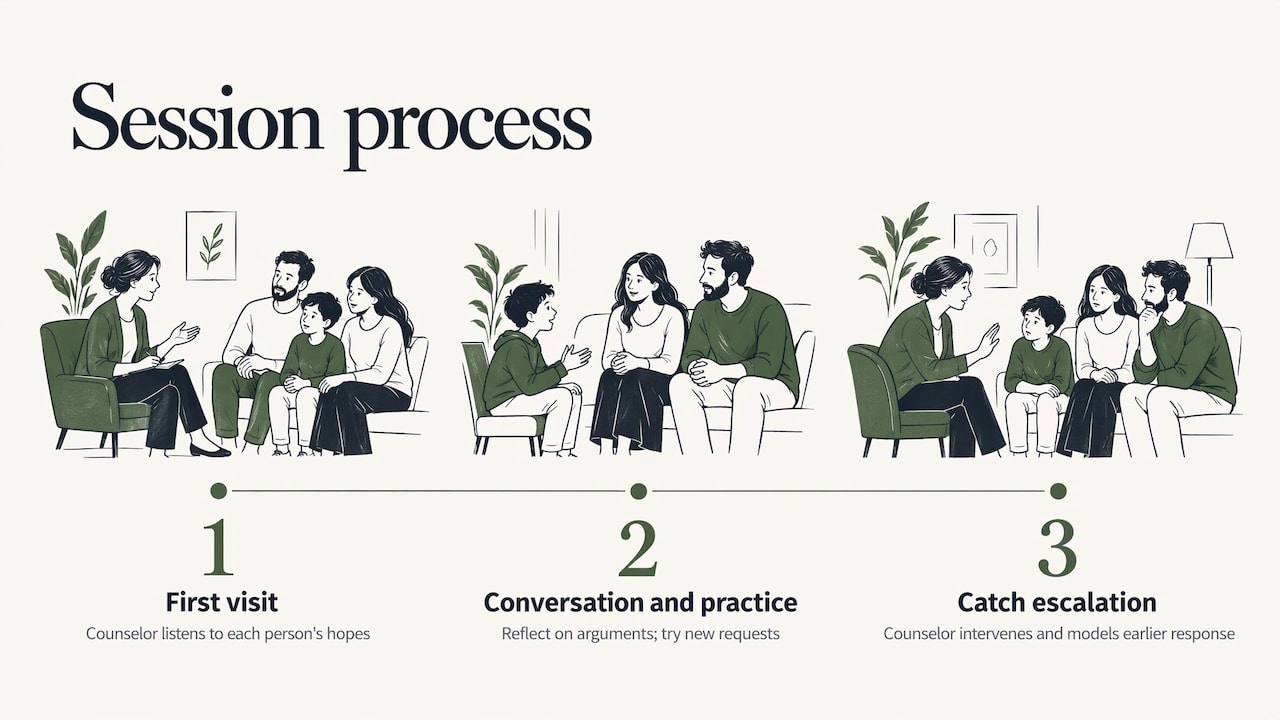
The first visit is mostly listening. A counselor will ask what brought you in, who lives in the home, what has been tried, and what each person hopes will be different. Nobody has to prove they are right.
After that, sessions usually blend conversation with practice. You might be asked to describe a recent argument while the others reflect it back, or to try a new way of making a request. The counselor steps in when the conversation starts to escalate and shows the family how to catch it earlier next time.
At The Bridge Therapeutic Services, our therapists use evidence-based methods tailored to each client and integrate psychological principles with Christian values. For families who want prayer, scripture or a shared spiritual language part of the work, that is available through our Christian counseling. Sessions are held in person in Tyler or through telehealth anywhere in Texas, which helps when a family is spread across cities or schedules are tight. Payment is by private pay or health insurance.
Skills that families learn and use
Counseling is not only a place to vent. It teaches specific skills, many of which are well supported by pediatric and mental health professionals. Here are the ones that matter most.
Listen to understand, not to fix
The Maryland chapter of the American Academy of Pediatrics, in its family communication guide, recommends active listening: feeding back the other person’s underlying concern with empathy, without interrupting and without trying to solve it. Try it this way: “It sounds like you feel I don’t trust you.” Then stop and let them answer.
Use “I” messages
The same guide recommends “I” messages in place of “you” attacks. “I get worried when I don’t hear from you at night” invites a conversation. “You never call” invites a defense.
Ask open questions
Questions that cannot be answered with yes or no, and that carry no judgment, keep people talking. The guide also suggests asking permission to raise a concern, for example, “Can I talk with you about something I’ve noticed?”
Take breaks, and come back
MGH Clay Center advises scheduling regular conversations, using time-outs when things heat up, and agreeing on a set time to resume. The second half matters. A break that never ends is avoidance, not resolution.
Own your part
MGH Clay Center’s Gene Beresin emphasizes that no conflict can truly be resolved while anyone feels criticized, blamed or shamed, and that accountability means recognizing everyone is part of the problem rather than deciding someone is “bad.” Apologizing, and identifying the problem and making a plan together, are on the same list. Consequences for a child can still be imposed while the child feels loved and valued.
Parents and teens: why the same fight keeps happening
The Maryland AAP guide explains why parent and teen conflict is so predictable. Parents tend to focus on safety and good decision-making. Teens focus on autonomy and creating some distance. Both are normal, and they collide over curfews, friends and phones.
Two approaches from that research are easy to try at home:
- Go solution-focused. Ask what is going well before listing what is wrong. A list of problems tends to turn into a blame game.
- Practice on something small. The American Counseling Association’s Counseling Today describes having the family pick a minor, low-stakes disagreement. Everyone takes turns speaking, the teen goes first, and parents restate the teen’s view before giving their own.
If your teen is struggling emotionally and not only arguing, our child and teen counseling gives them a space of their own, and parenting support gives you tools for the home front.
When the conflict is between spouses or in a blended family
Children feel tension between their parents even when nothing is said out loud. Barnardo’s, a UK children’s charity, notes that frequent, intense or poorly managed conflict can affect children’s self-esteem, health, behavior and school achievement, and that distressed parents can become more hostile toward their children, an effect often called emotional spillover, as described in its guide to managing parental conflict. Repairing the couple’s communication is often the fastest way to calm the whole house. Our article on marriage communication problems walks through this, and marriage and couples counseling is where that work happens.
Blended families face a different version: two sets of habits, new step-relationships and loyalty questions that no one planned for. You can read what to expect in our guide to blended family counseling, and learn about our divorce and blended family counseling in Tyler.
What to do between sessions
The change happens at home, in the ordinary hours between appointments. Families who make progress usually keep a few small routines:
- Pick a weekly check-in. Fifteen minutes, same time, no phones, one topic each.
- Agree on a pause signal. A word or a hand gesture that means “I need a break, and I’ll be back in twenty minutes.”
- Say one specific thing you appreciate. The Maryland AAP guide recommends recognizing good behavior and setting aside special time that is free of arguing.
- Write it down when speaking is too hard. Family Action, a UK charity, suggests letters when speaking feels overwhelming, and calming your body first with deep breathing, a walk or journaling, in its guide to difficult family relationships.
- Clarify your goal before you start. Ask yourself whether you want to be right or to be closer. The same guide advises settling your aim before a hard conversation.
- Bring what happened to your next session. A bad week is useful material, not a failure.
A worked example
Picture a family with a 15-year-old who is failing two classes and a father who checks grades every night. Dad says, “You don’t care about your future.” The teen slams a door. Mom steps in, and now the parents are arguing with each other.
In counseling, the counselor would slow that exchange down. Dad would learn to say, “I’m scared you’ll miss opportunities,” which is an “I” message. The teen would be asked to say what feels controlling about the nightly checks. Mom would be invited to say what she needs from the two of them. The family might agree on a weekly grade check instead of a nightly one, and a signal for when either side needs a break. Each person has been heard and has a part in the plan, which is how conflict begins to resolve instead of repeat.
How to choose a counselor for your family
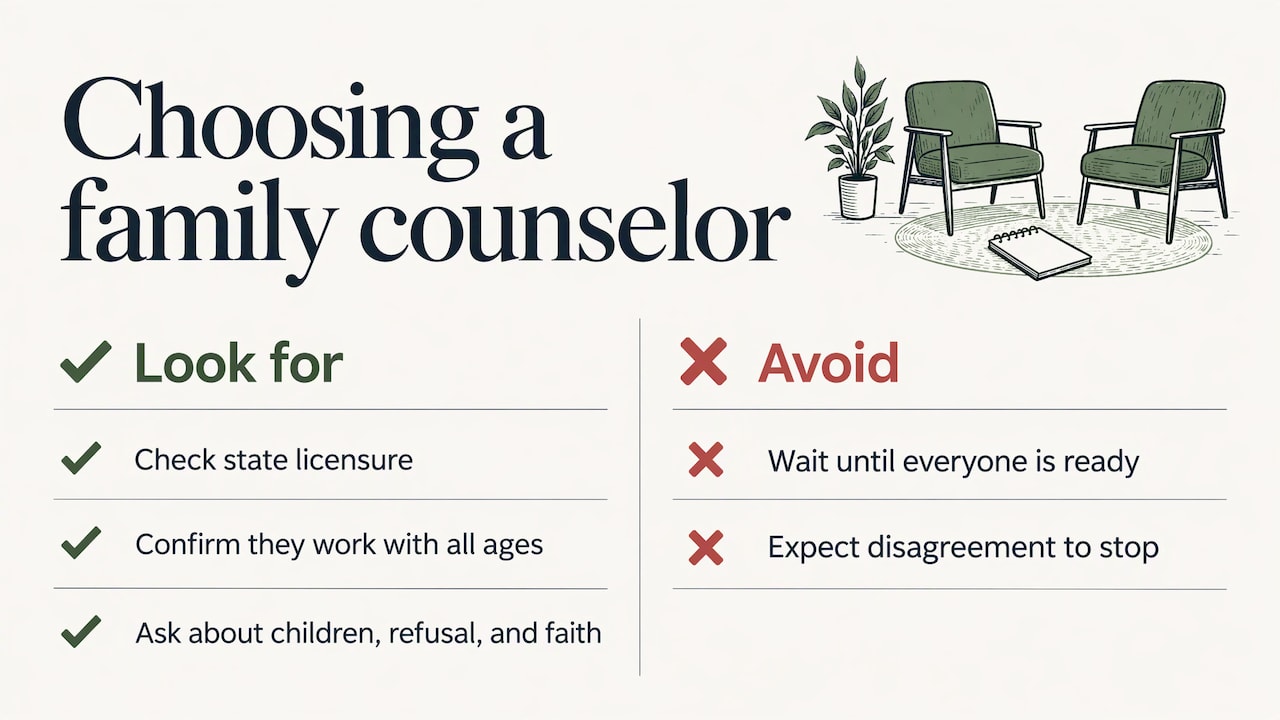
Look for someone who is licensed in your state, who works with every age in your household, and who makes the first session feel safe for the most reluctant person in the room. Ask how they involve children and teens, how they handle a family member who refuses to attend, and whether faith can be part of the work if you want it to be.
On that last point, the families we serve often want care that treats both their emotional health and their beliefs seriously. Our approach is designed to do that, and our therapists provide professional support that includes both spiritual understanding and practical tools.
Our perspective: conflict is where families learn to love well
We do not expect families to stop disagreeing. We hope they learn to disagree without losing each other. Most of the families who come to us are not broken. They are stuck in a pattern that made sense at one point and now hurts everyone.
Our approach is health-centered and holistic. We look at the whole person and the whole family, and we pair evidence-based psychological care with a Christian perspective for those who want it. For a parent, that can mean learning to correct a child while still showing them they are loved. For a teen, it can mean finally being heard. For a couple, it can mean realizing the argument at the dinner table is really about feeling alone.
We also believe that one person can start the change. A parent who learns to listen, or a teen who learns to ask for what they need, shifts the whole system. You do not have to wait until everyone is ready.
Jennifer Wood, LPC-S
Start with The Bridge Therapeutic Services
If arguments at home are wearing everyone down, The Bridge Therapeutic Services can help your family find a better way to talk. We see individuals, couples, families, children and teens in Tyler, and we offer telehealth counseling to Texans statewide. Learn more about our family counseling or reach out through our site to get started.

We also work with parents on their own, and with couples whose conflict is spilling into family life. Pricing is not published on our site, so contact us for details on private pay and insurance.
FAQ
Who should come to family conflict counseling?
The people most affected by the conflict, and as many of them as are willing to attend. That can be a whole household, a parent and a teen, or just one parent who wants new tools. Children are included in a way that fits their age.
What if a family member refuses to go?
Start without them. One person changing how they listen and respond can shift the whole pattern, and the reluctant person often joins once they see the sessions are not about blaming them. MGH Clay Center’s guidance that no one should feel criticized, blamed or shamed is a good rule for how you invite them.
How long does family counseling take?
It depends on how long the pattern has been in place, how many people are involved and what else is happening in the family. Your counselor will set goals with you in the first sessions and review progress along the way.
Can we do family counseling online?
Yes. The Bridge Therapeutic Services offers telehealth counseling across Texas, which suits families with busy schedules or members in different cities.
Is family counseling only for serious problems?
No. Many families come in because of a recurring argument, a hard transition or a communication breakdown. Getting help early usually makes the work easier.
T
The Bridge Therapeutic ServicesTalk About Your Family’s Needs
Call The Bridge Therapeutic Services to discuss family counseling and support for the challenges your household is facing.
+1 903 283 8729
Sources
- Sage Encyclopedia of Human Relationships: Conflict, Family
- GOV.UK: Reducing parental conflict, what is parental conflict?
- MGH Clay Center: Conflict Resolution Tips for Families
- Maryland AAP: Family Communication Problems (BI-PED)
- Counseling Today: De-escalating conflict between parents and teens
- Barnardo’s: Managing parental conflict
- Family Action: Navigating difficult family relationships