
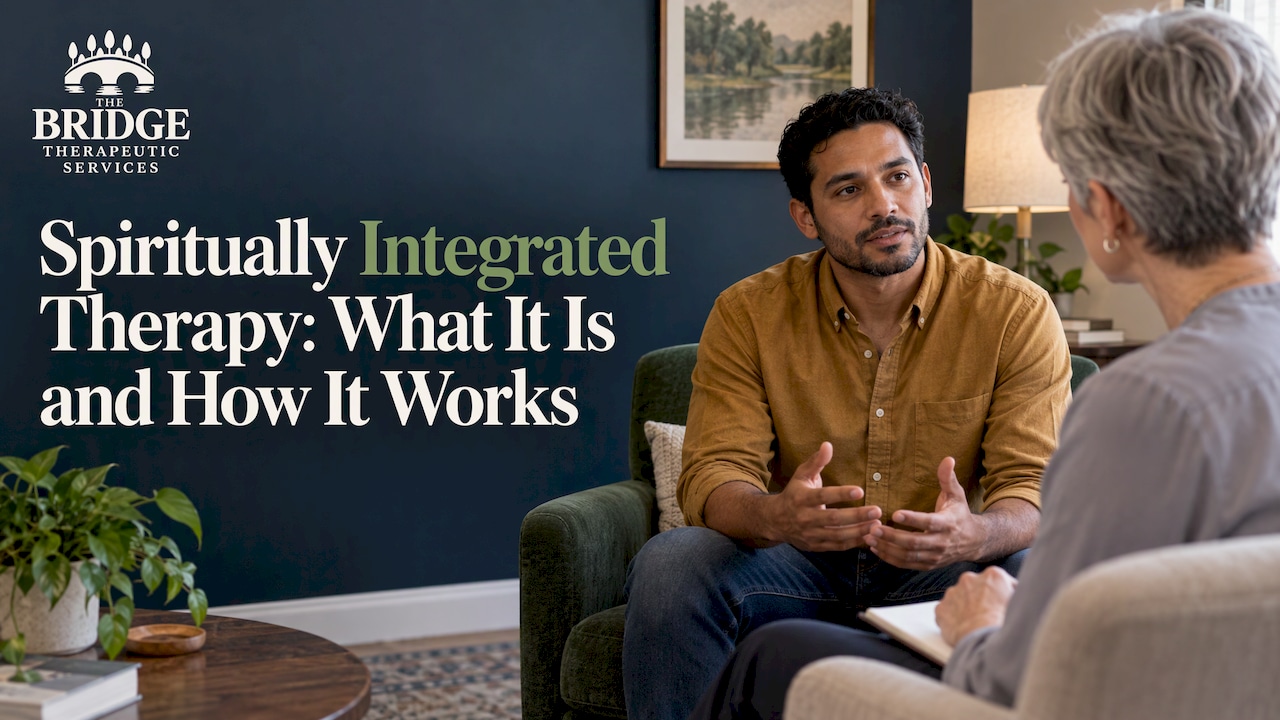
Spiritually integrated therapy is counseling that uses your faith, values and sense of meaning as resources for healing, alongside established psychological methods. It is not a separate religion class, and it does not ask you to believe anything new. At The Bridge Therapeutic Services in Tyler, Texas, our Christian counselors pair evidence-based care with a faith-informed perspective for individuals, couples, families, children and teens.
The Bridge Therapeutic Services
thebridgetherapy.com
Bring Your Faith Into Counseling
The Bridge offers evidence-based counseling with a faith-informed perspective for individuals, couples, families, children, and teens.
VisitTL;DR
- Spiritually integrated therapy uses a person’s own beliefs to ease emotional distress without trying to change those beliefs.
- A 2018 meta-analysis of 97 studies found that therapy adapted to a client’s religion or spirituality improved psychological and spiritual functioning compared with no treatment.
- Your consent matters: a good therapist asks before bringing faith into sessions and respects where you are.
- The Bridge Therapeutic Services offers this care in person in Tyler and by telehealth across Texas. Call us or use our contact page to schedule.
- In a crisis: call 911 for immediate physical danger or a medical emergency. Call or text 988 for suicide or mental health crisis support when emergency response is not needed.
Table of Contents
- What spiritually integrated therapy means
- Why faith belongs in the room for many clients
- What happens in a session
- Do you have to be religious?
- What the research shows
- Who it can help
- How to tell a therapist will respect your beliefs
- Our perspective
- Getting started with The Bridge Therapeutic Services
- FAQ
- Sources
What spiritually integrated therapy means
Most people come to counseling for a concrete reason: anxiety, grief, a strained marriage, a struggling teenager. For many, faith is part of how they cope and make sense of life. Spiritually integrated therapy treats that as a strength to work with rather than a topic to avoid.
Researchers Saunders, Miller and Bright define it as using a patient’s spiritual and religious beliefs and practices to ease emotional distress, without seeking to maintain or transform those beliefs. The goal is your wellbeing on your terms.
The U.S. National Center for PTSD describes a continuum of spiritual integration:
| Approach | What the therapist does |
|---|---|
| Spiritually avoidant | Steers away from faith topics |
| Spiritually conscious | Asks about spirituality and stays open to it |
| Spiritually integrated | Tailors treatment to your own goals for spiritual meaning |
| Spiritually directive | Focuses directly on spiritual beliefs, using practices such as prayer |
The same page notes that integrated or directive care calls for informed consent, assessed early and revisited, and for a therapist with real training in the area.
Why faith belongs in the room for many clients
Faith is central for a large share of the people seeking help. The American Psychological Association’s Monitor reported in 2023 that more than 70% of U.S. adults say religion is important in their lives, and that most patients want the chance to discuss it in therapy. The same article says up to 80% of practicing psychologists report little or no training in addressing spiritual and religious issues.
That gap is why the approach matters. Psychologist Kenneth Pargament identified four reasons to integrate spirituality: it can be part of the solution, it can be tied up in the problem, people want help with it, and it is hard to separate from therapy at all. Someone grieving a parent may be wrestling with questions about God. A spouse recovering from a betrayal may be asking what forgiveness actually requires. Ignoring that leaves part of the person outside the session.
What happens in a session
Sessions look like counseling, because they are counseling. The therapist uses recognized methods and weaves in the spiritual resources that matter to you. Published protocols show how this can work.
- Depression with chronic illness. A 10-session protocol uses the client’s own religious tradition to spot and replace unhelpful thoughts. Tools include scripture memorization, contemplative prayer, gratitude, forgiveness and involvement in a faith community.
- Trauma and moral injury. A 12-session treatment draws on compassion, grace, guided imagery, confession, forgiveness and making amends. It also treats spiritual struggles, such as anger at God or loss of faith, as normal and workable.
- General practice. The American Counseling Association’s practice brief lists methods such as being open to the client’s own definition of spirituality, using spirituality as a resource, reading sacred text, seeking forgiveness, meditation and ritual.
A worked example: a woman in her thirties comes in with panic attacks after a miscarriage. She says she feels abandoned by God. A therapist working this way would teach her calming and thought-reframing skills, and, because she wants it, make room to explore that sense of abandonment and what her faith has to say about suffering. If she preferred to keep sessions to skills only, the therapist would respect that.
For trauma specifically, you can read how we think about Christian trauma counseling and how faith and EMDR can work together.
Do you have to be religious?
Not for the general approach. Integrated care follows your lead. The National Center for PTSD notes that some of its spiritually informed programs, such as Building Spiritual Strength, are inclusive of all faith and non-faith belief systems. APA’s president at the time, Thema Bryant, said therapy is a place where people can say they are unsure what they believe and explore it.
At The Bridge Therapeutic Services, our work is rooted in a Christian perspective. If you are a Christian, or curious about how Christian faith and psychology fit together, our Christian counseling is built for you. If you are carrying wounds from church or a past faith community, our page on religious trauma therapy explains how we approach that.
What the research shows
The evidence base is growing, and the pattern is encouraging.
- A 2018 meta-analysis of 97 studies with 7,181 participants found that religion- and spirituality-adapted therapy improved both psychological and spiritual functioning versus no treatment (g = 0.74 for each), and was as effective as standard approaches for distress while producing greater spiritual wellbeing.
- Richards and Worthington’s review reported that three meta-analyses found spiritually oriented therapies effective overall, with effect sizes from .27 to .75, comparable to mainstream approaches. Six reviews specifically supported Christian cognitive therapy for depression and anxiety.
- A 2023 meta-analysis of 23 randomized trials found religious and spiritual therapy more effective than regular treatment after treatment and at follow-up, with the clearest benefit for depression.
- In a study of 1,227 clients, psychological distress dropped significantly, with the sharpest improvement in the first month.
One finding is worth knowing as a client. The National Center for PTSD reports that positive religious coping is generally linked to better functioning after trauma, while spiritual strain, such as feeling punished or abandoned by God, is linked to poorer mental health. That is a reason to bring those struggles into counseling rather than carry them alone. The authors of the 1,227-client study add that people who feel distant from God may improve more gradually and may benefit from more sessions, so a steady pace is normal.
Who it can help
Because the approach adapts to the person, it fits different members of a household.
- Individuals working through anxiety, depression, grief, trauma or life transitions. See our individual counseling.
- Couples who want shared faith and values to support communication and trust, whether in crisis or before marriage. See our marriage and couples counseling.
- Families navigating conflict, change or blended-family stress through family counseling.
- Children and teens facing emotional struggles, supported by child and teen counseling, with parenting support for the adults at home.
For children, a faith-informed approach is guided by the family’s values and what the parents and child are comfortable with.
How to tell a therapist will respect your beliefs
Good integrated care has recognizable features.
- They ask permission. Researchers say the therapist must obtain your assent before addressing spiritual beliefs, and be open to beliefs that differ from their own.
- They have the right qualities. Pargament names four essential qualities: spiritual knowledge, openness and tolerance, self-awareness and authenticity. It rests on competence, not on the therapist’s personal spiritual maturity.
- They follow your goals. Spirituality is not imposed or overstated. Pargament lists imposing values on clients among the real risks of poor practice.
- They still use proven methods. Faith deepens the work; it does not replace skills-based treatment.
At your first conversation, tell us how central faith is to you and how much you want it in sessions. That one answer shapes the plan.
Our perspective
Many people arrive believing they must choose between being taken seriously by a clinician and being understood in their faith. They should not have to choose. We use evidence-based psychological methods and treat a client’s faith as a real source of strength, hope and meaning.
What we have found matters most is permission and pace. We ask how much faith you want in the room, and we follow you. For a grieving parent, that may mean room to lament. For a couple, it may mean shared values becoming a foundation for trust. For a teen, it means a counselor who respects the family’s beliefs while giving the young person space to speak honestly.
Our approach is holistic and health-centered: your mind, your relationships and your spiritual life are connected, and healing tends to reach all three.
Jennifer Wood, LPC-S
Getting started with The Bridge Therapeutic Services
The Bridge Therapeutic Services provides Christian counseling in Tyler, Texas, with telehealth counseling across Texas for clients who prefer to meet from home. We work with individuals, couples, families, children and teens on anxiety, depression, trauma, grief, ADHD, relationship challenges and adoption and foster issues. Payment is by private pay or health insurance. To schedule, call us or use the contact page on our website.
FAQ
What is spiritually integrated therapy?
It is counseling that intentionally includes a client’s faith, values and sense of meaning in treatment, alongside psychological methods. The therapist uses those beliefs as resources for healing and follows the client’s lead on how much to include.
Is spiritually integrated therapy the same as pastoral counseling?
Not quite. It applies psychological training and evidence-based methods, with spirituality woven in at the client’s direction. The National Center for PTSD places it on a continuum, between spiritually conscious and spiritually directive care, depending on how directly faith is addressed.
Can it help with trauma and anxiety?
Yes, it is used for both. Published protocols apply it to PTSD and moral injury and to depression, and many clients bring anxiety into the work. You can learn more on our trauma and PTSD counseling page.
What if I am in crisis?
Call 911 for immediate physical danger or a medical emergency. Call or text 988 for suicide or mental health crisis support when emergency response is not needed. These are different services, so choose the one that matches your situation. For ongoing counseling, call us or use our contact page.
The Bridge Therapeutic Services
Questions About Faith-Informed Therapy?
Call to discuss how The Bridge's Christian counseling services may support your needs through an evidence-based, faith-informed approach.
Sources
- Spiritually Conscious Psychological Care
- Addressing Religious or Spiritual Dimensions of Trauma, National Center for PTSD
- Can religion and spirituality have a place in therapy? APA Monitor, 2023
- An empirically-based rationale for a spiritually-integrated psychotherapy
- Religiously Integrated Cognitive Behavioral Therapy
- Spiritually Integrated Cognitive Processing Therapy
- Integrating Religion and Spirituality, American Counseling Association
- Integrating clients’ religion and spirituality within psychotherapy, meta-analysis
- The Need for Evidence-Based, Spiritually Oriented Psychotherapies
- Evaluation of religious and spiritual therapy, 2023 meta-analysis
- Practice-based evidence for spiritually integrated psychotherapy
- Spiritually Integrated Psychotherapy, Pargament (2007)