
ADHD strains relationships because its symptoms, such as distraction, forgetfulness and impulsive reactions, are easy for a partner to read as not caring. The result is a loop of criticism and defensiveness that neither person intended. The good news is that the loop is learnable and breakable. When both partners understand what ADHD is doing and practice a few specific communication skills, most couples find the relationship gets calmer. At The Bridge Therapeutic Services in Tyler, Texas, we work with individuals, couples and families on exactly this kind of pattern, in person and by telehealth across the state.
The Bridge Therapeutic Services
Find Support for ADHD Relationship Strain
Explore faith-informed counseling for couples navigating ADHD-related conflict, with evidence-based support tailored to individual needs.
TL;DR
- ADHD-related conflict is common in adult relationships. It usually comes from executive-function struggles, not from a lack of love.
- The typical pattern: one partner carries the load and feels unseen, while the partner with ADHD feels constantly criticized.
- Structure helps: weekly planning, clear roles, one topic at a time, and calm moments for hard conversations.
- Both partners shape the dynamic, so both can change it. Treatment for ADHD and couples counseling work best together.
- Counseling is available at The Bridge Therapeutic Services in Tyler and by telehealth anywhere in Texas.
Table of Contents
- Why ADHD and relationships collide
- The pattern most couples describe
- Where it shows up: five common flashpoints
- What actually helps
- What ADHD-informed couples counseling covers
- Perspective from our counseling room
- Counseling for ADHD and relationships in Tyler and across Texas
- Communication habits to start this week
- FAQ
- Sources
Why ADHD and relationships collide
ADHD is a condition that affects attention, impulse control and executive functioning. Executive functioning is the set of mental skills we use to plan, remember, start tasks, finish them and manage emotions. In a relationship those skills are in constant demand: paying bills, keeping appointments, following through on promises, staying calm in an argument.
A Duke Department of Psychiatry research summary reports that partner conflict is common in the romantic relationships of adults with ADHD. It also notes that people facing relationship difficulties are at higher risk for depression, anxiety and substance use problems. That is a reason to take relationship strain seriously and address it early, not a verdict on any couple.
CHADD (Children and Adults with Attention-Deficit/Hyperactivity Disorder), a national nonprofit, explains that conflict is especially common where ADHD has never been diagnosed. Without a name for what is happening, forgetfulness, disorganization, distraction and emotional over-reaction look like personality flaws. The partner without ADHD may conclude the other person simply does not love them enough to try.
The pattern most couples describe
The details differ, but the shape is familiar.
The honeymoon, then the load
Early in a relationship, novelty and reward make it easy for a person with ADHD to be attentive and generous. CHADD’s 2024 article on ADHD and relationships describes how, as life gets more demanding with a mortgage, children and a busy household, executive-function challenges produce frustration and criticism. Without support that understands ADHD, this can escalate into a negative cycle.
The overburdened partner
According to CHADD’s guidance for couples, impulsive spending, forgotten requests and missed events often leave one partner managing everything. That partner can feel ignored, overburdened and unimportant. The partner with ADHD, meanwhile, feels criticized all the time, which leads to distrust and low self-esteem on both sides.
A 2023 interview study of 13 women living with partners who have ADHD, published in a peer-reviewed journal, named a theme of burden alongside everyday ADHD challenges and coping strategies. The title says it plainly: “I wish it wasn’t all on me.”
Loneliness on both sides
A 2025 qualitative study found that partners often interpret inattentiveness as emotional unavailability or indifference. People with ADHD in the study described feeling unseen, unheard and lonely, and partners reported lower intimacy and marital satisfaction. The same study describes inattention during intimacy leading a partner to wonder whether the other person was even interested.
So if you are asking why your partner makes you feel lonely, or why you feel so misunderstood, the answer is often the same loop seen from two sides.
Where it shows up: five common flashpoints
- Chores and household logistics. Items left out, tasks half done, bills forgotten. The issue is rarely the item. It is what the item seems to say about respect.
- Conversations. Drifting attention mid-sentence, interrupting, or reacting before thinking. The listener feels dismissed, and the speaker feels attacked when corrected.
- Money. Impulse purchases and missed due dates create real consequences and real mistrust. CHADD’s couple-therapy model names financial management as an ADHD-specific issue to address directly.
- Intimacy. Distraction can read as rejection. Resentment from an uneven household load can also dampen desire.
- Parenting. Two adults need a consistent plan. When one parent is the household’s memory and manager, co-parenting becomes another place where the imbalance shows.
If you see your own marriage in this list, you are far from alone. If the strain has reached trust itself, our article on support after an affair covers that separate situation.
What actually helps
Treat the ADHD, not the character
Melissa Orlov, who founded ADHD Marriage, says in a CHADD interview that treatment can make a “consistently inconsistent” person more reliable. She describes it as giving the person a second or two of pause before reacting. If you suspect ADHD and have never been evaluated, a medical evaluation is the right first step, and a physician or psychiatric provider is the person to see about diagnosis and medication. Information on adult ADHD treatment options can help you understand what a treatment plan might include.
Therapy then works on what medication alone does not: habits, communication and the history of hurt between two people.
Learn the three listening skills
Carol Ann Robbins, PhD, a CHADD expert, says poor communication is the root of difficulty for many ADHD couples. She recommends three skills in CHADD’s couple guidance:
- Mirroring: restate what you heard before responding.
- Validating: connect with your partner’s thoughts and feelings, even where you see it differently.
- Empathizing: say something like “I see how you feel.”
Orlov puts the core skill as speaking without aggression and listening without defensiveness, and she notes it is built through practice, not innate. That is encouraging: it means it can be taught.
Build an ADHD-friendly routine together
In the 2023 study, women used strategies that any couple can borrow:
- A joint weekly planning session.
- Written lists and clear role definitions.
- Routines for recurring tasks.
- Eye contact during important conversations.
- Repeating critical instructions and checking understanding.
- One topic at a time.
- Choosing calmer moments for sensitive subjects, for example on a walk or after medication has worn off in the evening.
A worked example: instead of a nightly argument over dishes, a couple sits down for fifteen minutes on Sunday. They write who owns which tasks that week, set phone reminders for the person who owns them, and agree that the partner will not remind or redo. On Sunday they check what worked. The point is to move the “memory” out of one person’s head and onto a shared page, which removes the nagging and the guilt at once.
Set boundaries without withdrawing
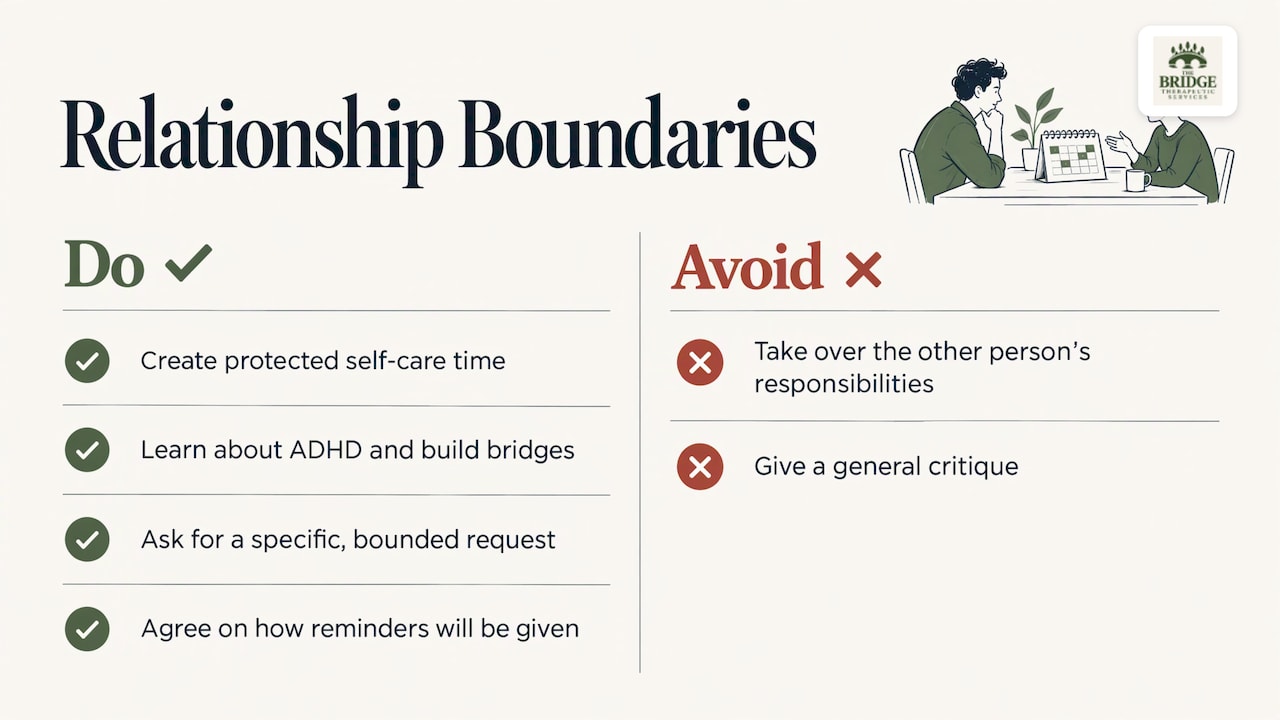
In the same study, partners without ADHD described protective boundaries: not taking over the other person’s responsibilities, since stepping in can let the responsibility slip away, and creating “protected islands” of self-care such as time alone, time out of the house and time with friends. Learning about ADHD and creating “bridges” to compensate for ADHD-related barriers were also part of how these women coped.
If you are the partner with ADHD, the mirror image applies: ask for a specific, bounded request instead of a general critique, and agree on how reminders will be given.
Safety comes first
Research summarized by Duke notes that women with a childhood history of ADHD, especially when symptoms continue into adulthood, face higher risk of interpersonal violence. A 2025 study also cites findings that people with ADHD are more likely to experience or perpetrate psychological and physical intimate partner violence. If you feel unsafe in your relationship, contact the National Domestic Violence Hotline at 1-800-799-7233, or call 911 in an emergency. Counseling is meant for relationships where both people are safe.
The Bridge Therapeutic Services
Explore Couples Counseling In Person
Come explore faith-informed counseling that supports couples facing relationship challenges with evidence-based care tailored to their needs.
The Bridge Therapeutic Services
3800 Paluxy Drive, Suite 240, Building 2, Tyler, TX 75703
What ADHD-informed couples counseling covers
CHADD’s published model for ADHD-focused couple therapy lists seven components:
- Educating both partners about ADHD.
- Clarifying each person’s perspective through an “ADHD lens.”
- Helping the couple keep track of medication.
- Guiding practical habits.
- Teaching structured turn-taking without criticism or interruption.
- Developing practical co-parenting strategies.
- Addressing ADHD-specific topics such as sexual intimacy, finances, screen overuse and denial of the diagnosis.
This framework shows what a good process looks like: it is about understanding and structure, not assigning blame. It also reflects Orlov’s point that both partners help create the dynamic, one through symptoms and the other through responses, which is why both have a part in changing it.
Perspective from our counseling room
At The Bridge Therapeutic Services, the couples who come to us about ADHD are rarely short on love. They are worn out by a pattern: one person feels like the household manager and the other feels like a permanent disappointment. Our job is to help both people see the pattern as the problem, not each other.
We bring evidence-based psychological methods together with a Christian perspective, so couples who value faith can address patience, forgiveness and commitment alongside practical tools. Those tools matter: listening skills, shared routines, and ways to talk about hard subjects without the conversation turning into an attack.
We also see the whole family. A marriage under strain affects children, and a child with ADHD can add pressure to a couple’s relationship. That is why we offer individual, couples, family and child and teen counseling under one roof, so the right support can follow your situation as it changes.
Jennifer Wood, LPC-S
Counseling for ADHD and relationships in Tyler and across Texas
If ADHD is part of the tension in your home, we can help you sort out what is ADHD and what is the habit of how you two respond. Our ADHD counseling and support page explains how we work with ADHD in Tyler. Couples can start with marriage and couples counseling, while individuals can work on their own patterns through individual counseling. Children and teens with ADHD can be seen through child and teen counseling, and parents can add parenting support.
Sessions are available in person in Tyler or by telehealth anywhere in Texas. Payment is by private pay or health insurance.

If you want to understand what couples sessions are like when you are not in the same room, see what to expect from online couples counseling. To start now, reach The Bridge Therapeutic Services.
Communication habits to start this week
You do not need to wait for a first appointment to begin. These small changes come straight from the research above.
- Pick the time. Schedule important conversations for a calm moment, not at the door after work or at bedtime.
- One topic, one conversation. If a second subject appears, write it down for another day.
- Mirror before you answer. “What I hear is that you felt alone with the bills this week. Is that right?”
- Write it down. Requests, deadlines and agreements go on a shared list, not in anyone’s memory.
- Name the pattern. Say “we’re in the loop again” instead of “you always” or “you never.”
- Protect your own time. Both partners benefit when the overburdened one has real rest.
For more general ideas on talking things through, our article on marriage communication problems goes deeper. If conflict has spread to parents, siblings or children, family conflict counseling is a good next read.
FAQ
How does ADHD affect relationships?
ADHD affects the executive functions that relationships depend on, such as remembering, planning, listening and managing emotions. Partners often read the resulting behavior as indifference. That produces criticism on one side and shame and defensiveness on the other, which is the cycle most couples need help breaking.
Can ADHD cause a marriage to fail?
Research summarized by Duke reports that women with ADHD have a higher divorce rate than men with ADHD, and that relationship conflict is common when ADHD is present. That does not mean divorce is likely for your marriage. Couples who learn about ADHD, treat it and practice new communication habits can change the direction.
Why does my partner with ADHD make me feel lonely?
Inattention, such as a partner looking at a phone or drifting off mid-conversation, can feel like emotional absence even when it is not a choice. A 2025 study found both partners can feel unseen and unheard. Naming the pattern and agreeing on ways to connect, such as eye contact and one topic at a time, helps.
How can I support a partner with ADHD without losing myself?
Learn about ADHD, agree on who owns which tasks, and avoid taking over what is theirs. Keep time for yourself and your friends. Counseling gives both of you a structured place to practice these boundaries.
Do we need to be in Tyler to work with you?
No. We offer in-person counseling in Tyler and telehealth counseling for clients anywhere in Texas.
The Bridge Therapeutic Services
Talk Through Relationship Challenges
Call to discuss relationship challenges and learn about counseling grounded in psychological principles and Christian values.
Sources
- Study Summarizes Research on ADHD’s Impact on Romantic Relationships, Duke Department of Psychiatry & Behavioral Sciences
- Marriage and Partnerships, CHADD
- ADHD and Relationships: When Love Gets Lost in Translation, CHADD (2024)
- How Can Couples with ADHD Keep a Strong Relationship?, CHADD (2019)
- ADHD and the “Just-Right” Relationship, CHADD (2023)
- A New Model for Adult ADHD Couple Therapy, CHADD (2016)
- “I wish it wasn’t all on me”: women’s experiences living with a partner with ADHD (2023)
- “I Felt Like a Burden”: An Exploration Into the Experience of ADHD in Relationships (2025)